Anatomy of a Supplier Delisting: Three Patterns and What Helps
Delistings rarely come from one audit failure. Three patterns explain how a factory ends up removed from a brand's supplier list, what the law does and does not require of brands, and how to avoid becoming one.
By Hufsa8 October 20267 min read
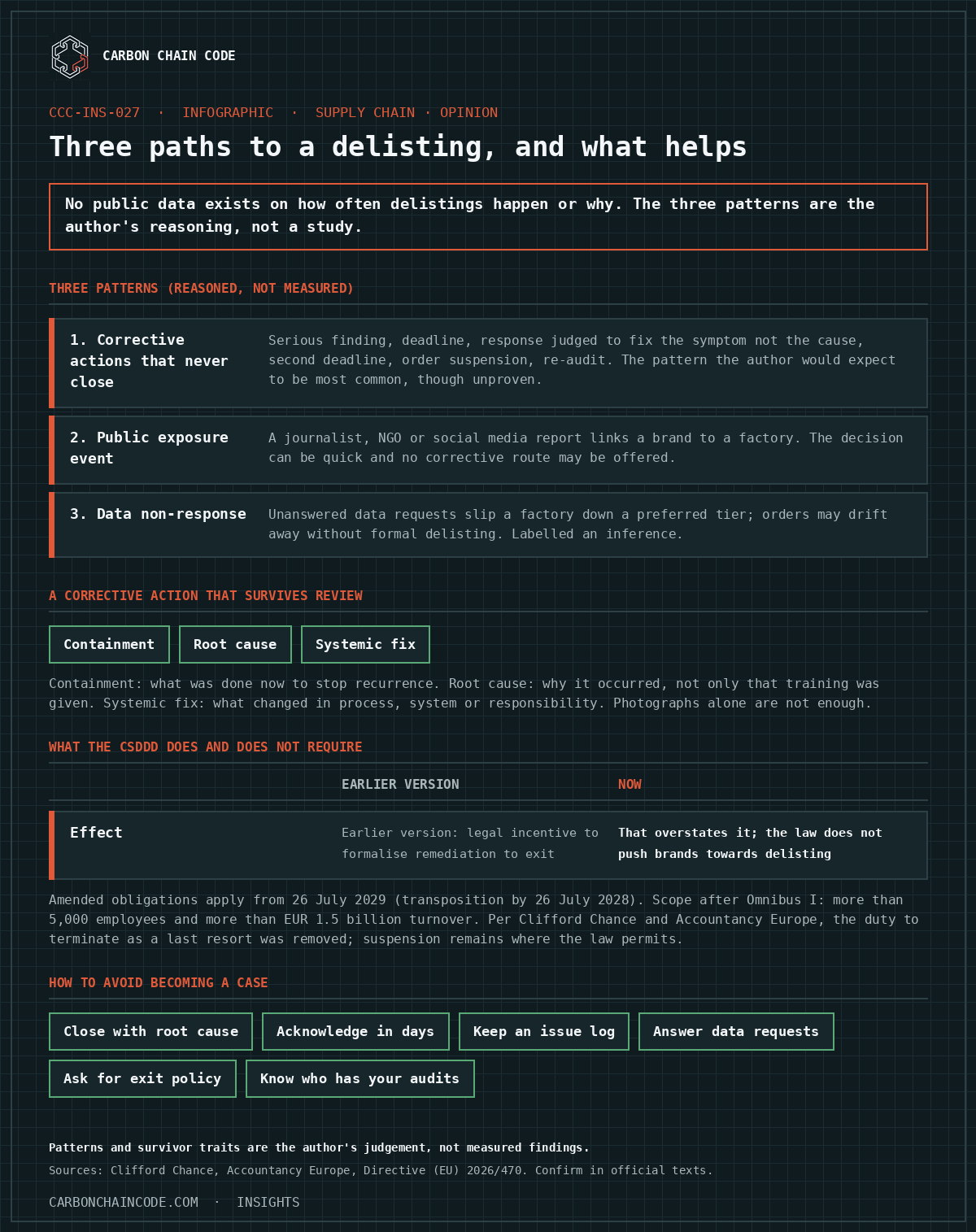
A supplier delisting is the removal of a factory from a brand's approved list and the end of its purchase orders. It is one of the most damaging commercial events a factory can face. I found no public data on how often delistings happen or why, and brands rarely publish their reasons. So the three patterns below are a reasoned description, not a study. They follow how corrective action and sourcing systems are generally built. Treat them as a framework to test against your own experience. An earlier version of this article presented them as established facts and made several legal and factual claims I could not support, which are corrected below.
Pattern 1: Corrective Actions That Never Close
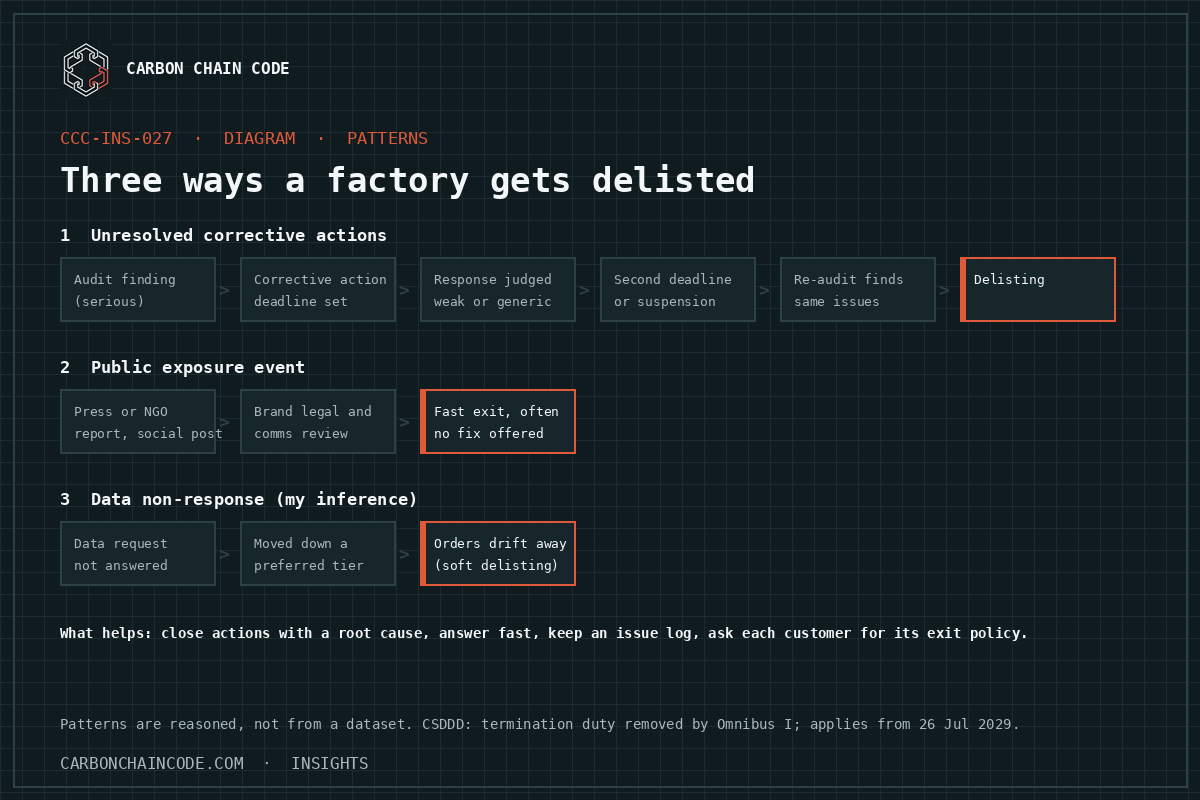
This is the pattern I would expect to be most common, though I cannot prove it. An audit finds a serious non-conformance, or several. The brand sets a deadline, and the length varies by programme. The factory submits a response with photographs, and the brand's compliance team judges it insufficient, because it fixes the symptom and not the cause. A second deadline follows, and then often a suspension of new orders pending a re-audit. If the re-audit finds the same issues, the delisting follows. The earlier version gave typical deadlines of 30, 60 or 90 days. I could not source those, so I have dropped them.
Pattern 2: A Public Exposure Event
Illustrative summary
A journalist's report, an NGO investigation or a social media campaign links a brand to a factory with documented problems. The brand's legal and communications teams then weigh the cost of staying against the cost of leaving. In this pattern the decision can be quick, and a corrective action route may not be offered, because the question has changed from whether the problem can be fixed to whether the relationship can be defended. This is my reasoning from how such cases are reported, not a measured sequence. The earlier version named Know The Chain as a tool that links brands to factories. As far as I know it benchmarks companies and does not map factories, so I removed it. The Open Apparel Registry is a database of facility locations, which is how a factory name can be matched to a brand.
Pattern 3: Data Non-Response and Quiet Deprioritisation
A factory does not answer a brand's data requests, for example on emissions or on a platform such as CDP. The brand's sustainability team marks it non-responsive and it slips down a preferred tier. If the factory is easy to replace, its orders may drift away without any formal delisting. I have no evidence of how often this happens, so I label it an inference. It is a commercial effect and not a legal one. The CSRD does not oblige any customer to drop a supplier that does not respond. And from financial years starting on or after 1 January 2027, a protected company with 1,000 or fewer employees can decline CSRD-driven requests beyond the Annex II items of the voluntary standard. That does not stop a customer asking under its own supplier code, or preferring suppliers that answer.
What Separates Survivors
This is my judgement from how corrective action systems work. Factories that keep a relationship through a bad finding usually acknowledge it quickly, give a credible root-cause analysis, and commit to dated milestones. The ones that argue, send generic reports or go quiet give the brand's team a paper trail that supports exit. A named contact at the brand who knows the site also helps, if the relationship rests on being reachable and transparent, and not on lobbying.
A useful benchmark is the management system standards. ISO 14001 and ISO 9001, in their 2015 editions, have a clause 10.2 on nonconformity and corrective action. In my reading, it asks the organisation to react to the nonconformity, evaluate whether the causes need to be eliminated, carry out the action, check that it worked, and update the system where needed. I am quoting this from my own knowledge of the standards, so check the clause wording. A corrective action report written to that sequence is also the one a brand reviewer is looking for.
Shared Databases
The earlier version said delisting can shut a factory out of other brands because SEDEX, SLCP and Higg data are shared. I do not think that is how those platforms work. As I understand it, they let a supplier share its assessments and audit results with the customers it approves, and I know of no central record of delistings. Check each platform's settings. The real exposure is narrower: if you shared an audit with several customers, they can all see its findings.
What the CSDDD Does and Does Not Require
The earlier version said the CSDDD gives brands a legal incentive to formalise a path from remediation to exit. That overstates it, for three reasons. First, the amended obligations do not apply until 26 July 2029, and Member States must transpose them by 26 July 2028. Second, after Omnibus I the scope is companies with more than 5,000 employees and more than €1.5 billion turnover. Third, according to Clifford Chance and Accountancy Europe, the final text removes the duty to terminate a business relationship as a last resort, and the only last-resort measure left is suspension, where the law permits it, unless suspension would cause manifestly more severe impacts. Due diligence now starts with scoping on reasonably available information and prioritises the most severe and likely impacts, with priority to direct business partners. Information requests to partners with fewer than 5,000 employees are to be limited to what cannot reasonably be obtained otherwise.
So the law does not push brands towards delisting. A brand may still formalise its own escalation process, and the OECD's due diligence guidance, as I understand it, treats disengagement as a last resort after trying to improve. I have not re-read that guidance. For a supplier, the useful step is to ask a customer for its escalation and exit policy before a problem arises.
A corrective action that survives review
It covers three things: containment, meaning what was done right now to stop recurrence; the root cause, meaning why the problem occurred and not only that training was given; and the systemic fix, meaning what changed in the process, system or responsibility. Photographs alone are not enough.
How to avoid becoming a case
Close every corrective action with a root cause and a check that the fix worked, not only photos.
Acknowledge findings within days and send a dated plan, even when you disagree with part of the finding.
Keep an issue log with owner, deadline and status for every open finding from every customer.
Answer data requests on time, or say what you can supply and when.
Ask each key customer for its escalation process and its notice and exit terms.
Know which of your audit reports have been shared with whom.
Frequently Asked Questions
What is the most common reason for delisting?
I found no public data. A corrective action that stays open after repeated deadlines is the pattern I would expect to be most common, but that is reasoning and not a measured finding.
Does the CSDDD force brands to terminate suppliers?
No. After Omnibus I, the duty to terminate as a last resort was removed. Suspension remains the last-resort measure where permitted, and the amended rules apply from 26 July 2029.
Can one brand's delisting stop other brands buying from me?
I know of no central delisting record on Sedex, SLCP or Higg. Audit results you shared are visible to the customers you shared them with.
What makes a corrective action credible?
A containment step, a root cause, and a systemic fix with evidence that it worked. Photographs alone are rarely enough.
References
Clifford Chance, Omnibus I: the European Union concludes CSDDD and CSRD reforms (February 2026). Accountancy Europe, Omnibus explained: key changes to the CSDDD (January 2026). Directive (EU) 2026/470. The description of ISO 14001 and ISO 9001 clause 10.2, the OECD guidance, the Open Apparel Registry and the Sedex, SLCP and Higg sharing model are from my own knowledge and were not checked in a source. The three patterns are my reasoning, not a study.
Free tool · Sustainability Frisk
FREE TOOL FROM SUSTAINABILITY FRISK
The ISO 14001 Readiness Assessment scores your current environmental management system against the standard’s ten requirements in five minutes.
Need a CSRD gap analysis or hands-on implementation? Sustainability Frisk can help. www.sustainability-frisk.com
A certificate issued three weeks before a fire that killed more than 250 workers. What the case says about how social audits are bought and run, and what the due diligence laws now ask of companies.
Brands ask factories for more certificates and data. What the evidence says about who pays, where purchasing practices are improving, and what the EU due diligence law actually requires.
 Carbon Chain Code