 Carbon Chain Code
CSRD · ESRS
ESRS Explained: The 12 Standards and the Revised Draft
What each of the 12 European Sustainability Reporting Standards covers, which ones reach suppliers, and what the Commission's 2026 revision changes.
A certificate issued three weeks before a fire that killed more than 250 workers. What the case says about how social audits are bought and run, and what the due diligence laws now ask of companies.
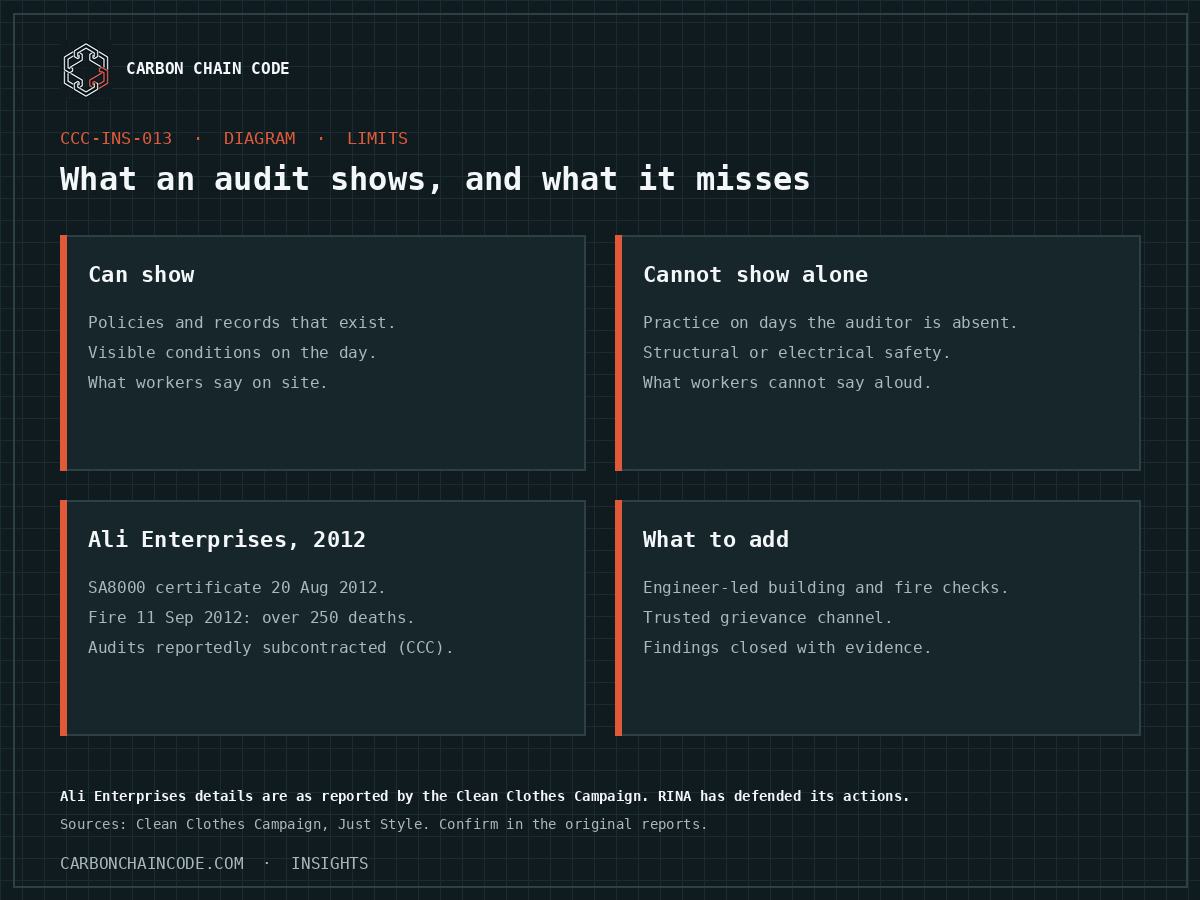
On 11 September 2012 a fire at the Ali Enterprises garment factory in Karachi killed more than 250 workers. The factory held an SA8000 social certification issued about three weeks earlier. That fact is the starting point for a fair question: what can a social audit tell you, and what can it not? This article stays with the documented record, and separates what is reported by campaign groups from what is established.
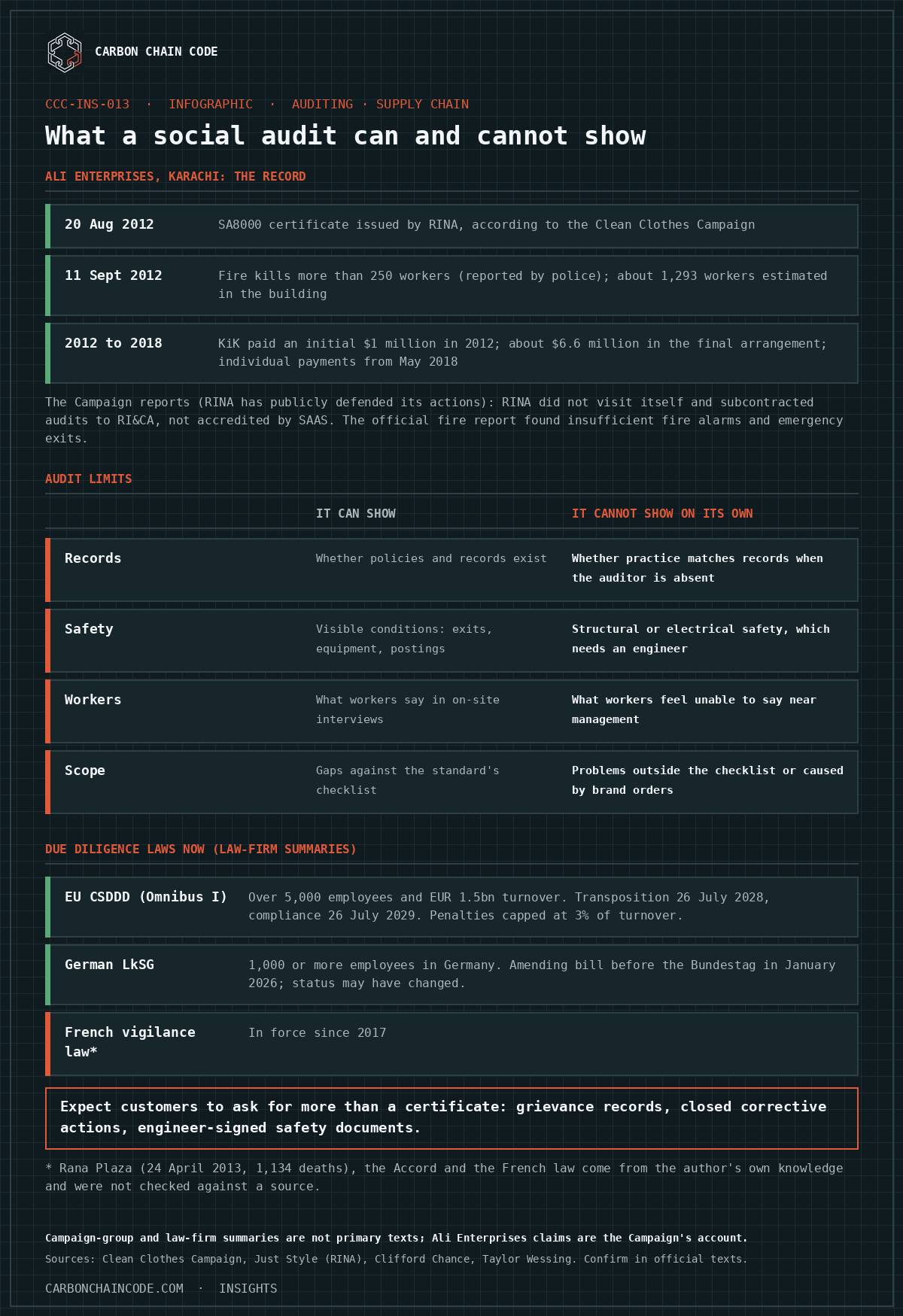
The death toll is reported as over 250 by police, with an initial inquiry citing 259 and later reports 262. Police estimated that about 1,293 workers were in the building. The official fire report found insufficient fire alarms and emergency exits.
According to the Clean Clothes Campaign, the SA8000 certificate was issued on 20 August 2012 by RINA, an Italian company. The Campaign reports that RINA did not visit the factory itself and subcontracted the audits to another firm, RI&CA, which was not accredited by Social Accountability Accreditation Services (SAAS), and that these audits took place in June and July 2012. RINA has publicly defended its actions, so treat these as the campaigners' account and read RINA's statements too.
The Campaign reports that the German retailer KiK was the main buyer, with about 90% of the factory's production intended for it, and that KiK did not contradict this. KiK paid an initial $1 million in 2012. A 2016 agreement brought KiK's total to about $5.9 million, and the final arrangement, including a contribution from the Sindh social security institution, was about $6.6 million. Individual pension-style payments were made from May 2018, more than six years after the fire.
I am adding this section from my own knowledge, without a fresh source, so check it. The Rana Plaza building in Bangladesh collapsed on 24 April 2013 and 1,134 people died. Reports after the collapse said that some factories in the building had been audited, but social compliance audits generally did not include structural engineering assessments. The better-known response was the Accord on Fire and Building Safety in Bangladesh, a legally binding agreement between brands and trade unions with independent inspections. The two cases support the same point: a social audit is not a building or fire safety inspection.
| It can show | It cannot show on its own |
|---|---|
| Whether policies and records exist | Whether practice matches the records on days the auditor is absent |
| Visible conditions on the day: exits, equipment, postings | Structural or electrical safety, which needs an engineer |
| What workers say in on-site interviews | What workers feel unable to say while management is nearby |
| Gaps against the standard's checklist | Problems outside the checklist, or caused by the brand's own orders |
The limits follow from how audits work. They are a snapshot, usually scheduled in advance, and they depend on documents the factory prepares. Interviews done inside the factory carry risk for workers. In many programmes the factory pays for the audit and has influence over which approved firm is used. That arrangement gives the audited party a stake in the outcome. I have not found a source that measures how common this is, so I describe it as a risk.
The original version of this article also said that off-site interviews are standard in independent investigations but rarely used in commercial audits because of cost. I could not confirm that comparison, so I removed it. Off-site or confidential worker interviews are widely recommended, and a supplier should expect more of them.
The Better Buying Institute (formerly the Better Buying Partnership) publishes supplier ratings of brands' purchasing practices, and the common concern is that late changes, short lead times and cancellations push factories into overtime. I could not confirm the specific findings the original attributed to its data, so I do not repeat them. The argument itself is sound without them: an audit cannot compensate for orders that make compliance impossible.
The original said the Fair Labor Association's model is worker-driven and that the Responsible Business Alliance moved to continuous monitoring. I removed those claims because I could not confirm them. The clearest example of worker-driven verification in the garment sector is the Bangladesh Accord, which combined union involvement, binding commitments and independent inspections. The model works best where workers have a real voice, so it is harder to replicate where unions are weak.
| Law | Current position | Source type |
|---|---|---|
| EU CSDDD (as changed by Omnibus I) | Applies to EU companies with over 5,000 employees and over €1.5bn turnover. Member states transpose by 26 July 2028 and companies comply from 26 July 2029. The EU-wide civil liability regime was removed and penalties are capped at 3% of turnover. Companies take a risk-based approach and may seek information from smaller business partners only where necessary | Law-firm summary |
| German LkSG | Applies to companies with 1,000 or more employees in Germany. A bill to amend it was before the Bundestag in January 2026, and the reporting requirement to BAFA has effectively been suspended since November 2025. Core due diligence duties remain | Law-firm summary, January 2026; status may have changed |
| French duty of vigilance law | In force since 2017 | My own knowledge |
The original said that under the CSDDD a clean audit is not a complete legal defence if the audit method was inadequate. The summaries I read do not mention audits at all. My understanding is that the directive allows companies to use third-party verification and industry schemes, but does not let them replace the company's own duty to assess and act. That is from memory, so check the text of the directive before repeating it.
Expect customers to ask for more than a certificate: worker feedback and grievance records, corrective action closure, and building and fire safety documents from qualified engineers. The strongest position is to be able to show that your controls work on a day when nobody is watching.
Practical steps for a supplier
It held an SA8000 certificate issued on 20 August 2012, about three weeks before the fire, according to the Clean Clothes Campaign. Campaigners report that the audits behind it were subcontracted to a firm that was not accredited for the scheme. RINA has defended its actions.
They can find documented and visible problems. They are weak at structural safety, hidden practices and problems caused by buyer behaviour, so they should be one tool among several.
Not directly unless you are a very large company. Customers in scope may ask you for information, but the directive says requests to smaller business partners should be targeted and proportionate.
Clean Clothes Campaign, Timeline for the Ali Enterprises case, and related reports on RINA. Just Style, RINA defends actions over Ali Enterprises fire. Clifford Chance, Omnibus I: the European Union concludes CSDDD and CSRD reforms (February 2026). Taylor Wessing, Supply Chain Act (LkSG) in change (January 2026). The Rana Plaza, Accord, Better Buying and French law points come from my own knowledge and were not checked against a source. Campaign groups and law-firm summaries are not primary texts; confirm in the official sources.
Free tool · Sustainability Frisk
FREE TOOL FROM SUSTAINABILITY FRISK
The ISO 14001 Readiness Assessment scores your current environmental management system against the standard’s ten requirements in five minutes.
Need a CSRD gap analysis or hands-on implementation? Sustainability Frisk can help. www.sustainability-frisk.com
What each of the 12 European Sustainability Reporting Standards covers, which ones reach suppliers, and what the Commission's 2026 revision changes.
The gas release that killed thousands, the safety failures behind it, the court outcomes, and the laws it helped to shape.