 Carbon Chain Code
CCC-SUS-001Sustainability/ESG · Workbook
CSRD Data Request Workbook
Decode EU customer sustainability questionnaires and build one reusable, evidence-backed answer set. PDF guide + Excel workbook for manufacturers.
What each of the 12 European Sustainability Reporting Standards covers, which ones reach suppliers, and what the Commission's 2026 revision changes.
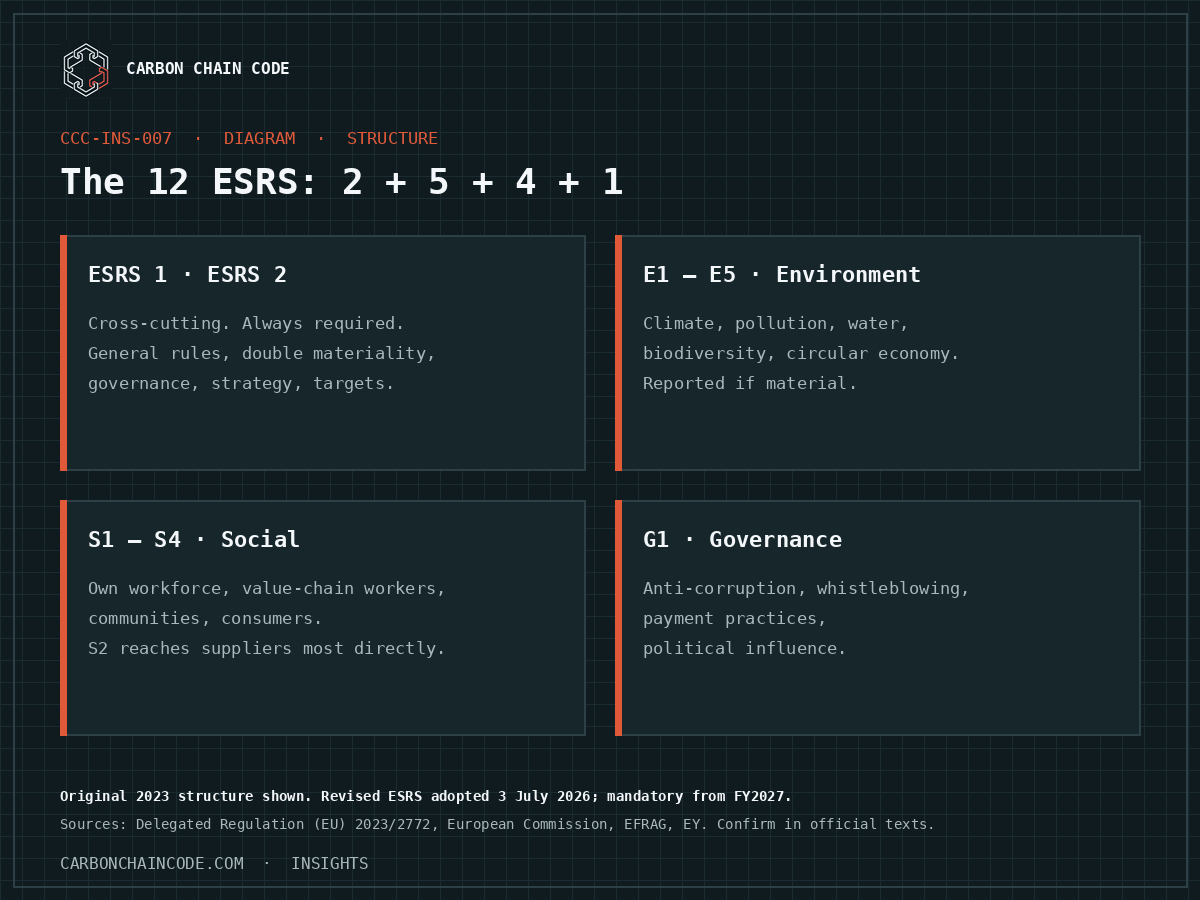
The European Sustainability Reporting Standards (ESRS) set out what a company reporting under the CSRD must disclose. There are 12: two cross-cutting standards, five environmental, four social and one on governance. This article explains what each covers and where suppliers feel the effect, then covers the revision adopted in 2026, which changes a lot of detail.
The original ESRS were adopted in 2023. The Commission published draft revised ESRS for consultation on 6 May 2026 and adopted the delegated act on 3 July 2026. Adviser summaries report publication in the Official Journal on 21 September 2026 and entry into force on 10 November 2026; I have not confirmed that date in the Official Journal. The revised ESRS apply to financial years starting on or after 1 January 2027, and a company already reporting may apply them early for 2026. One adviser puts the cut in mandatory datapoints at about 60% (the May draft said 61%). A separate voluntary standard based on the VSME entered into force on 24 September 2026. Check the Official Journal text before relying on any detail below.
Omnibus I (Directive (EU) 2026/470, in force since 18 March 2026) narrowed the CSRD to companies with more than 1,000 employees and more than €450 million in turnover. Many manufacturers and most small suppliers are now outside direct scope. They can still be asked for data by a customer that is inside it.
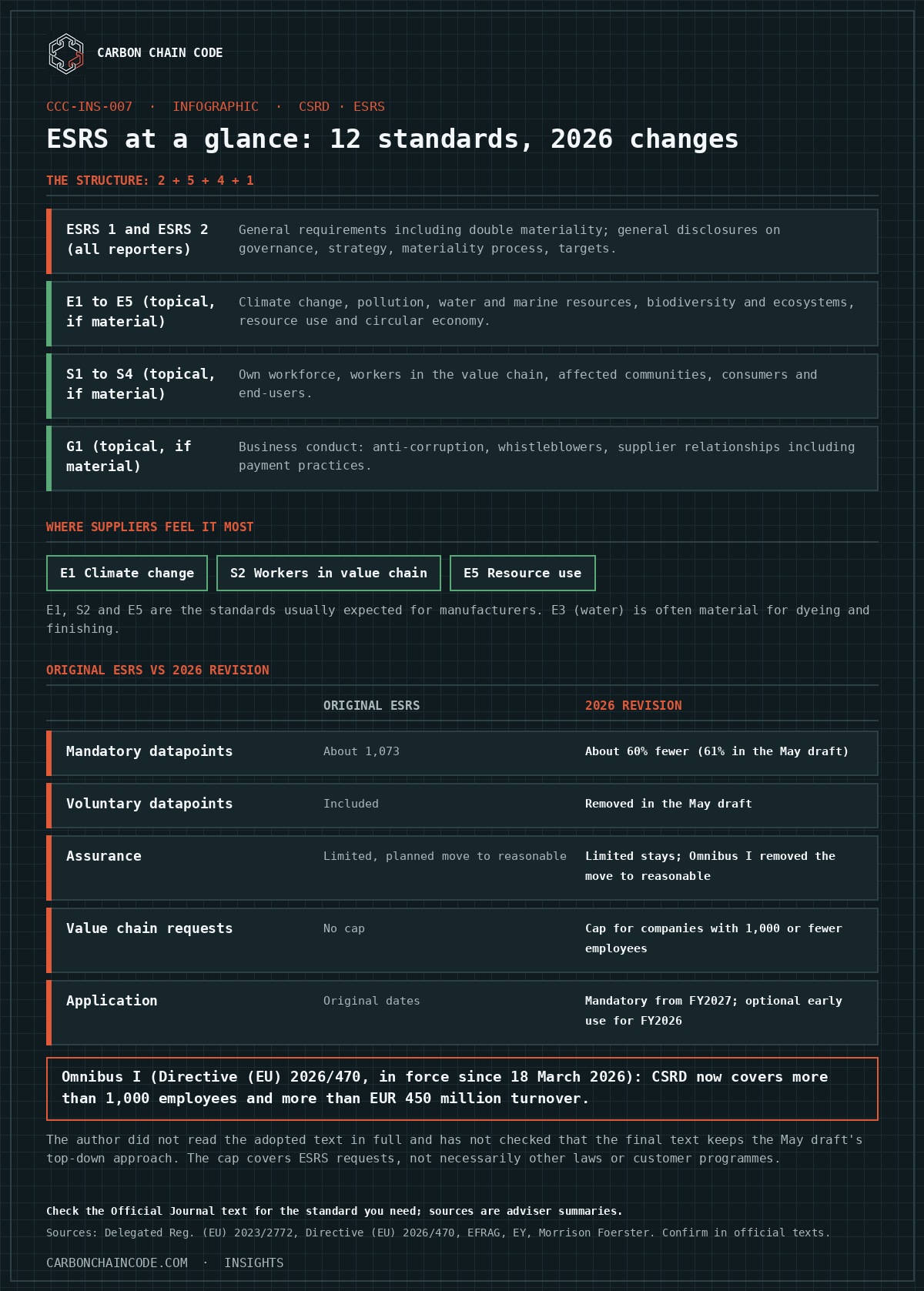
| Standard | Topic | Applies to |
|---|---|---|
| ESRS 1 | General requirements, including double materiality | All reporters |
| ESRS 2 | General disclosures: governance, strategy, materiality process, targets | All reporters |
| E1 | Climate change | Topical, if material |
| E2 | Pollution | Topical, if material |
| E3 | Water and marine resources | Topical, if material |
| E4 | Biodiversity and ecosystems | Topical, if material |
| E5 | Resource use and circular economy | Topical, if material |
| S1 | Own workforce | Topical, if material |
| S2 | Workers in the value chain | Topical, if material |
| S3 | Affected communities | Topical, if material |
| S4 | Consumers and end-users | Topical, if material |
| G1 | Business conduct | Topical, if material |
ESRS 1 sets the rules, including double materiality. A company assesses impact materiality (its effect on people and the environment) and financial materiality (sustainability risks and opportunities that affect the company). A topic is reportable if it is material on either view. ESRS 2 sets the general disclosures that every reporter provides, and the company must also describe how it did its materiality assessment. The 2026 revision keeps double materiality at the centre. The May draft allowed a top-down approach at topic level and said companies must not report information that is not material; I have not checked that the final text keeps both.
E1 (Climate change) is material for most manufacturers. It covers Scope 1, 2 and 3 greenhouse gas emissions using the GHG Protocol, energy, targets and a transition plan. The original text asks for the Scope 3 categories that are significant for the company, not all 15 categories automatically; the company decides which are significant. For a manufacturer, purchased goods and services is usually where supplier data matters most.
E2 (Pollution) covers pollutants to air, water and soil. It follows the pollutants listed in EU legislation, including the E-PRTR Regulation, rather than a fixed short list. E3 (Water) covers water use, withdrawal and discharge, and where operations are in water-stressed areas. For dyeing and finishing, E3 is often material. The standard expects a recognised method for identifying water stress; tools such as the WRI Aqueduct are commonly used, but I could not confirm which tool the standard names, and I could not find the "UN Global Freshwater Stress Index" cited in earlier versions of this article.
E4 (Biodiversity) and E5 (Resource use and circular economy) are also topical. E5 matters for manufacturers with significant material inputs and waste, and for brands facing product-design rules such as the ESPR.
S1 (Own workforce) covers employment conditions, health and safety, training, pay and collective bargaining for the company's own employees, including factory workers. Existing audits such as SA8000 or SMETA may help with data collection, but they do not replace the ESRS disclosures.
S2 (Workers in the value chain) is the standard that reaches suppliers most directly. A reporting brand must describe impacts on workers in its supply chain, which pushes it to ask suppliers for audit results, grievance mechanisms and policies. S3 (Affected communities) is relevant mainly where operations affect local communities, for example through pollution or land use. S4 (Consumers and end-users) covers impacts on people who use the company's products, such as product safety and information.
G1 (Business conduct) covers anti-corruption and anti-bribery policies, whistleblower protection, the handling of supplier relationships including payment practices, and political influence. It also requires disclosure of confirmed corruption incidents.
| Point | Original ESRS | 2026 revision |
|---|---|---|
| Mandatory datapoints | About 1,073 | About 60% fewer (61% in the May draft) |
| Voluntary datapoints | Included | Removed in the May draft |
| Double materiality | Impact and financial, detailed process | Kept; the May draft allowed a top-down topic-level approach |
| Assurance | Limited, with a planned move to reasonable | Limited stays; Omnibus I removed the move to reasonable assurance |
| Value chain requests | No cap | Large reporters may not require more than the voluntary standard from companies with 1,000 or fewer employees (the voluntary standard is in force from 24 September 2026) |
| Application | Original dates | Mandatory from FY2027; optional early use for FY2026 |
I did not read the adopted text in full, so I cannot say exactly which topical standards or datapoints remain or how each is restructured. Check the Official Journal text for the standard you need. The value chain cap matters most for suppliers: a small or mid-sized supplier has a right to refuse requests that go beyond the cap, and the voluntary standard for smaller companies, based on the VSME and in force since 24 September 2026, can be used to answer them. The cap covers requests made for ESRS reporting; it does not necessarily limit requests under other laws or customer programmes.
Practical steps
Twelve in the original set: ESRS 1 and 2, five environmental (E1–E5), four social (S1–S4) and one governance standard (G1). The 2026 revision changes their content and cuts the mandatory datapoints. I did not confirm whether the revised set keeps the same twelve-standard structure.
ESRS 1 and 2 apply to every reporter. The topical standards apply to the extent the company finds the topic material through its double materiality assessment.
Not directly unless it is itself within CSRD scope. It may be asked for data by a customer that is. The value chain cap limits what companies with 1,000 or fewer employees can be required to provide for ESRS reporting.
From financial years starting on or after 1 January 2027, with optional early use for 2026, according to EFRAG's and EY's summaries of the adopted act. Entry into force was reported for 10 November 2026; confirm in the Official Journal.
Delegated Regulation (EU) 2023/2772 (ESRS) and Directive (EU) 2022/2464 (CSRD). Directive (EU) 2026/470 (Omnibus I). Morrison Foerster, European Commission Proposes Revised ESRS and New Voluntary Sustainability Reporting Standard (May 2026). Dcycle, ESRS 2.0: final draft and voluntary window for FY2026. EFRAG, 2026 Revised ESRS (knowledge hub) and its news item of 3 July 2026. EY, European Commission adopts revised ESRS. Ebner-Stolz, simplified ESRS (22 September 2026). XBRL International, voluntary standard and value chain cap enter EU law (27 September 2026). The sources are law-firm and adviser summaries; confirm details in the official text.
Free tool · Sustainability Frisk
Not sure if CSRD applies to your business?
Use the free CSRD Applicability Checker — answer 5 questions and get a clear in/out result.
Need a CSRD gap analysis or hands-on implementation? Sustainability Frisk can help. www.sustainability-frisk.com
Decode EU customer sustainability questionnaires and build one reusable, evidence-backed answer set. PDF guide + Excel workbook for manufacturers.
Practical CSRD guide and Excel workbook for manufacturers answering EU customer sustainability requests. Value chain cap, Annex II decoder, reply templates.

Omnibus I removed most companies from the CSRD, but it did not stop supplier data requests. Here is who still reports, what the value chain cap protects, and what a factory should prepare.
Most brands still estimate the emissions of their factories from spend data. This guide explains why that is changing, what brands will ask suppliers for, and what a factory can measure now from records it already has.