The Scope 3 Data Gap for Footwear and Apparel Suppliers
Most brands still estimate the emissions of their factories from spend data. This guide explains why that is changing, what brands will ask suppliers for, and what a factory can measure now from records it already has.
By Hufsa8 October 20268 min read
For a footwear or apparel brand, the emissions from the factories that make its products fall under Scope 3 Category 1, purchased goods and services. For most brands this is among the largest sources of emissions, though the share varies by company. Many brands still calculate it from spend data, not from what their factories actually emit. That gap between estimated and measured emissions is what suppliers will be asked to close. This guide explains how the estimates work, why they are being questioned, what a supplier-specific data request looks like, and what a factory can build from its own utility bills and fuel records.
How Brands Calculate Category 1 Today
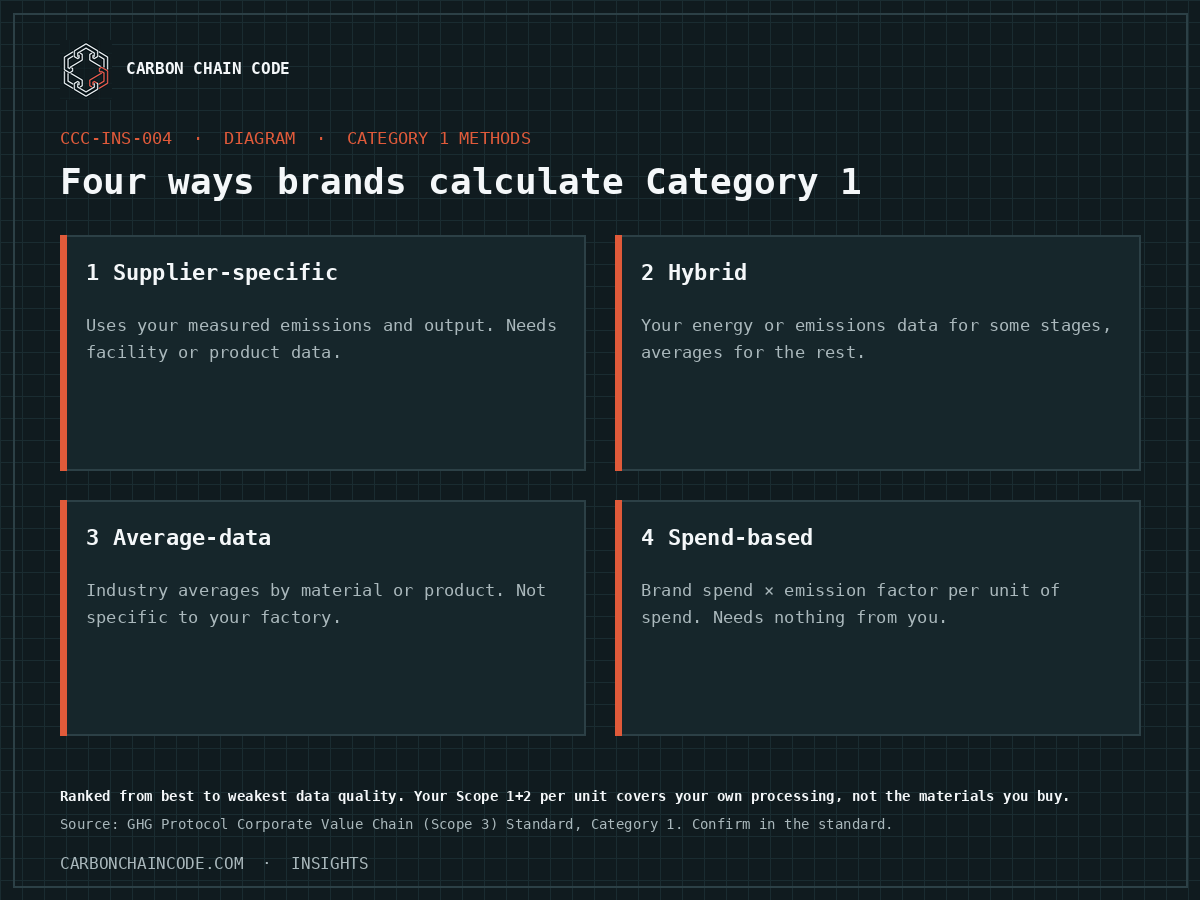
The GHG Protocol Scope 3 Standard describes four methods for Category 1. The supplier-specific method uses data from the supplier for the product bought. The hybrid method combines supplier data for some stages with average data for the rest. The average-data method uses industry-average emission factors for the materials or products. The spend-based method multiplies what the brand paid by an emission factor per unit of spend from a database such as EXIOBASE or Ecoinvent. The standard allows spend-based estimates when better data is not available, and for most suppliers it still is not.
Method
Data needed from the factory
Main limitation
Supplier-specific
Facility or product-level emissions and production output
Needs measured data and a clear boundary
Hybrid
Supplier energy or emissions data for some stages, averages for the rest
Mixed data quality, boundary must be explained
Average-data
Material or product type and quantity
Not specific to your factory or energy mix
Spend-based
None, calculated from the brand's purchasing data
Reflects price and sector averages, not your emissions
These are calculation methods. They are not the same as supplier tiers such as Tier 1 or Tier 2, which describe a supplier's position in the supply chain.
Why Spend-Based Estimates Are Being Questioned
Illustrative summary
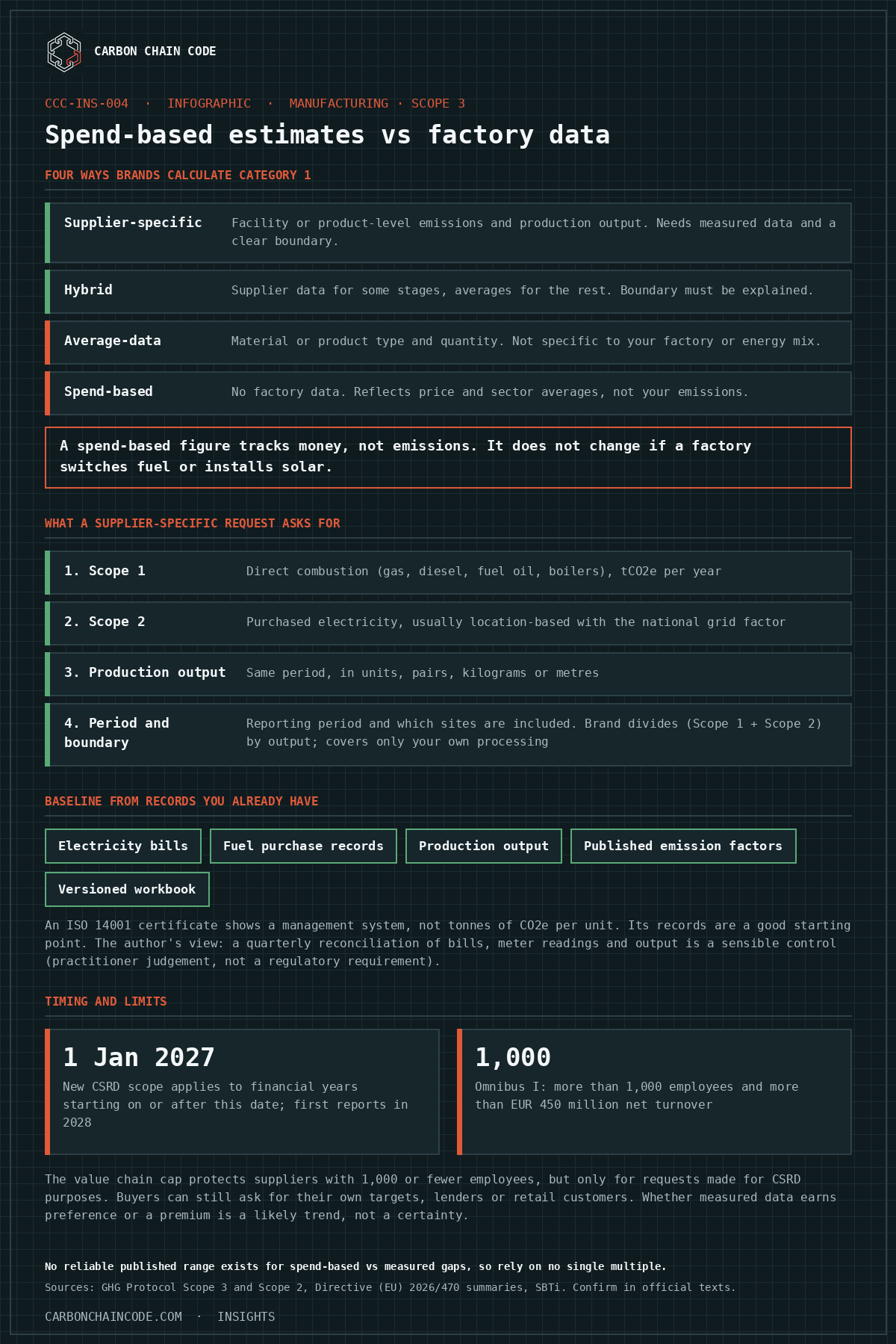
A spend-based figure tracks money, not emissions. It does not change if a factory switches fuel, installs solar or cuts steam losses, and it moves when prices change even if nothing physical has changed. A brand that sets reduction targets on such numbers cannot show whether its suppliers are improving. I have not found a reliable published range for how far spend-based estimates differ from measured factory emissions, so I would not rely on any single multiple.
Reporting rules also push in this direction. Under the CSRD, companies in scope disclose their Scope 3 emissions and the methods behind them, and limited assurance remains in place after Omnibus I. The revised ESRS apply to financial years starting on or after 1 January 2027, and companies that have not reported before start from that year, with reports in 2028. Assurance providers review how significant figures were calculated, so a material figure based only on spend is harder to defend. Targets under the Science Based Targets initiative also expect companies to engage their suppliers. Check the current SBTi criteria for the exact requirement, because the standard is being revised.
What a Supplier-Specific Data Request Asks For
A request usually asks for four things. The first is total Scope 1 emissions for the facility, in tCO₂e per year, from direct combustion such as gas, diesel, fuel oil and boilers. The second is total Scope 2 emissions from purchased electricity, usually location-based using the national grid factor. The third is total production output for the same period, in units, pairs, kilograms or metres. The fourth is the reporting period and the organisational boundary, meaning which sites are included. The brand divides emissions by output to get an intensity per unit, then multiplies by the quantity it bought from you.
Requests often also ask for the emission factors used and their source and version, whether the figures were verified, and a split by energy source. One limit to keep in mind: your Scope 1 and Scope 2 per unit cover only your own processing. A product's full cradle-to-gate emissions also include the materials you bought, such as yarn, fabric, rubber and leather. Brands usually add those from other data, which is why many use the hybrid method.
The Scope 3 Data Gap in Numbers
GHG Protocol Scope 3 Standard: four methods for Category 1 (supplier-specific, hybrid, average-data, spend-based). Intensity formula: (Scope 1 tCO₂e + Scope 2 tCO₂e) ÷ units produced. CSRD: limited assurance remains after Omnibus I. New CSRD scope applies to financial years starting on or after 1 January 2027, with first reports in 2028. A factory's Scope 1 and 2 per unit is not the full product footprint.
Does an ISO 14001 Certificate Answer the Question?
No, not by itself. An ISO 14001 certificate shows that a factory runs an environmental management system. It does not state tonnes of CO₂e per unit of production. But the records the system should already contain, such as energy monitoring, objectives and legal compliance data, are a good starting point for the numbers a brand will ask for. A factory that has them in order can usually respond much faster.
Timing: Requests Will Continue, With Limits
Omnibus I narrowed the CSRD to companies with more than 1,000 employees and more than €450 million of net turnover, so fewer customers must report. Those that do still need supplier data. Suppliers with 1,000 or fewer employees are protected by the value chain cap, which limits what CSRD reporting companies can require to the Voluntary Standard, but the cap covers only requests made for CSRD purposes. A buyer can still ask for emissions data for its own targets, lenders or retail customers. Whether suppliers with measured data will be preferred or paid more is a likely trend but not a certainty, so treat it as a commercial judgement and not as a rule.
What It Takes to Measure
The minimum needs no new instruments: monthly electricity bills, fuel purchase records and production output. Better data needs metering. Sub-metering electricity by production line or process, logging fuel use against production, and calculating boiler emissions from fuel consumed are engineering tasks, and the number of meters depends on the site. In practice a quarterly reconciliation of bills, meter readings and production output is a sensible control. This is practitioner judgement, not a regulatory requirement.
Building your Scope 1 and Scope 2 baseline
Collect electricity bills and fuel purchase records for the last 12 months, and confirm they cover every production building in your boundary.
Calculate Scope 1: multiply each fuel quantity by its emission factor. Use published default factors, state the source and the version, and state which IPCC assessment report's global warming potentials you applied.
Calculate location-based Scope 2: multiply kWh by the national grid factor for the reporting year, and record the source, version and date. Add market-based Scope 2 if you hold qualifying certificates or contracts.
Record production output for the same period in the units your buyers use, by product type.
Calculate intensity: (Scope 1 + Scope 2) ÷ output, and state what is and is not included.
Keep bills, factor sources and the calculation workbook in a versioned file so an outside party can check them.
Share the baseline with your main customers' sustainability teams before they ask, with the method and boundary stated clearly.
Frequently Asked Questions
Do I need a consultant to calculate Scope 1 and 2?
Not always. A sustainability or quality manager can calculate Scope 1 and Scope 2 from bills and fuel records using a documented workbook and published emission factors. Outside help is useful when you need verification, have a complex site boundary, or must provide data in a format a brand's Scope 3 calculation can use.
What is the difference between location-based and market-based Scope 2?
Location-based Scope 2 uses the average grid factor where the electricity is used. Market-based Scope 2 uses the factor of the electricity you contracted for, for example through renewable energy certificates. The GHG Protocol Scope 2 Guidance asks for both where market-based instruments exist, and brands usually say which one they want.
My customer says spend-based data is fine for now. Should I still measure?
Measuring costs little compared with the time lost answering requests without data. Spend-based figures do not reflect your efficiency work, so measured data is the only way to show it. Whether it earns a price premium depends on your customers, and I would not promise one.
Is my Scope 1 and 2 per unit the full footprint of the product?
No. It covers your own processing. The cradle-to-gate footprint also includes the emissions from the materials you bought, which brands normally add from other data.
References
GHG Protocol, Technical Guidance for Calculating Scope 3 Emissions, Category 1, and the Corporate Value Chain (Scope 3) Standard. GHG Protocol Scope 2 Guidance. Directive (EU) 2026/470 (Omnibus I), with summaries by Covington, Linklaters and Accountancy Europe. ESG Today on the revised ESRS (September 2026). Science Based Targets initiative, criteria and recommendations (check the current version). I used summaries, not the full standards, so confirm details in the originals.
Free tool · Sustainability Frisk
Want to calculate your factory carbon footprint?
Use the free Carbon Footprint Calculator — built for manufacturers, covers Scope 1 and 2.
Need a CSRD gap analysis or hands-on implementation? Sustainability Frisk can help. www.sustainability-frisk.com
Omnibus I removed most companies from the CSRD, but it did not stop supplier data requests. Here is who still reports, what the value chain cap protects, and what a factory should prepare.
How the EU ETS allowance price feeds into CBAM certificate prices, why price forecasts should be treated with caution, and what suppliers can do with the number.
 Carbon Chain Code