 Carbon Chain Code
CCC-SUS-001Sustainability/ESG · Workbook
CSRD Data Request Workbook
Decode EU customer sustainability questionnaires and build one reusable, evidence-backed answer set. PDF guide + Excel workbook for manufacturers.
Omnibus I removed most companies from the CSRD, but it did not stop supplier data requests. Here is who still reports, what the value chain cap protects, and what a factory should prepare.

A figure that circulates about this reform says the CSRD shrank by 61%. That number does not describe company scope. It comes from EFRAG's proposal to cut the mandatory datapoints in the reporting standards. The change to scope is much larger: commentators put the reduction at around 90% of the companies originally expected to report. For a supplier, the more important point is that fewer companies being legally required to report does not mean fewer data requests. This guide sets out who is still in scope, what the value chain cap does and does not protect, and what to prepare.
The Omnibus I Directive, Directive (EU) 2026/470, was published in the Official Journal on 26 February 2026 and entered into force on 18 March 2026. Member States must transpose the CSRD changes by 19 March 2027. It followed the stop-the-clock directive of April 2025, which had already delayed the second wave of reporting. Omnibus I raised the scope thresholds sharply, kept limited assurance and dropped the move to reasonable assurance, and introduced a cap on what reporting companies can ask of smaller business partners.
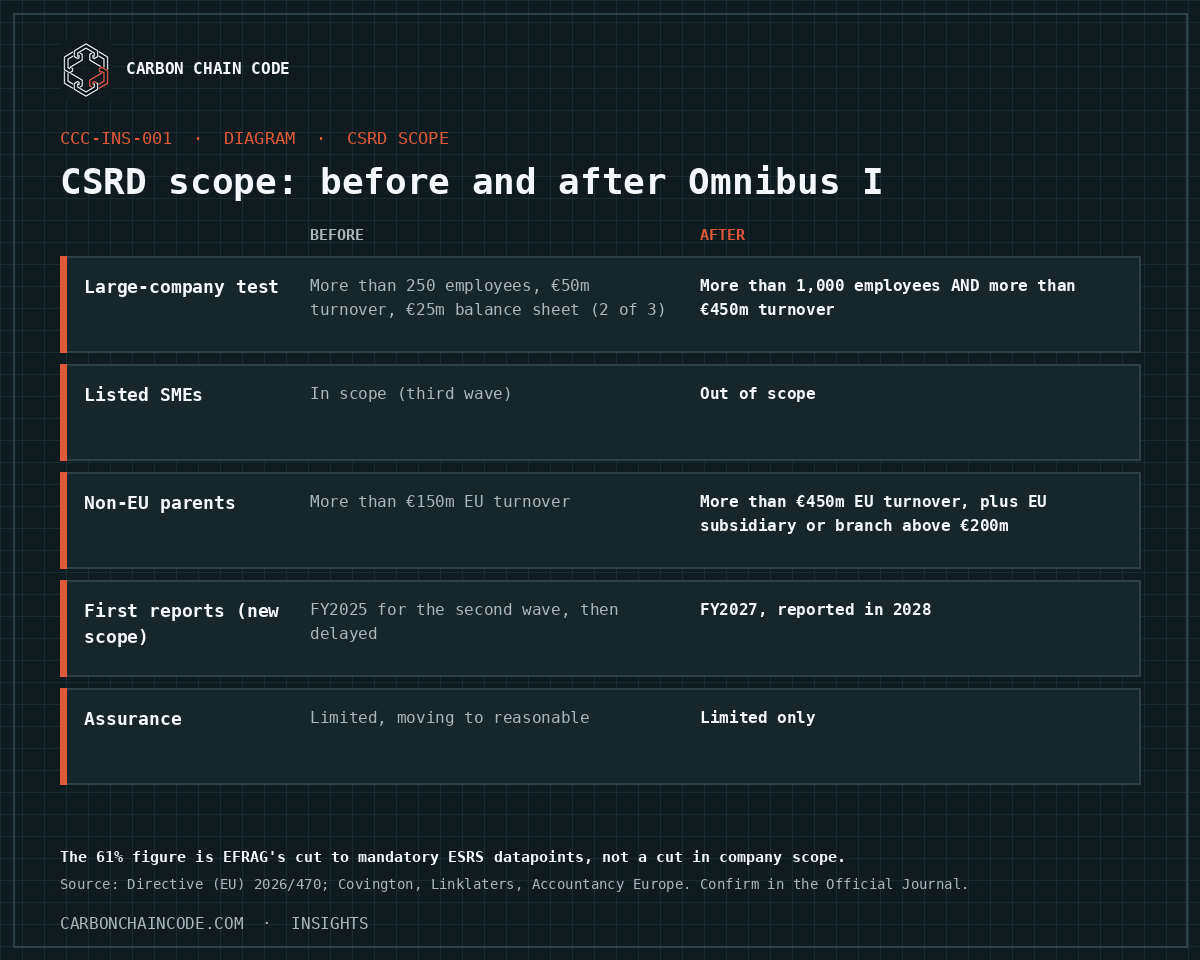
| Item | Before | After Omnibus I |
|---|---|---|
| Large-company test | 2 of 3: more than 250 employees, €50 million turnover, €25 million balance sheet | More than 1,000 employees and more than €450 million net turnover. Both are required, and there is no balance sheet test |
| Listed SMEs | In scope (third wave) | Out of scope |
| Non-EU parent companies | More than €150 million EU turnover; EU subsidiary or branch above €40 million | More than €450 million EU turnover in each of the last two years, and an EU subsidiary or branch above €200 million |
| First reports for companies not yet reporting | FY2025 for the second wave, then pushed back by stop-the-clock | FY2027, reported in 2028 (non-EU parents: FY2028, reported in 2029) |
| Assurance | Limited, moving to reasonable | Limited assurance remains; reasonable assurance dropped |
I could not find an official final count of companies in scope. Estimates differ by source and some are not attributed, so treat any single number with caution. The thresholds themselves are what matter for you: if your customer does not have more than 1,000 employees and more than €450 million of net turnover, it is not directly required to publish a CSRD report.
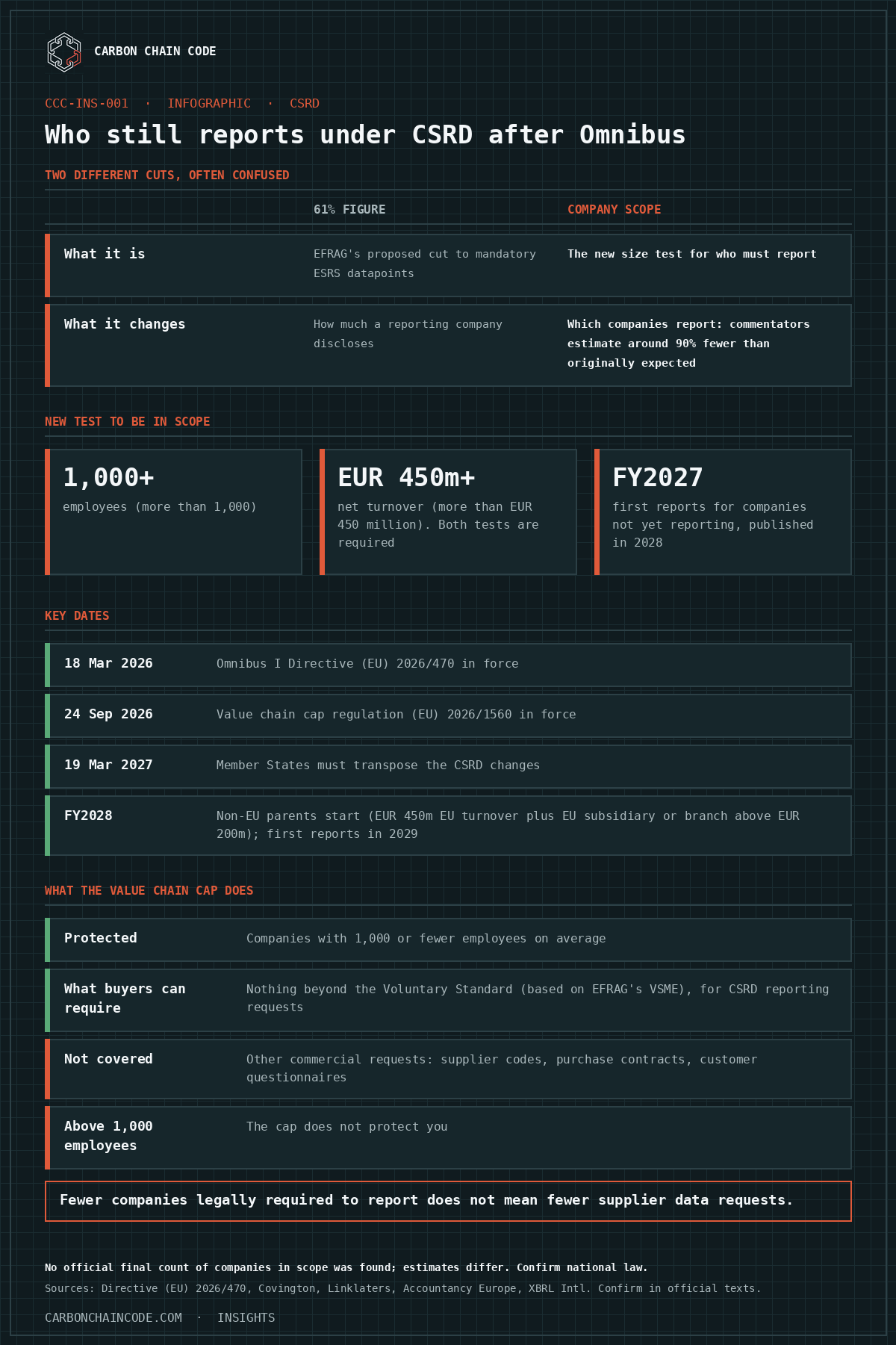
EFRAG proposed simplified ESRS that cut mandatory datapoints by 61%, and by more than 70% when voluntary disclosures are removed as well. The Commission published the revised ESRS in September 2026. They enter into force on 10 November 2026 and apply to financial years starting on or after 1 January 2027. So the 61% is about how much a reporting company has to disclose, not how many companies have to report.
Large public-interest entities that were already under the earlier reporting rules began CSRD reporting for FY2024. Those that are below the new thresholds, for example with 500 to 1,000 employees, are no longer required to continue from FY2027. Member States may also exempt such companies for FY2025 and FY2026, so the position depends on the country.
Companies that meet the new thresholds and have not reported before start with financial years beginning on or after 1 January 2027, with reports in 2028. The earlier distinction between second-wave and third-wave companies has been removed.
Listed SMEs are fully out of scope. They were previously due to report in the third wave.
A non-EU parent is in scope if it has more than €450 million of EU net turnover in each of the last two years and an EU subsidiary or branch with more than €200 million of net turnover. Reporting starts with FY2028, with first reports in 2029, and needs limited assurance. They will use a separate standard for non-EU companies, which is still in draft, with a consultation open until 31 October 2026.
If your customers are among the companies still reporting, they need information from their supply chain, and the revised ESRS still ask in-scope companies about their value chain, with fewer mandatory datapoints and subject to materiality. Even customers that no longer report may keep asking, for example because of their own targets, lenders, retail customers or due diligence obligations.
The value chain cap limits what in-scope companies can ask. Companies with 1,000 or fewer employees on average are protected undertakings. A CSRD reporting company cannot require them to provide information beyond the Voluntary Standard, which is based on EFRAG's VSME, and protected companies may decline requests that go beyond it. They can rely on self-declarations, and contract terms that go against the cap are not binding. The delegated regulation setting out the standard, Commission Delegated Regulation (EU) 2026/1560, was published in the Official Journal and entered into force on 24 September 2026.
The cap has limits. It applies to requests made for CSRD reporting purposes, and it does not cover other commercial information exchanges. A buyer can still ask for data in a supplier code, a purchase contract or a customer questionnaire for its own reasons, and you will need to decide commercially how to respond.
Directive (EU) 2026/470: published 26 February 2026, in force 18 March 2026, CSRD transposition by 19 March 2027. New scope: more than 1,000 employees and more than €450 million net turnover, for financial years starting on or after 1 January 2027. Non-EU parents: more than €450 million EU turnover plus an EU subsidiary or branch above €200 million, from FY2028. Value chain cap: protects companies with 1,000 or fewer employees, in force from 24 September 2026. The 61% figure: EFRAG's cut to mandatory ESRS datapoints, not company scope.
The Corporate Sustainability Due Diligence Directive (Directive (EU) 2024/1760) was also amended. It now applies to EU companies with more than 5,000 employees and more than €1.5 billion of net worldwide turnover, and to non-EU companies with more than €1.5 billion of turnover generated in the EU. Member States must transpose it by 26 July 2028, and companies must comply from 26 July 2029. The mandatory EU-wide civil liability regime and the duty to adopt and put into effect a climate transition plan were removed, and the maximum penalty is capped at 3% of net worldwide turnover. Companies may request information from partners with fewer than 5,000 employees only when they cannot reasonably get it by other means. Check the national law in the countries where your customers are based.
Three things matter for a supplier. First, the final standard for non-EU companies, since some of your customers' parents may fall under it. Second, how buyers update their supplier questionnaires to reflect the cap, which has not happened uniformly. Third, the Commission's review of the scope, due by 30 April 2029, which could change thresholds again.
What a supplier should do now
No, not in company scope. The 61% figure refers to EFRAG's proposed cut to mandatory ESRS datapoints. The change in scope is larger. The new test is more than 1,000 employees and more than €450 million of net turnover, and commentators estimate this removes around 90% of the companies originally expected to report. I could not find an official final count.
It depends on your size and on the request. If you have 1,000 or fewer employees, you can decline requests made for CSRD purposes that go beyond the Voluntary Standard. Buyers can still ask for information for commercial reasons, and companies with more than 1,000 employees are not protected by the cap.
It limits what CSRD reporting companies can require from partners with 1,000 or fewer employees to the Voluntary Standard, which is based on EFRAG's VSME. The delegated regulation, (EU) 2026/1560, entered into force on 24 September 2026. The cap covers requests for CSRD reporting and not other commercial information exchanges.
The new scope applies to financial years starting on or after 1 January 2027, with first reports in 2028 for companies that have not reported before. Non-EU parents start with FY2028, with first reports in 2029. Member States must transpose the changes by 19 March 2027, so national rules may differ in detail.
Directive (EU) 2026/470 (Omnibus I), Official Journal, 26 February 2026. Covington, EU CSDDD/CSRD Omnibus published in the Official Journal (February 2026). Linklaters, EU CSRD after the Omnibus. Accountancy Europe, Omnibus explained: CSRD factsheet (January 2026). XBRL International, Voluntary sustainability standard and value chain cap enter EU law (September 2026). ESG Today, EU publishes final revised ESRS (22 September 2026). Dcycle, CSRD Omnibus I approved. I used law-firm and industry summaries, not the full legal texts, so confirm the details in the Official Journal and in your customers' national laws.
Free tool · Sustainability Frisk
Not sure if CSRD applies to your business?
Use the free CSRD Applicability Checker — answer 5 questions and get a clear in/out result.
Need a CSRD gap analysis or hands-on implementation? Sustainability Frisk can help. www.sustainability-frisk.com
Decode EU customer sustainability questionnaires and build one reusable, evidence-backed answer set. PDF guide + Excel workbook for manufacturers.
Practical CSRD guide and Excel workbook for manufacturers answering EU customer sustainability requests. Value chain cap, Annex II decoder, reply templates.
What each of the 12 European Sustainability Reporting Standards covers, which ones reach suppliers, and what the Commission's 2026 revision changes.

Textiles are not covered by the EU Carbon Border Adjustment Mechanism, and they are not in the Commission's current extension proposal. This guide explains what CBAM does cover, how its costs are calculated, and what a Pakistani textile manufacturer should prepare.