CBAM and Pakistani Textile Exports: What Is and Isn't Covered
Textiles are not covered by the EU Carbon Border Adjustment Mechanism, and they are not in the Commission's current extension proposal. This guide explains what CBAM does cover, how its costs are calculated, and what a Pakistani textile manufacturer should prepare.
By Hufsa8 October 20268 min read
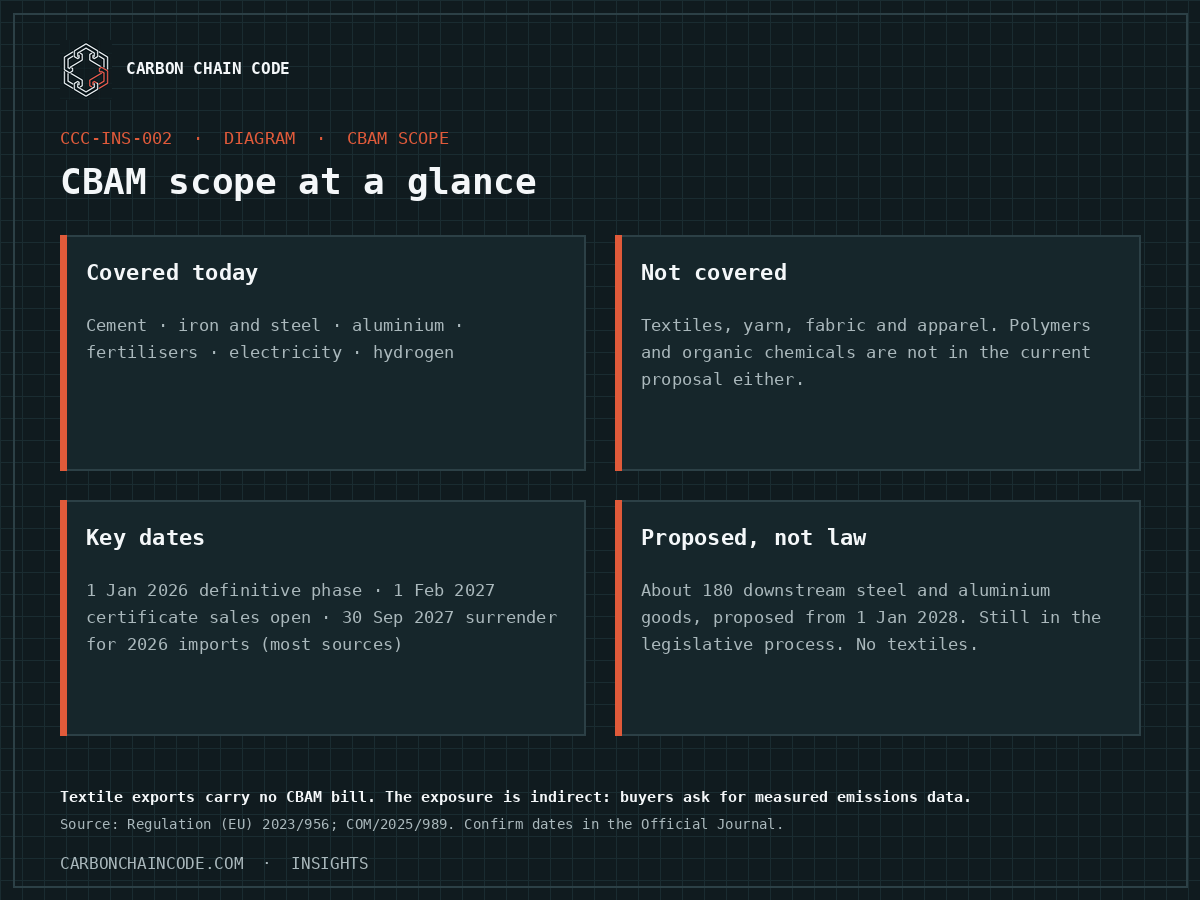
Does the EU Carbon Border Adjustment Mechanism (CBAM) apply to Pakistani textile exports? Not today. CBAM covers cement, iron and steel, aluminium, fertilisers, electricity and hydrogen. Textiles, yarn, fabric and apparel are not on the list, and the Commission's December 2025 proposal to extend CBAM adds downstream steel and aluminium goods, not textiles. That does not mean a textile factory can ignore carbon data. This guide explains what is covered, how CBAM costs are calculated, what could change, and what to prepare. An earlier version of this article estimated an 8–12% cost for Pakistani textiles. I have removed that estimate because it assumed textiles would be covered, and nothing in the proposal supports that.
What CBAM Covers Today
CBAM (Regulation (EU) 2023/956) puts a carbon price on the emissions embedded in certain imported goods. It had a transitional reporting phase from October 2023 to the end of 2025, and the definitive phase started on 1 January 2026. The obligation sits with the EU importer, who must be an authorised declarant above an annual threshold of 50 tonnes of net mass, and who buys and surrenders CBAM certificates for the embedded emissions of covered goods.
Goods
Status
Cement
Covered
Iron and steel
Covered
Aluminium
Covered
Fertilisers
Covered
Electricity
Covered
Hydrogen
Covered
Textiles, yarn, fabric, apparel
Not covered and not in the current extension proposal
Polymers and organic chemicals
Not covered and not in the current extension proposal
What Is Proposed, and What Is Not
Illustrative summary
On 17 December 2025 the Commission proposed (COM/2025/989) to add about 180 downstream goods made largely from steel or aluminium, such as industrial equipment, vehicles and parts, and metal furniture, and to add anti-circumvention measures. The proposed start is 1 January 2028, and it still has to go through the ordinary legislative procedure. The proposal also adds to the Commission's review the question of extending CBAM to other goods at risk of carbon leakage, and the European Parliament has said it wants more sectors considered. Some campaign groups urge starting with chemicals. Those are views and possible future steps, not proposals. There is no proposal to cover textiles or synthetic fibres, and "Phase 2" is not an official term.
How CBAM Costs Are Calculated for Covered Goods
In outline, the cost is the embedded emissions of the imported goods, adjusted for matters such as free allocation under the EU Emissions Trading System, multiplied by the CBAM certificate price. For 2026 imports the price is the quarterly average of EU ETS auction prices, and from 2027 it follows the weekly average. The Q1 2026 price was published as €75.36 per tonne of CO₂, according to one summary, so check the Commission's published price. Certificates go on sale from 1 February 2027. The surrender deadline for 2026 imports is 30 September 2027 in most sources, while two earlier sources give 31 August 2027, so confirm the date in Article 22 of the consolidated regulation. Which emissions count depends on the good: under the regulation indirect emissions from electricity are included for only some goods, such as cement and fertilisers, so check the current annex for any good you handle.
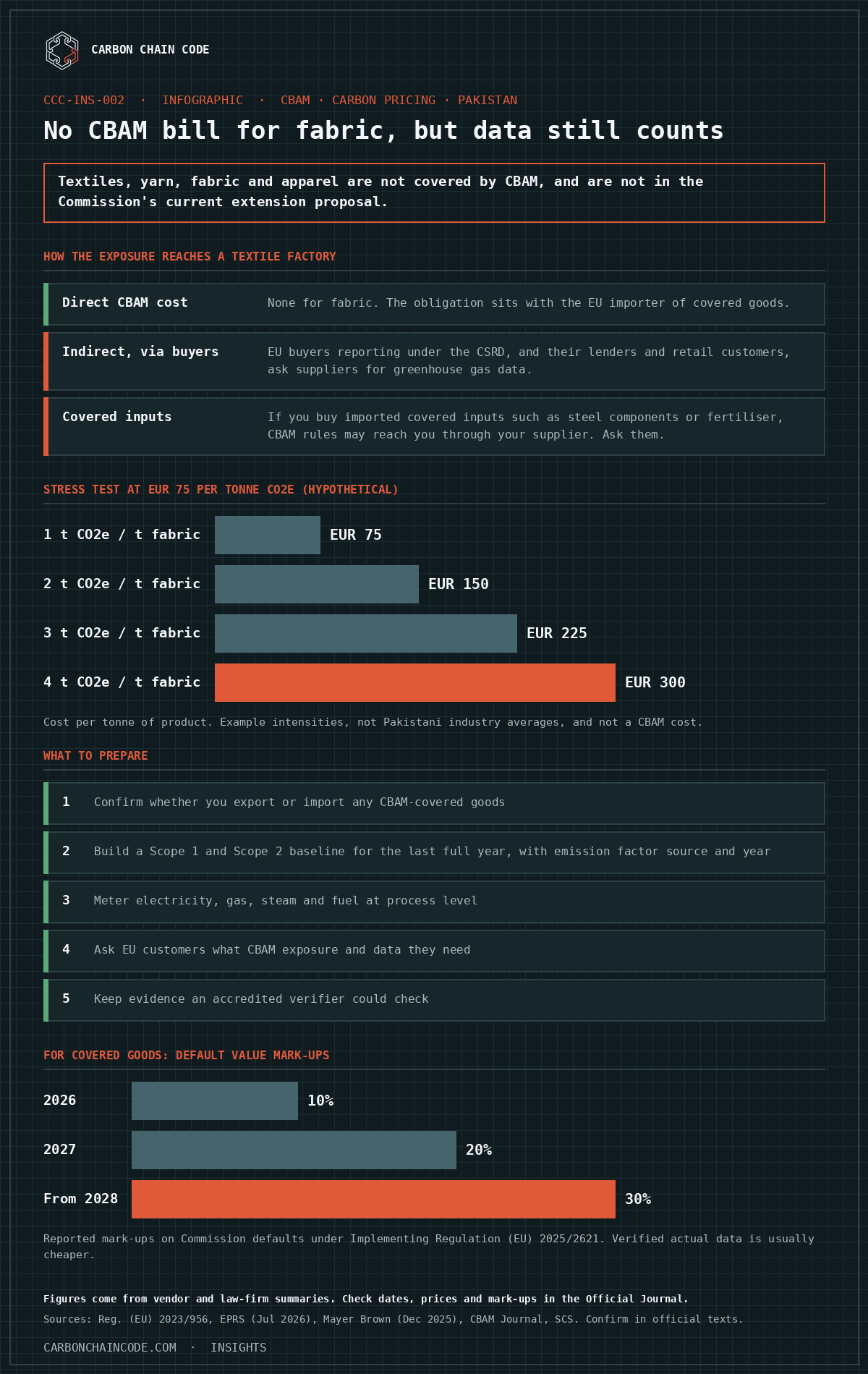
Importers can use either actual emissions data, verified by an accredited verifier, or Commission default values. Under Implementing Regulation (EU) 2025/2621, default values carry a mark-up, reported as 10% for 2026, 20% for 2027 and 30% from 2028. Verified actual data is therefore usually cheaper for the importer than defaults. These details come from vendor summaries, so check them against the regulations.
A Stress Test You Can Run Yourself
Because textiles are not covered, there is no CBAM bill for fabric. If you want to understand how sensitive your business would be to a carbon price, you can run a hypothetical test using your own data. Multiply your measured emissions per tonne of product by a price per tonne of CO₂e. The table shows the arithmetic at a price of €75 per tonne. The intensities are examples, not Pakistani industry averages, and the result is not a CBAM cost.
Hypothetical intensity
Cost per tonne of product at €75 per tonne CO₂e
1 t CO₂e per tonne of fabric
€75
2 t CO₂e per tonne of fabric
€150
3 t CO₂e per tonne of fabric
€225
4 t CO₂e per tonne of fabric
€300
Compare the result with your own selling price per tonne. The point of the exercise is that the number depends on your measured intensity, which is why metered data matters.
CBAM in Numbers
Definitive phase: from 1 January 2026. Covered goods: cement, iron and steel, aluminium, fertilisers, electricity, hydrogen. Annual threshold: 50 tonnes of net mass per importer. Q1 2026 certificate price: €75.36 per tonne CO₂ (one published summary, check the Commission's figure). Certificate sales open: 1 February 2027. Surrender for 2026 imports: 30 September 2027 in most sources. Default value mark-ups: 10% in 2026, 20% in 2027, 30% from 2028. Downstream extension: about 180 steel and aluminium goods, proposed from 1 January 2028, still in the legislative process. Textiles: not covered.
Where a Pakistani Textile Factory Is Affected
The EU is a major destination for Pakistani textile and clothing exports. Pakistan's exports to Europe were reported at about $7.55 billion in the first ten months of FY2025, up 8.6% on a year earlier. The exposure from carbon rules is indirect. EU buyers that report under the CSRD, and their lenders and retail customers, ask suppliers for greenhouse gas data, and a factory that can show metered Scope 1 and Scope 2 figures, with the emission factor source and year, answers those requests faster. If you supply CBAM-covered goods, or buy imported covered inputs such as steel components or fertiliser for a fibre business, the CBAM rules may reach you through your importer or supplier, so ask them.
CBAM also allows a carbon price paid in the country of origin to be taken into account. I have not checked whether any domestic Pakistani levy would qualify, so do not assume it does.
What to prepare
Confirm whether you export or import any CBAM-covered goods. If you do not, you have no direct CBAM obligation or customer-facing CBAM cost.
Establish a Scope 1 and Scope 2 baseline for the last full year from utility bills, fuel records and meter readings, and record the emission factor source and year.
Meter electricity, gas, steam and fuel at process level where you can, and calculate emissions per tonne of fabric or per unit by process. This is the data buyers ask for.
Ask your EU customers whether they have CBAM exposure for any goods you supply, and what data they need from you.
Keep evidence that an accredited verifier could check later: meter records, bills, production records and the calculation workbook.
Document any on-site solar or other renewable generation with metered output, and keep it separate from purchased grid electricity.
Check the Commission's CBAM pages every quarter for the final extension proposal outcome and any new review.
Frequently Asked Questions
Does CBAM apply to finished textiles or apparel exported to the EU?
No. CBAM covers cement, iron and steel, aluminium, fertilisers, electricity and hydrogen. Textiles and apparel are not covered and are not part of the Commission's December 2025 extension proposal, which adds about 180 downstream steel and aluminium goods.
Will textiles be added to CBAM in future?
I could not find any proposal to do so. The Commission's review can consider other goods at risk of carbon leakage, and some groups urge adding chemicals, but that is not a proposal. Check the Commission's CBAM pages for updates.
What happens if my EU customer cannot get actual emissions data for a covered good?
The importer can use Commission default values, which carry a mark-up reported as 10% in 2026, rising to 20% in 2027 and 30% from 2028. Verified actual data by an accredited verifier is usually cheaper for the importer, and the importer will often ask the supplier for it.
Is CBAM the same as the CSRD or Scope 3 requests I get from brands?
No. CBAM is a border carbon price on specific goods and the importer pays it. CSRD requests come from companies that report on sustainability and are about information, not a payment. The same measured energy and emissions data helps with both.
References
Regulation (EU) 2023/956 (CBAM). European Parliamentary Research Service, CBAM extension to downstream products (July 2026). Mayer Brown, European Commission issues CBAM operational rules and proposes downstream extension (December 2025). CBAM Journal, EU CBAM certificate surrender explained (2026–2027). SCS Global Services, CBAM verification. Dawn, Exports to Europe swell to $7.5bn (June 2025). I used summaries by law firms, advisers and vendors, not the full legal texts, so check dates, prices and mark-ups in the Official Journal before relying on them.
Free tool · Sustainability Frisk
Does CBAM affect your exports?
Use the free CBAM Applicability Checker to see whether your goods are covered and what it means.
Need a CSRD gap analysis or hands-on implementation? Sustainability Frisk can help. www.sustainability-frisk.com
How the EU ETS allowance price feeds into CBAM certificate prices, why price forecasts should be treated with caution, and what suppliers can do with the number.
The EU Digital Product Passport will put product-level data requirements on textile supply chains, but the rules for textiles are not adopted yet. This guide separates what is in force, what is expected and what a factory can build now.
 Carbon Chain Code