Digital Product Passport for Textiles: What to Prepare
The EU Digital Product Passport will put product-level data requirements on textile supply chains, but the rules for textiles are not adopted yet. This guide separates what is in force, what is expected and what a factory can build now.
By Hufsa8 October 20269 min read
The Digital Product Passport (DPP) comes from the EU Ecodesign for Sustainable Products Regulation (ESPR, Regulation (EU) 2024/1781). It is a machine-readable record of product data, reached through a data carrier such as a QR code on the product, for use by authorities, recyclers and buyers. It does not apply to every product yet. ESPR is a framework, and each product group gets its own rules through a delegated act that sets the data and the dates. For textiles, that act has not been adopted. This guide sets out what is already in force, what is expected, and what a factory can build now. Compared with the CSRD it works at product level, not company level, which is why it is a bigger data challenge for many factories.
What the Law Says and Where It Stands
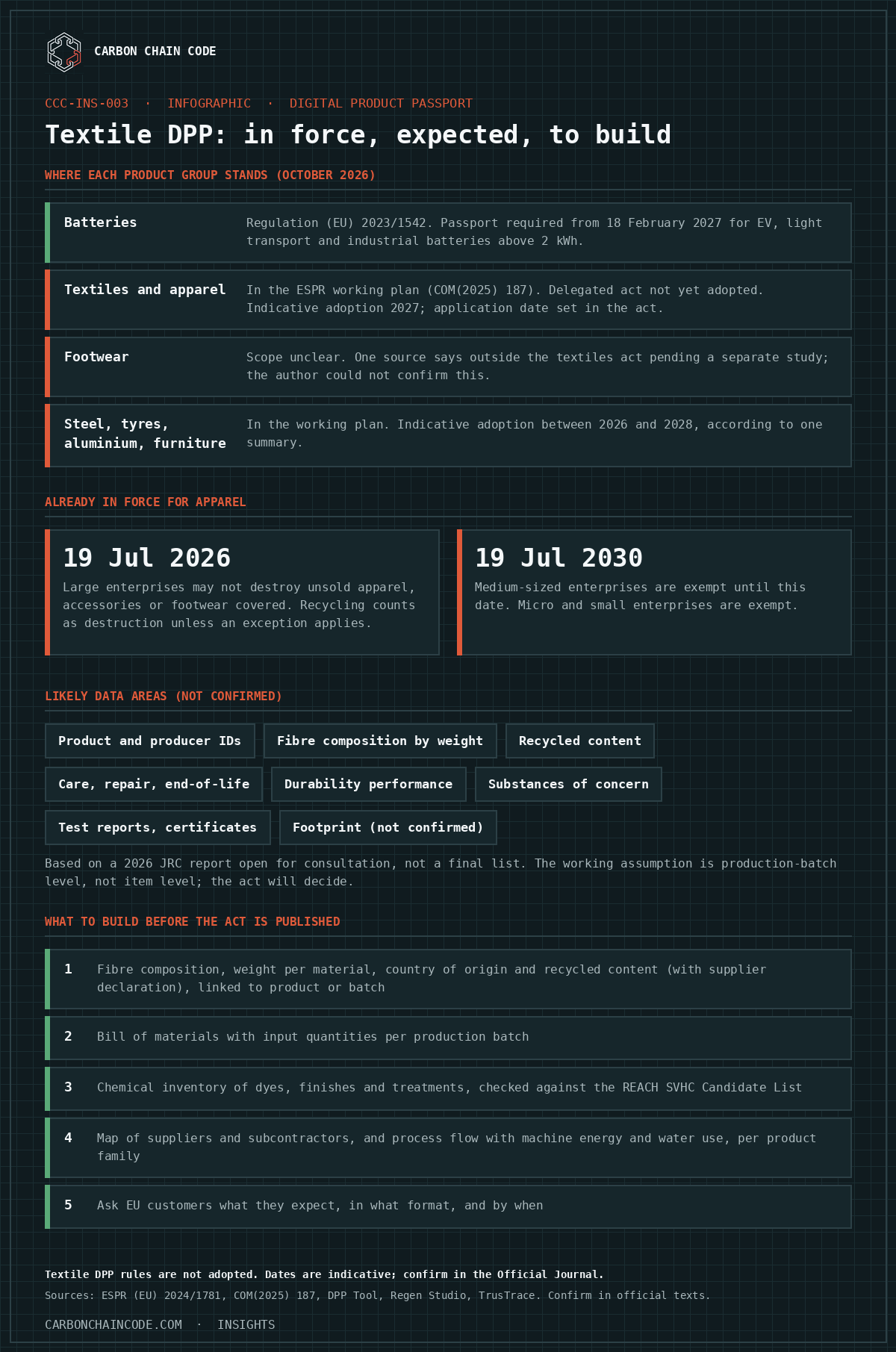
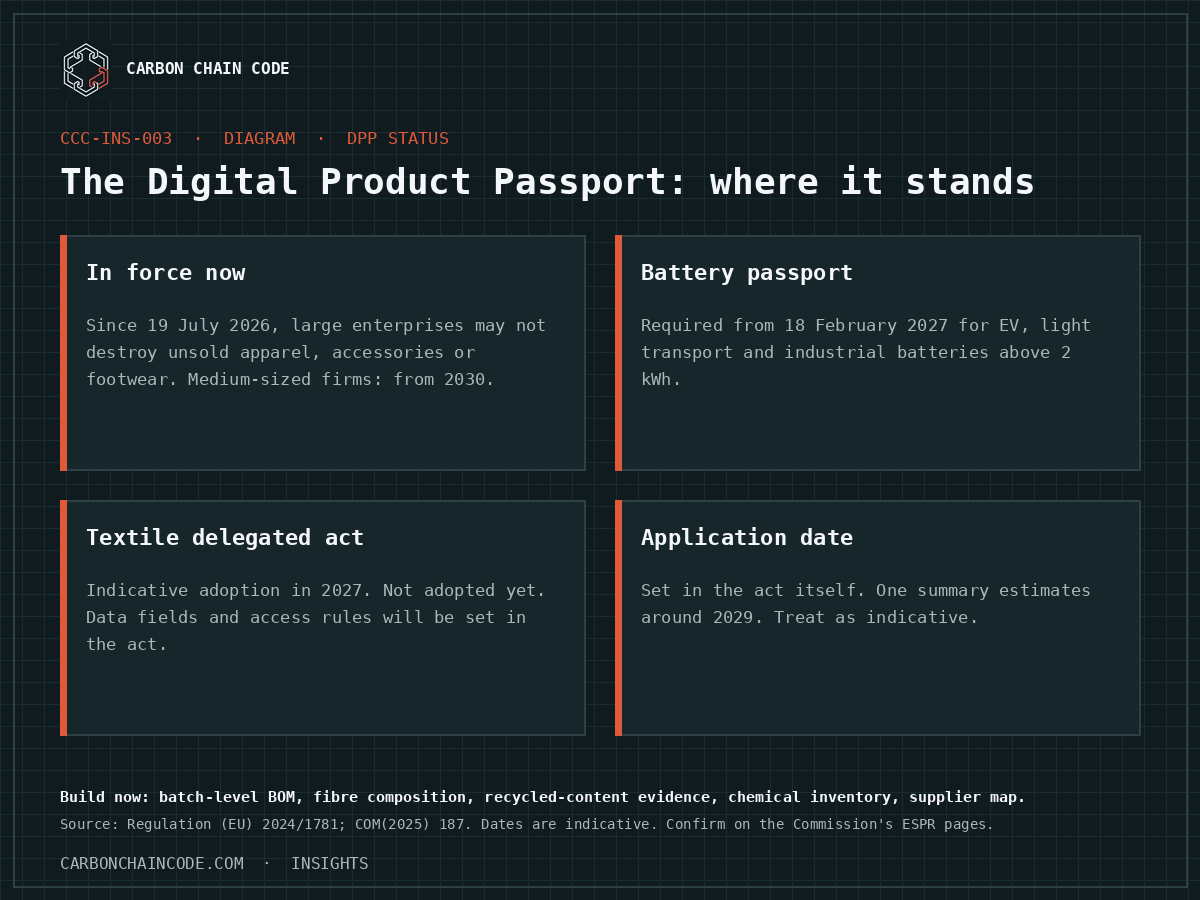
ESPR was adopted in 2024 and sets the framework for ecodesign requirements and the DPP. The Commission's first ESPR working plan, published on 16 April 2025 (COM(2025) 187), lists the product groups it will address first. Textiles are in it, and the indicative adoption date for the textile delegated act is 2027. The application date will be set in the act itself, and one summary estimates compliance around 2029. Footwear's position is less clear: one source says it is currently outside the textiles scope pending a separate study, and I could not confirm this. These dates are indicative, and the Commission has said it will review the plan.
Product group
Status (October 2026)
Timing
Batteries
Governed by Regulation (EU) 2023/1542
Battery passport required from 18 February 2027 for EV batteries, batteries for light means of transport and industrial batteries above 2 kWh
Textiles and apparel
In the ESPR working plan, delegated act not yet adopted
Indicative adoption 2027, application date to be set in the act
Footwear
Scope unclear, one source says outside the textiles act pending a separate study
Not confirmed
Iron and steel, tyres, aluminium, furniture
In the working plan
Indicative adoption between 2026 and 2028, according to one summary
Treat the dates for groups other than batteries as indicative, not binding. Check the Commission's ESPR pages before you plan around any of them.
What Is Already in Force for Apparel
Illustrative summary
One ESPR rule for clothing already applies. Since 19 July 2026, large enterprises may not destroy unsold apparel, clothing accessories or footwear covered by the regulation, and recycling counts as destruction unless an exception applies. There are exceptions under Delegated Regulation (EU) 2026/296, for example for safety reasons or damage that cannot be repaired. Medium-sized enterprises are exempt until 19 July 2030, and micro and small enterprises are exempt. Large enterprises must also disclose what they discard and why. This affects your EU brand customers first, and it can change how they plan production volumes and returns with you.
What Data Will a Textile DPP Contain?
The exact data will be set by the textile delegated act and has not been published. The Commission's Joint Research Centre has published a 2026 report assessing candidate data points for textiles, which is open for consultation and is not a final list. Based on that work and on the ESPR framework, the following are likely areas, but they are not confirmed:
Likely data areas (not yet confirmed)
Product and producer identification: unique identifiers for the product, the manufacturer and the facility.
Product information: fibre composition by weight, recycled content, and care, repair and end-of-life information.
Durability and other ecodesign performance information, which the JRC treats as central.
Substances of concern, which ESPR links to the REACH SVHC Candidate List among other sources.
Compliance documentation, such as test reports and certificates.
Environmental footprint information, which the framework allows but which has not been confirmed for textiles.
The delegated act will also set who may see which data. Some will be public and some restricted to authorities. For textiles, the working assumption in the JRC study is production-batch level, not item level, so do not assume one passport per SKU or per colourway. The act will decide the level.
Why the DPP Is Different From the CSRD
The CSRD is a company-level reporting regime. The DPP attaches data to products, so the data has to be traceable to a model or batch. A factory that supplies several brands will be asked for composition, supplier and chemical data per product or batch, and that data must be consistent with what it told the brand last season. If a footprint figure is eventually required, it will be a product-level calculation. ISO 14067 is the usual method for that, and you can see our guide to it for what the calculation involves.
Most factories already have the building blocks, such as bills of materials, supplier records and test reports. The challenge is that these are often in paper files, PDFs and spreadsheets that are not linked to a batch or a product, which makes them hard to turn into reliable structured data.
DPP in Numbers
ESPR: Regulation (EU) 2024/1781. First working plan: 16 April 2025 (COM(2025) 187). Textile delegated act: indicative adoption 2027, not yet adopted. Battery passport: required from 18 February 2027. Destruction ban on unsold apparel and footwear: applies to large enterprises since 19 July 2026. Medium-sized enterprises: exempt until 19 July 2030. Granularity for textiles: working assumption is batch level, to be set in the act.
What to Build Before the Delegated Act Is Published
The requirements are not final, but the data foundations are predictable, and none of the steps below needs a new platform. Ask your main EU customers which system or format they plan to use, since many brands will tell suppliers how they want data delivered.
DPP readiness checklist
Record fibre composition, weight per material, and country of origin for each active product, and keep it linked to the product or batch it describes.
Record recycled content for each input with a supplier declaration or certificate, for example a Global Recycled Standard transaction certificate where the buyer relies on that scheme.
Keep a bill of materials that records input quantities per production batch. This is also the raw data for any product-level carbon calculation.
Make a chemical inventory of dyes, finishes and treatments, and check each against the REACH SVHC Candidate List. See our REACH guide for the rules.
Map your direct suppliers and subcontractors for each product family, with the location of each production step.
Document your process flow per product family, with the machines used and their energy and water use per unit or batch.
Ask your EU customers what they expect, in what format, and by when.
Frequently Asked Questions
Is the DPP already required for textiles?
No. The delegated act for textiles has not been adopted. The Commission's working plan gives an indicative adoption date of 2027, and the application date will be set in the act. Batteries are different, with a battery passport required from 18 February 2027.
Does the DPP apply to goods made outside the EU?
Yes, it applies to products placed on the EU market wherever they are made. The legal obligation sits with the economic operator placing the product on the market, such as the brand or importer, but the data must come from the supply chain, so factories will be asked for it.
Will a textile DPP include a carbon footprint?
I could not confirm this. The ESPR framework allows environmental footprint information, but the data for textiles will be set in the delegated act, and the Commission's candidate data points are still being assessed. Do not build around a footprint requirement without checking.
How is the DPP different from certificates such as GOTS or GRS?
GOTS and GRS are voluntary schemes that verify specific claims. The DPP is a legal requirement for a product record. A certificate can be evidence behind a DPP data point, so the two are complementary.
References
Regulation (EU) 2024/1781 (ESPR). Commission, Ecodesign for Sustainable Products and Energy Labelling Working Plan 2025–2030, COM(2025) 187. Regulation (EU) 2023/1542 (Batteries Regulation). DPP Tool, ESPR delegated acts status (August 2026). Regen Studio, The expected ESPR delegated act on textiles. TrusTrace, What happens on 19 July 2026 under ESPR. Automotive IQ, The EU battery passport explained. I used industry summaries, not the legal texts, so confirm dates and scope in the Official Journal and on the Commission's ESPR pages.
Free tool · Sustainability Frisk
FREE TOOL FROM SUSTAINABILITY FRISK
The CSRD Applicability Checker tells you which thresholds apply to your company and what timeline to follow — in under two minutes.
Need a CSRD gap analysis or hands-on implementation? Sustainability Frisk can help. www.sustainability-frisk.com
Most brands still estimate the emissions of their factories from spend data. This guide explains why that is changing, what brands will ask suppliers for, and what a factory can measure now from records it already has.
Textiles are not covered by the EU Carbon Border Adjustment Mechanism, and they are not in the Commission's current extension proposal. This guide explains what CBAM does cover, how its costs are calculated, and what a Pakistani textile manufacturer should prepare.
 Carbon Chain Code