EU Carbon Price and CBAM: What to Track if You Sell to the EU
How the EU ETS allowance price feeds into CBAM certificate prices, why price forecasts should be treated with caution, and what suppliers can do with the number.
By Hufsa8 October 20266 min read
The price of an EU Emissions Trading System (ETS) allowance now sets the price of CBAM certificates, so it matters to any manufacturer exporting CBAM-covered goods to the EU. This article explains the link, the figures that are officially published, and what is only forecast. An earlier version of this article reported an allowance price of €62.40 in May 2026. I could not find support for that figure, and the official CBAM prices for 2026 are higher, so I removed it.
What the Official Prices Say
Item
Price (€ per tonne CO₂)
Source
CBAM certificate price, Q1 2026
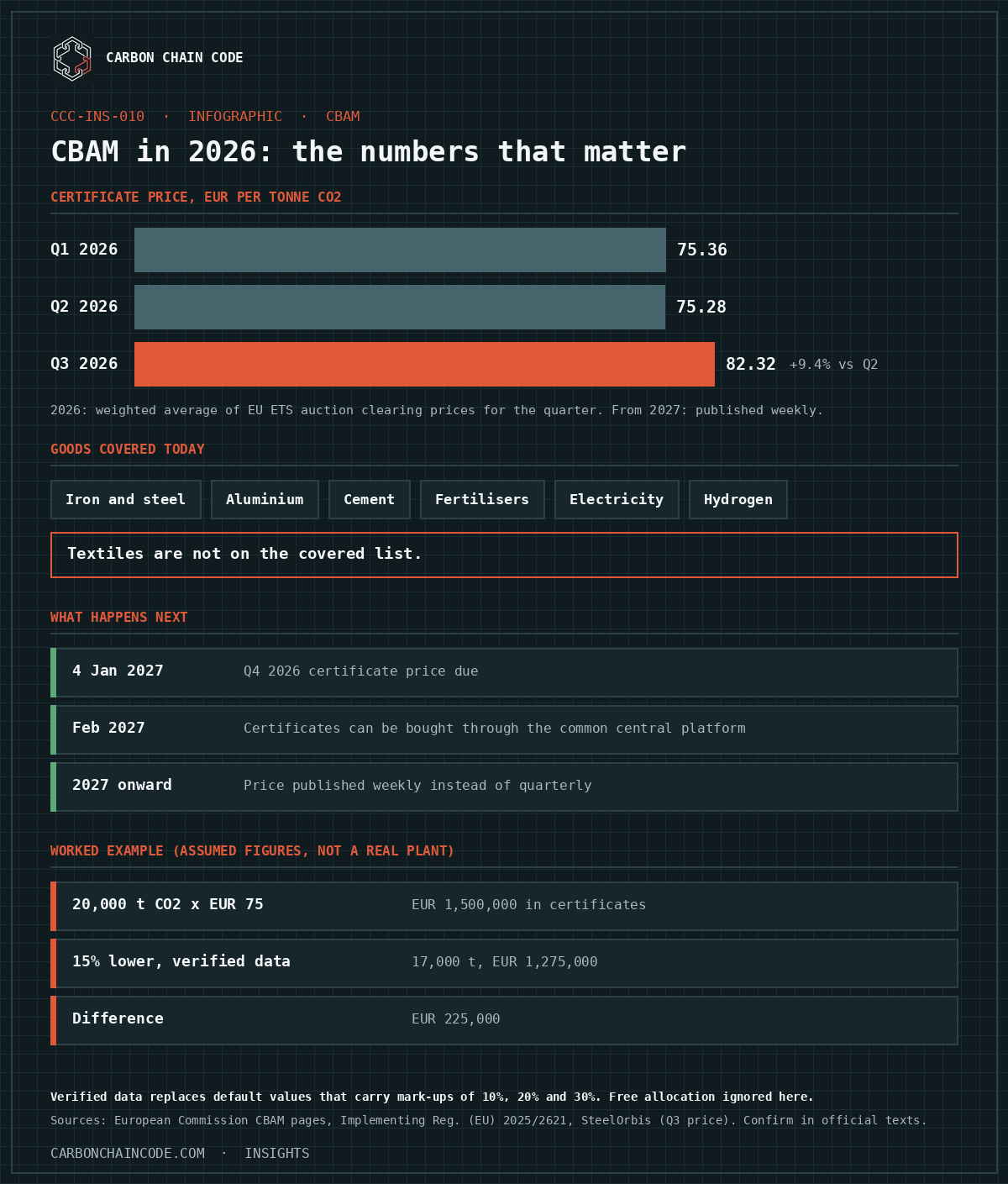
75.36
European Commission, published 7 April 2026
CBAM certificate price, Q2 2026
75.28
European Commission, published 6 July 2026
CBAM certificate price, Q3 2026
82.32
Published in early October 2026 (reported by SteelOrbis, citing the Commission); confirm on the Commission page
Market range reported for mid-2026
About 80–90
Adviser commentary, not an official figure
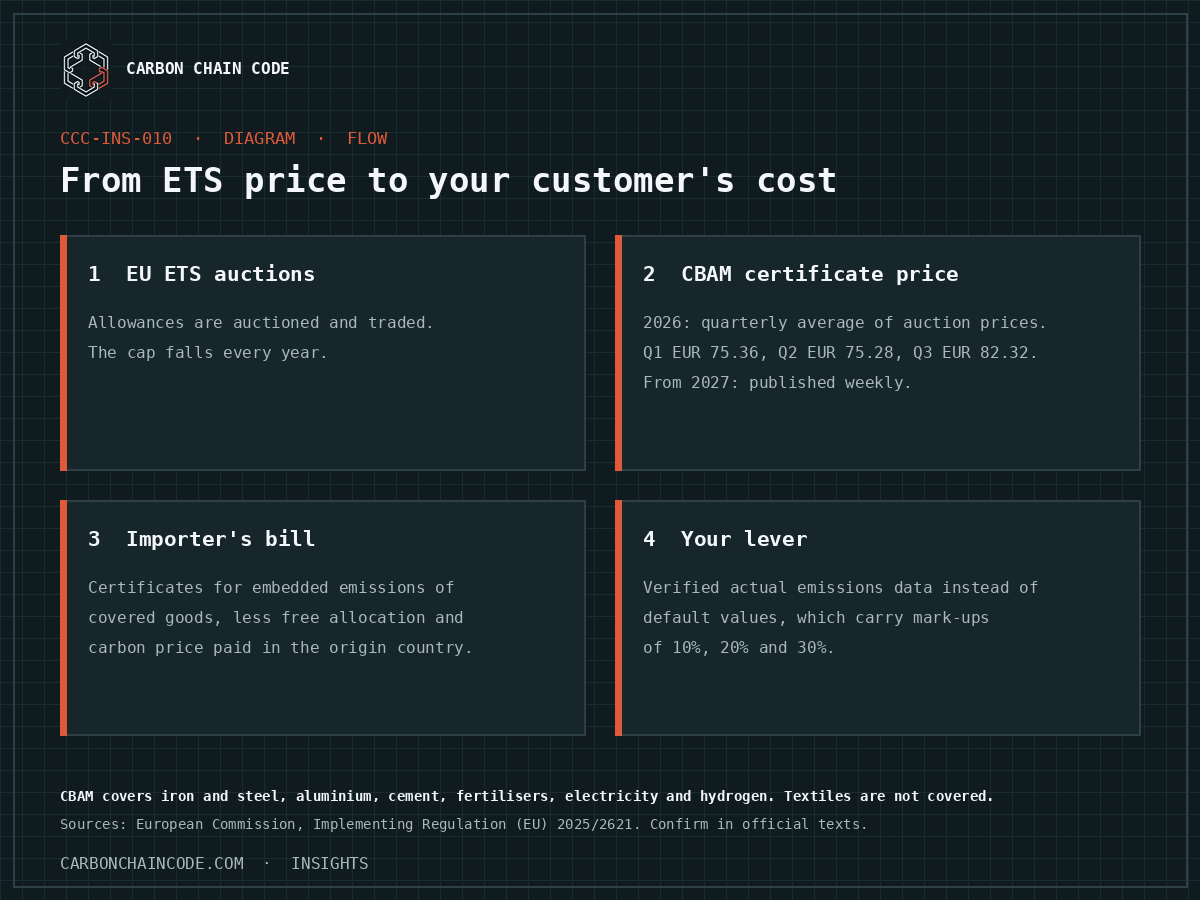
In 2026 the CBAM certificate price is the weighted average of the auction clearing prices of EU ETS allowances for the quarter. From 2027 the Commission will publish a price weekly. The market price on any given day can differ from these averages. The Q3 price was 9.4% above Q2, according to the same report. The Q4 price is due on 4 January 2027, and certificates can be bought through the common central platform from February 2027, according to that report. I could not find a reliable spot price for early October 2026, so check a live source before quoting one.
How the EU ETS Works
Illustrative summary
The EU ETS is a cap-and-trade system. The EU sets a cap on emissions from covered sectors, issues allowances up to that cap and lets companies trade them. The cap falls every year, by a little over 4% a year in the current phase (sources differ on the exact figure, between 4.2% and 4.3%). Allowances are removed from the market or added to it by the Market Stability Reserve, which has been under review in 2026.
Free allocation to industry is being reduced step by step, which is the other side of CBAM: as free allowances shrink, CBAM covers the carbon cost of imports. I did not confirm the year-by-year schedule, so check the legal text for the percentage that applies in a given year. ETS2, the separate system for buildings and road transport fuels, has been delayed to 2028.
What It Means for Exporters
CBAM currently applies to a defined list of goods: iron and steel, aluminium, cement, fertilisers, electricity and hydrogen. Textiles are not on the list. A textile factory is therefore not charged under CBAM for its own products, but it may buy inputs or energy, or supply customers who do, and its customers may ask for emissions data for other reasons.
For a covered product, the importer must buy certificates for the emissions embedded in the goods, less any allowance for free allocation and any carbon price already paid in the country of origin. When a supplier cannot give verified actual emissions data, the importer has to use default values, which the Commission has set with mark-ups of 10%, 20% and 30% in successive years (Implementing Regulation (EU) 2025/2621). That is the practical reason suppliers measure: actual data can lower the cost to the customer.
A Worked Example, With Assumed Numbers
The figures below are assumptions to show the arithmetic, not data from a real plant, and they use €75 per tonne, close to the Q1 and Q2 2026 CBAM prices (Q3 was €82.32).
Step
Value
Embedded emissions in a shipment of covered goods
20,000 tonnes CO₂
Allowance for free allocation (assumed)
0 tonnes, for simplicity
Carbon price paid in country of origin (assumed)
None
Certificates needed
20,000
Cost at €75
€1,500,000
If verified data shows 15% lower emissions
17,000 tonnes, cost €1,275,000, a saving of €225,000
A real calculation has more steps, including free allocation adjustments and the carbon price paid abroad, so use it only to see how the price multiplies emissions.
Treat forecasts with care
Forecasts I found put the allowance price at about €100 at the end of 2026, with a planning range of roughly €70 to €110. Those are opinions from banks and advisers, and they depend on policy decisions, including a review of the ETS in 2026. Do not build a capital plan on one number.
What To Do With the Number
For a manufacturer with EU customers
Check whether any of your products or inputs fall under a CBAM product code. If they do not, you are not directly charged, but customers may still ask for data.
Measure emissions per product with a method that a verifier can check; default values with mark-ups are the fallback you want to avoid.
Use the published quarterly CBAM price, and from 2027 the weekly price, when you show a customer the value of a reduction.
Test any investment case at several prices, for example €60, €80 and €100, and do not rely on a forecast.
Keep the carbon price you pay at home on record, since it can reduce the CBAM cost.
Ask each EU customer which data they need and in what format before it is requested at short notice.
Frequently Asked Questions
What is the current EU carbon price?
The official CBAM certificate prices for 2026 were €75.36 for Q1, €75.28 for Q2 and €82.32 for Q3. Market prices change daily, and one adviser reports €80–90 in mid-2026. Check a live source for today's price.
Does the EU ETS price set the CBAM price?
Yes. In 2026 the CBAM certificate price is the quarterly weighted average of ETS auction clearing prices. From 2027 the Commission will publish it weekly.
Do textile exporters pay CBAM?
Not at present, because textiles are not on the covered list. Check the list before relying on that, because the scope may be reviewed.
Will the price keep rising?
Some analysts expect it to, but forecasts are opinions and depend on policy decisions. This article does not predict a price.
References
European Commission, Price of CBAM certificates (taxation-customs.ec.europa.eu). SteelOrbis, EU CBAM certificate price rises to €82.32 for Q3 2026. Implementing Regulation (EU) 2025/2621. Nista.io, The EU ETS Carbon Price in 2026. ABN AMRO, Carbon Market Strategist (December 2025). The cap reduction rate and the free allocation schedule differ between sources; confirm them in the legal text.
Free tool · Sustainability Frisk
Does CBAM affect your exports?
Use the free CBAM Applicability Checker to see whether your goods are covered and what it means.
Need a CSRD gap analysis or hands-on implementation? Sustainability Frisk can help. www.sustainability-frisk.com
Textiles are not covered by the EU Carbon Border Adjustment Mechanism, and they are not in the Commission's current extension proposal. This guide explains what CBAM does cover, how its costs are calculated, and what a Pakistani textile manufacturer should prepare.
Most brands still estimate the emissions of their factories from spend data. This guide explains why that is changing, what brands will ask suppliers for, and what a factory can measure now from records it already has.
 Carbon Chain Code