Bhopal 1984: What Happened and What It Changed in Safety Law
The gas release that killed thousands, the safety failures behind it, the court outcomes, and the laws it helped to shape.
By Hufsa8 October 20267 min read
Just after midnight on 3 December 1984, methyl isocyanate (MIC) gas escaped from a storage tank at the Union Carbide India Limited (UCIL) pesticide plant in Bhopal, India. It is still the worst industrial chemical disaster on record. This article sets out what is documented about the cause, the toll, the legal outcomes and the regulation that followed, and marks the points that remain disputed.
What Happened
Reports say about 30 tonnes of MIC escaped from the tank within 45 to 60 minutes, and later estimates put the total at up to 40 tonnes within two hours. MIC was used at the plant to make the pesticide carbaryl. The gas spread over densely populated neighbourhoods near the plant. Over 500,000 people were exposed. A 2006 affidavit from the Indian government reported 558,125 injuries.
Measure
Figure
Source type
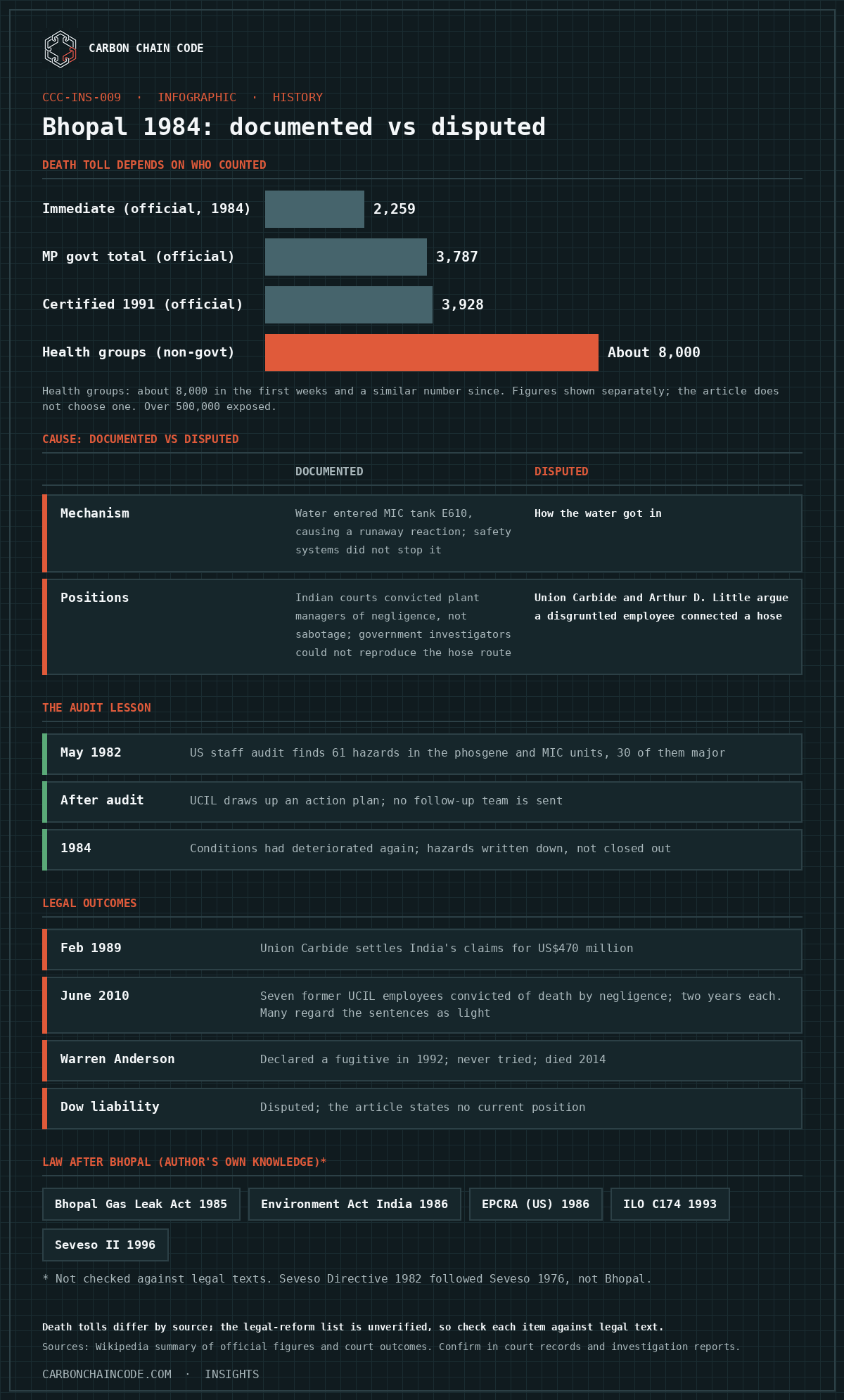
Deaths recorded immediately
2,259
Official, 1984
Madhya Pradesh government total deaths from the gas
3,787
Official
Deaths certified in 1991
3,928
Official
Estimates by health groups
About 8,000 in the first weeks and a similar number since
Non-governmental estimates
People exposed
Over 500,000
Various, including official
The death toll depends on who counted and when, so I give the figures separately and have not chosen one. The earlier version of this article cited a figure "above 15,000" for later government assessments and a 2006 journal study of "up to 25,000". I could not confirm either, so I removed them.
Why It Happened
Illustrative summary
Water entered the MIC storage tank (E610), which set off a runaway reaction. The safety systems intended to contain a release did not stop it. Accounts of the investigation describe the refrigeration unit, the scrubber and the flare tower as out of service or inadequate for the quantity released; check the investigation reports for the details of each system.
The cause of the water entry is disputed. Union Carbide and a report by Arthur D. Little argue that a disgruntled employee deliberately connected a hose to the tank. Investigators for the Indian government found that this route could not be reproduced. The Indian courts convicted plant managers of negligence, not sabotage.
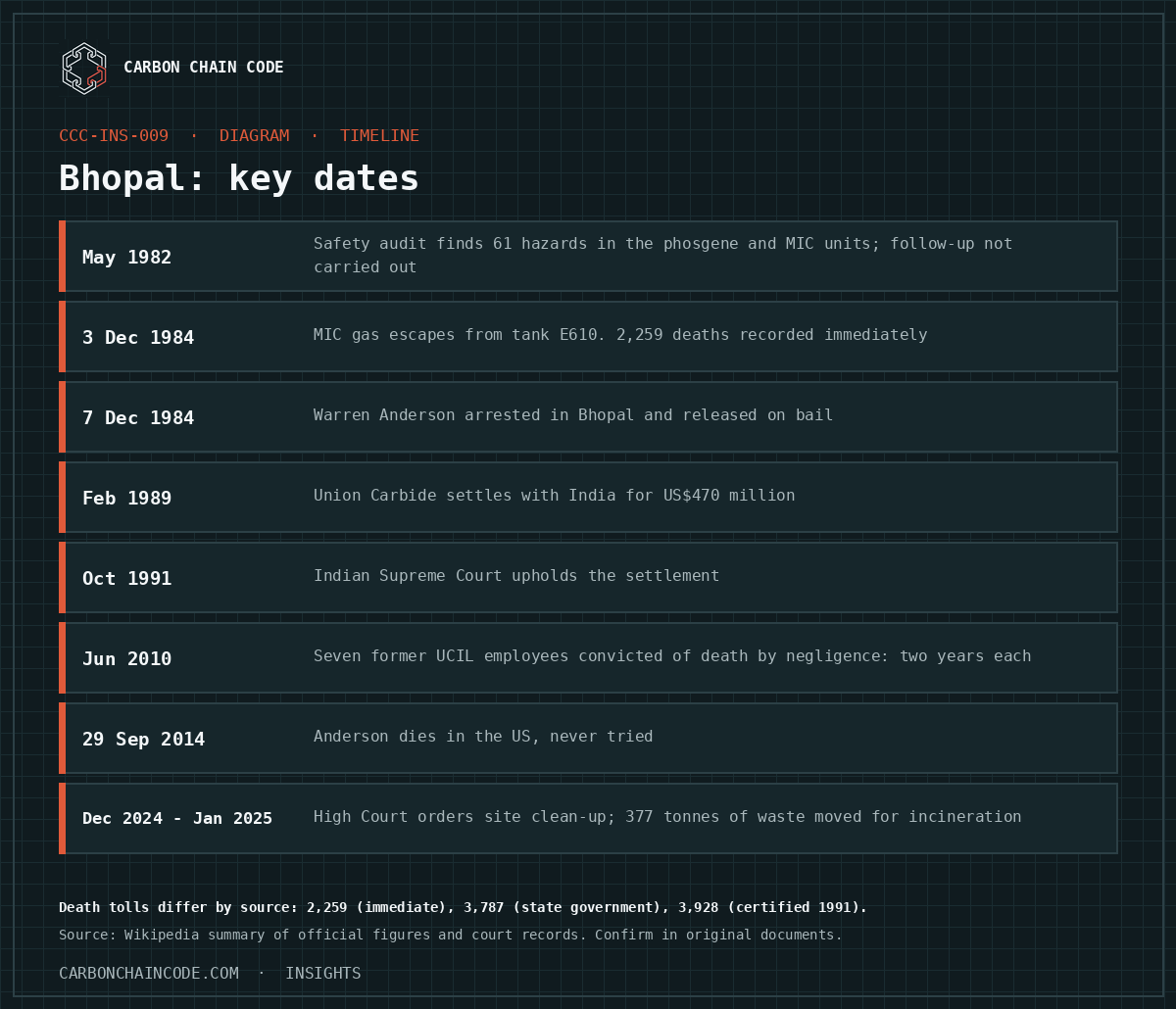
A May 1982 safety audit by Union Carbide's US staff identified 61 hazards in the phosgene and MIC units, 30 of them major. UCIL drew up an action plan, but Union Carbide did not send a follow-up team, and conditions had deteriorated again by 1984. That is the part of the story most relevant to auditors: the hazards were written down and not closed out.
The Legal Outcomes
Warren Anderson, then Union Carbide's chairman, was arrested in Bhopal on 7 December 1984 and released on bail within hours. India charged him with manslaughter in 1991 and declared him a fugitive in 1992. The United States declined to extradite him. He died on 29 September 2014, aged 92, without standing trial.
In February 1989 Union Carbide settled India's claims for US$470 million. The Indian Supreme Court upheld the settlement in October 1991 and ordered medical cover for 100,000 people. In March 2023 the Supreme Court dismissed a petition seeking higher compensation.
In June 2010 a court in Bhopal convicted seven former UCIL employees, including the then chairman Keshub Mahindra, of causing death by negligence. Each received two years' imprisonment and a fine of ₹100,000, and they were released on bail soon after. An eighth defendant died before the judgment. So the claim that no one was held criminally responsible is not accurate, although many people regard the sentences as light.
Dow Chemical bought Union Carbide in 2001. Dow has said that it is not liable for Bhopal, and Union Carbide's position is that it settled in 1989. I did not find a recent ruling that settles the question, so I have not stated how liability stands today.
The Site Today
The site was never fully cleaned up. Eveready ended its clean-up work in 1998, when the state government took over, and chemicals have continued to leak into groundwater. On 3 December 2024 the Madhya Pradesh High Court ordered the site to be cleaned within a month, and on 1 January 2025 about 377 tonnes of waste were moved to Pithampur for incineration, which drew protests.
What It Changed in Law
I took this section from my own knowledge, not from the sources above, so check each item against the legal text.
Law
Year
Link to Bhopal
Bhopal Gas Leak Disaster (Processing of Claims) Act (India)
1985
Gave the Indian government the right to represent victims in claims
Environment (Protection) Act (India)
1986
Passed after the disaster; basis for later hazardous substances rules
Emergency Planning and Community Right-to-Know Act (US)
1986
Requires emergency planning and public reporting of chemical inventories and releases, including the Toxics Release Inventory
Seveso II Directive (EU)
1996
Replaced the 1982 Seveso Directive, which came before Bhopal. Bhopal was one of several accidents behind the tightening of the rules, along with others in Europe
ILO Convention 174, Prevention of Major Industrial Accidents
1993
International standard for major hazard installations
A common error is to say that Bhopal produced the Seveso rules. The first Seveso Directive (1982) responded to the 1976 Seveso accident in Italy. Bhopal came later and reinforced the direction of the rules.
The audit lesson
The 1982 audit found the hazards. The disaster happened because they were not closed out and because the emergency plan and safety systems did not work when needed. An audit of documents is not an audit of whether the system works. For a supplier, the practical test is whether a safety control would still operate on a bad night, not whether a procedure exists.
What a compliance team can take from Bhopal
Track every audit finding to closure, with an owner, a date and evidence that the fix works.
Test safety systems under realistic conditions, not only inspect that they exist.
Check that emergency plans reach the people who need them, including neighbours of the site.
Keep a chemical inventory and know the quantities stored against what the permit allows.
Treat repeated findings and deferred maintenance as a risk signal.
Frequently Asked Questions
How many people died at Bhopal?
It depends on the source. Official counts are 2,259 immediately, 3,787 according to the Madhya Pradesh government and 3,928 certified in 1991. Some health groups estimate about 8,000 in the first weeks and a similar number since.
Was anyone convicted?
Yes. In 2010 a Bhopal court convicted seven former UCIL employees of causing death by negligence. Each received two years in prison. Warren Anderson was never tried.
Did Bhopal cause the Seveso Directive?
No. The Seveso Directive of 1982 followed an accident in Italy in 1976. Bhopal influenced later revisions and other laws, such as the US EPCRA in 1986.
Is the site cleaned up?
Not fully. A court ordered clean-up in December 2024 and some waste was moved in January 2025, but groundwater contamination has been reported for years.
References
Wikipedia, Bhopal disaster (summary of official figures, court outcomes and site clean-up). The law table is from my own knowledge and was not checked against the legal texts. Confirm figures and dates in the original court records and investigation reports before relying on them.
Need a CSRD gap analysis or hands-on implementation? Sustainability Frisk can help. www.sustainability-frisk.com
How software that detected emissions tests led to the biggest emissions fraud case in the car industry, what it cost Volkswagen, and what it does and does not tell us about verifying environmental data.
What Patagonia changed in its cotton supply chain between 1996 and today, what is documented, and what a supplier can learn from a brand that built its sourcing around supplier knowledge.
 Carbon Chain Code