Volkswagen Dieselgate: What Happened, Cost and Consequences
How software that detected emissions tests led to the biggest emissions fraud case in the car industry, what it cost Volkswagen, and what it does and does not tell us about verifying environmental data.
By Hufsa8 October 20269 min read
On 18 September 2015 the US Environmental Protection Agency made public that Volkswagen had fitted diesel cars with software that reduced emissions when it detected a test and let them rise on the road. Volkswagen said that around 11 million cars worldwide could be affected. The company's chief executive resigned within days, and total costs have been reported at more than €30 billion. This case study sets out what the software did, how it was found, what it cost, which criminal cases have concluded, and which regulations changed afterwards. It also looks at what the case does and does not show about verifying environmental data, because the lesson is often overstated.
What Volkswagen Did
The software in the EA189 diesel engines, sold from about 2009 to 2015, tracked steering wheel position, vehicle speed, engine run time and barometric pressure. When these matched the pattern of a regulatory test, the car reduced its nitrogen oxide (NOx) emissions. Outside the test, the emission controls were less effective. Researchers measured NOx on the road at 15 to 40 times the US limit in two of three cars tested, and the EPA described exceedances of up to 40 times. The result was cars that passed the laboratory cycle but emitted far more in normal driving.
How It Was Found
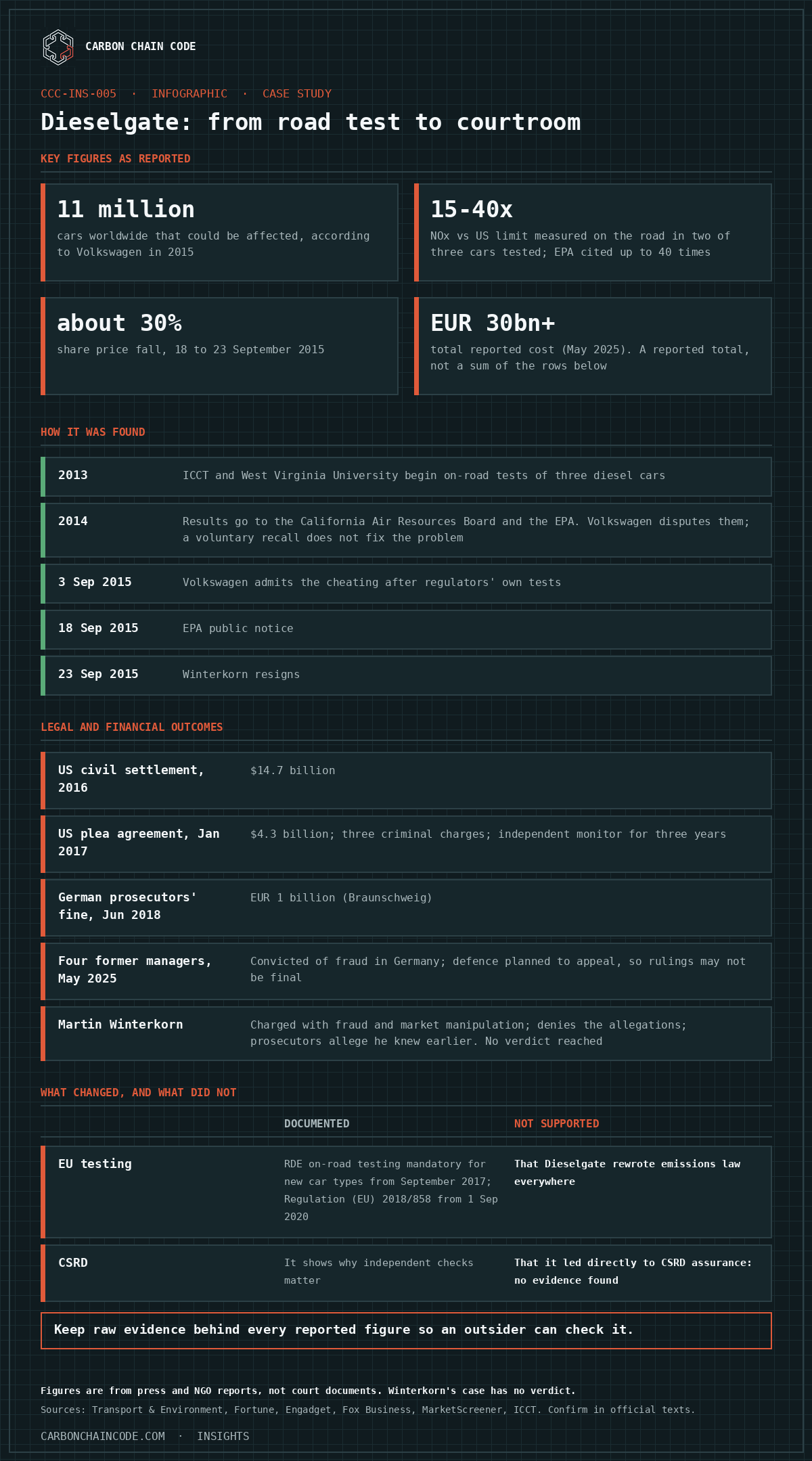
Illustrative summary
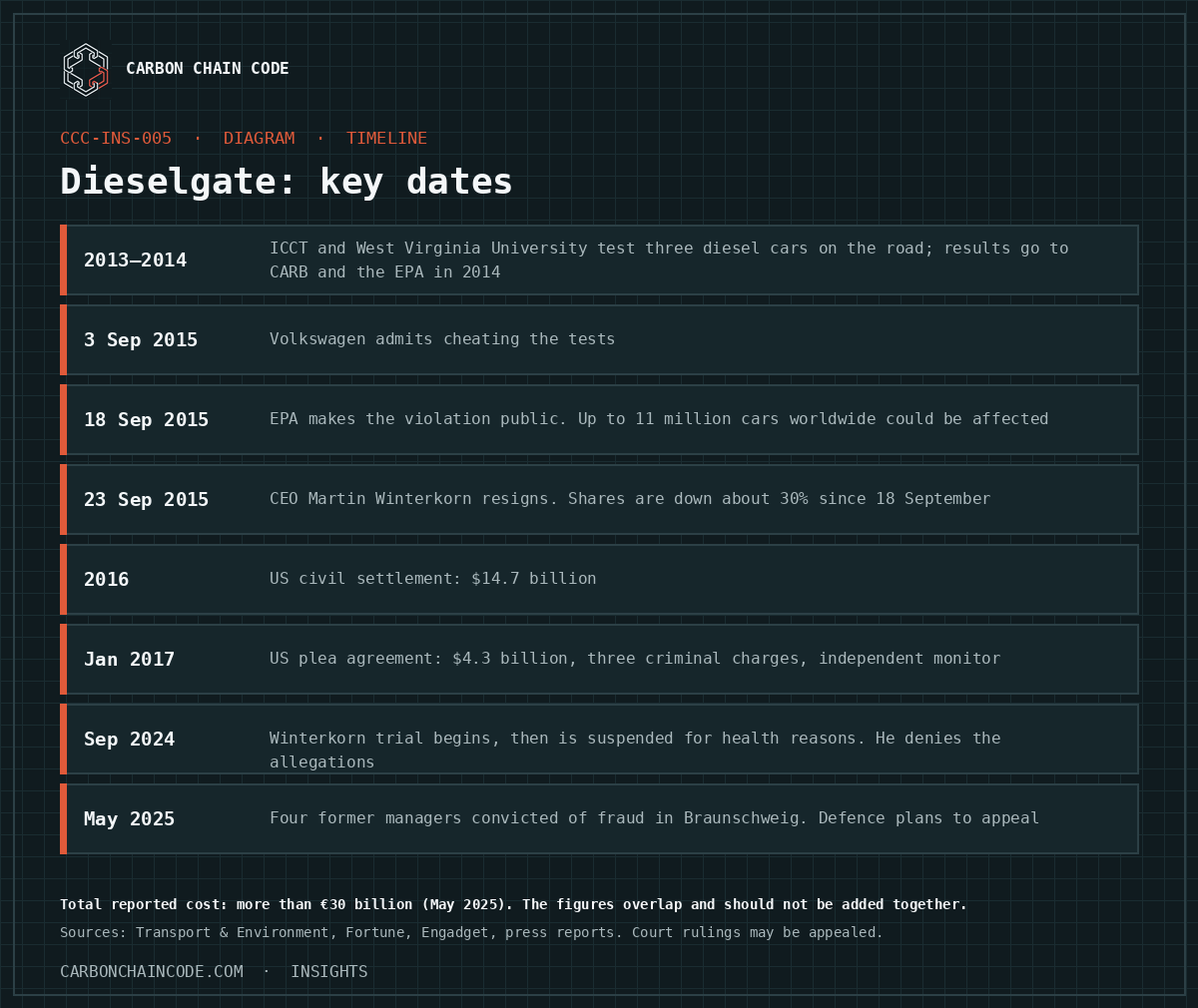
The discovery came from independent testing, not from the regulators' routine checks. The International Council on Clean Transportation (ICCT) and West Virginia University began testing three diesel cars on the road in 2013. Two of them, a Volkswagen Jetta and a Passat, exceeded the NOx limits by a large margin. The results went to the California Air Resources Board and the EPA in 2014. Volkswagen disputed the findings and carried out a voluntary recall that did not solve the problem. After regulators' own tests found software that tracked the test conditions, Volkswagen admitted the cheating on 3 September 2015, and the EPA's public notice followed on 18 September. Winterkorn resigned on 23 September, and Volkswagen shares fell about 30% between 18 and 23 September. European authorities had received the same information earlier but did not investigate.
The Financial and Legal Cost
Item
Amount
Notes
US civil settlement (2016)
$14.7 billion
Settlement with US regulators and owners covering vehicle buybacks or repairs, owner compensation and environmental remediation
US plea agreement (January 2017)
$4.3 billion
Volkswagen pleaded guilty to three criminal charges and accepted an independent monitor for three years
German prosecutors' fine (June 2018)
€1 billion
Fine imposed on Volkswagen by the Braunschweig prosecutors
Total reported cost
More than €30 billion
Reported figure as of May 2025; includes fines, settlements, buybacks, legal costs and compensation across jurisdictions
I have not tried to add these numbers together, because they overlap and the total comes from company and press reporting. Treat the more than €30 billion as a reported total, not a sum of the rows above.
The Criminal Cases
In the United States, Oliver Schmidt, a former Volkswagen compliance manager, was sentenced to seven years in prison. In Germany, four former managers and engineers were tried at the Braunschweig Regional Court. In May 2025 all four were convicted of fraud. The sentences were four and a half years for a senior manager in diesel engine development, two years and seven months for the long-time head of powertrain technology, a suspended sentence of one year and three months for the head of development for the core VW brand, and a suspended sentence of one year and ten months for a department head. The defence planned to appeal, so the rulings may not be final.
The former chief executive, Martin Winterkorn, was charged with fraud and market manipulation. His trial began in September 2024 and was suspended soon afterwards because of his health. The court has provisionally ended the proceedings while his health is reviewed, and he denies the allegations. Prosecutors allege he knew about the software well before September 2015. No verdict has been reached in his case.
What Changed in Regulation
The main changes were in vehicle testing and approval. In the EU, real driving emissions (RDE) testing, which measures emissions on the road with portable equipment, became mandatory for new passenger car types from September 2017, together with the new laboratory test procedure (WLTP). The EU also reformed type approval in Regulation (EU) 2018/858, which applies from 1 September 2020. It gives the Commission power to run verification tests and start recalls, and to fine manufacturers up to €30,000 per non-compliant vehicle in some cases. Authorities also gained access to vehicle software to help detect defeat devices, and member states must run market surveillance tests. Other jurisdictions made their own changes, so it is wrong to say Dieselgate rewrote emissions law everywhere.
Dieselgate in Numbers
Affected vehicles: around 11 million worldwide, according to Volkswagen in 2015. Software in EA189 diesel engines, sold from about 2009 to 2015. EPA public notice: 18 September 2015. Winterkorn resigned: 23 September 2015. Shares fell about 30% between 18 and 23 September 2015. US civil settlement: $14.7 billion (2016). US plea: $4.3 billion (January 2017). Total reported cost: more than €30 billion (May 2025). German convictions: four former managers, May 2025, not final.
What the Case Does and Does Not Show About Sustainability Reporting
It is often said that Dieselgate led directly to the CSRD's assurance requirements. I could not find evidence for that. The CSRD followed the European Green Deal and the review of the earlier non-financial reporting rules, and the two have different subjects: Dieselgate was deliberate cheating in a product test, and the CSRD covers corporate sustainability reporting. What the case does show is why independent checks matter. Results that rely on what the producer tells the tester can be gamed, and the cheating went on for years because nobody tested cars on the road as a routine step. Under the CSRD, limited assurance of sustainability reporting remains after Omnibus I, while the move to reasonable assurance was dropped.
The Supplier Dimension
Robert Bosch GmbH supplied the engine control systems. In May 2019 the Stuttgart prosecutors fined Bosch €90 million for a negligent violation of supervisory obligations, saying that software in systems it supplied from 2008 partly contained prohibited strategies. Prosecutors said the initiative came from the automaker's employees. Bosch also agreed to a US civil settlement of $327.5 million. The case shows that suppliers can face penalties and settlements under existing law when their products enable a breach. It is not an application of the EU's Corporate Sustainability Due Diligence Directive, which is a different law with its own scope and liability rules.
What a supplier's data team can take from the case
Keep raw evidence behind every reported figure: meter readings, bills, lab reports and calculation files, so an outsider can check them.
Test under normal operating conditions, not only under the best case. A figure that holds only on the day of the audit is a risk, not a result.
Control who can change reported numbers and keep a record of changes and approvals.
Give technical staff a clear route to escalate a measurement problem to senior management, and record how it was handled.
Do not promise numbers to a customer that your records cannot support.
Frequently Asked Questions
How did the software know it was being tested?
It tracked conditions such as steering wheel position, vehicle speed, engine run time and barometric pressure. When these matched the pattern of a regulatory test, the car reduced its emissions.
How many cars were affected?
Volkswagen said in 2015 that around 11 million cars worldwide could be affected. Roughly 475,000 to 480,000 were in the United States, where the 2016 settlement covered buybacks or repairs. Figures differ by source and by engine type, so check the original reports if you need exact counts.
Was Dieselgate the reason the CSRD requires assurance?
I found no evidence for that. It is a clear example of why independent verification matters, but the CSRD followed other policy developments. Limited assurance of sustainability reporting remains, and the planned move to reasonable assurance was dropped by Omnibus I.
Has Winterkorn been convicted?
No verdict has been reached. His trial began in September 2024 and was suspended because of his health. He denies the allegations. Four other former managers and engineers were convicted of fraud in May 2025, and the defence planned to appeal.
References
Transport & Environment, VW caught cheating emissions tests by US regulators after ICCT tip-off. Fortune, Volkswagen stock drop (23 September 2015). Engadget, VW pleads guilty in US emissions scandal (11 January 2017). Fox Business, Germany's Bosch fined $100M over diesel scandal (23 May 2019). MarketScreener and Yahoo News reports on the Braunschweig verdict (May 2025). MarketBeat, German court suspends Winterkorn trial (2025). ICCT, EU type-approval system policy update (2018). I used press and NGO reports, not court documents.
Need a CSRD gap analysis or hands-on implementation? Sustainability Frisk can help. www.sustainability-frisk.com
A US class action over H&M's sustainability scorecards ended without a ruling, but it sits inside a real shift in how environmental claims are policed. Here is what was alleged, what is confirmed, and what it means for supplier data.
 Carbon Chain Code