 Carbon Chain Code
CSRD · ESRS
ESRS Explained: The 12 Standards and the Revised Draft
What each of the 12 European Sustainability Reporting Standards covers, which ones reach suppliers, and what the Commission's 2026 revision changes.
A US class action over H&M's sustainability scorecards ended without a ruling, but it sits inside a real shift in how environmental claims are policed. Here is what was alleged, what is confirmed, and what it means for supplier data.
In July 2022 a US consumer, Chelsea Commodore, sued H&M in federal court in New York, alleging that the company's online "Sustainability Profiles" made its clothes look greener than they were. The case never reached a ruling. It is still worth studying, because it shows how a scorecard built on supplier and material data can become a legal problem for a brand, and why that data comes back to the factory.
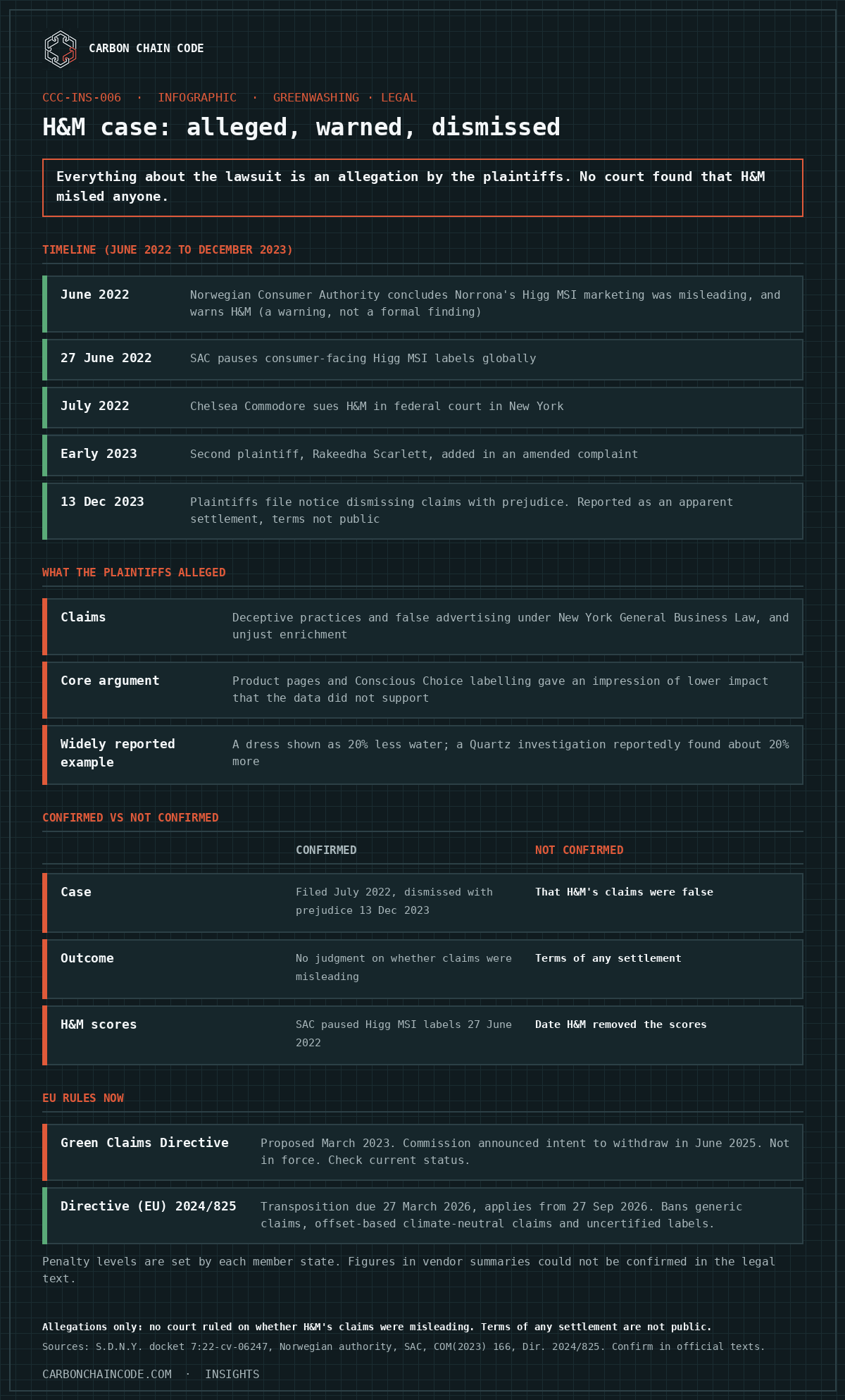
Everything about the lawsuit below is an allegation made by the plaintiffs. H&M did not lose a judgment, and no court found that it misled anyone.
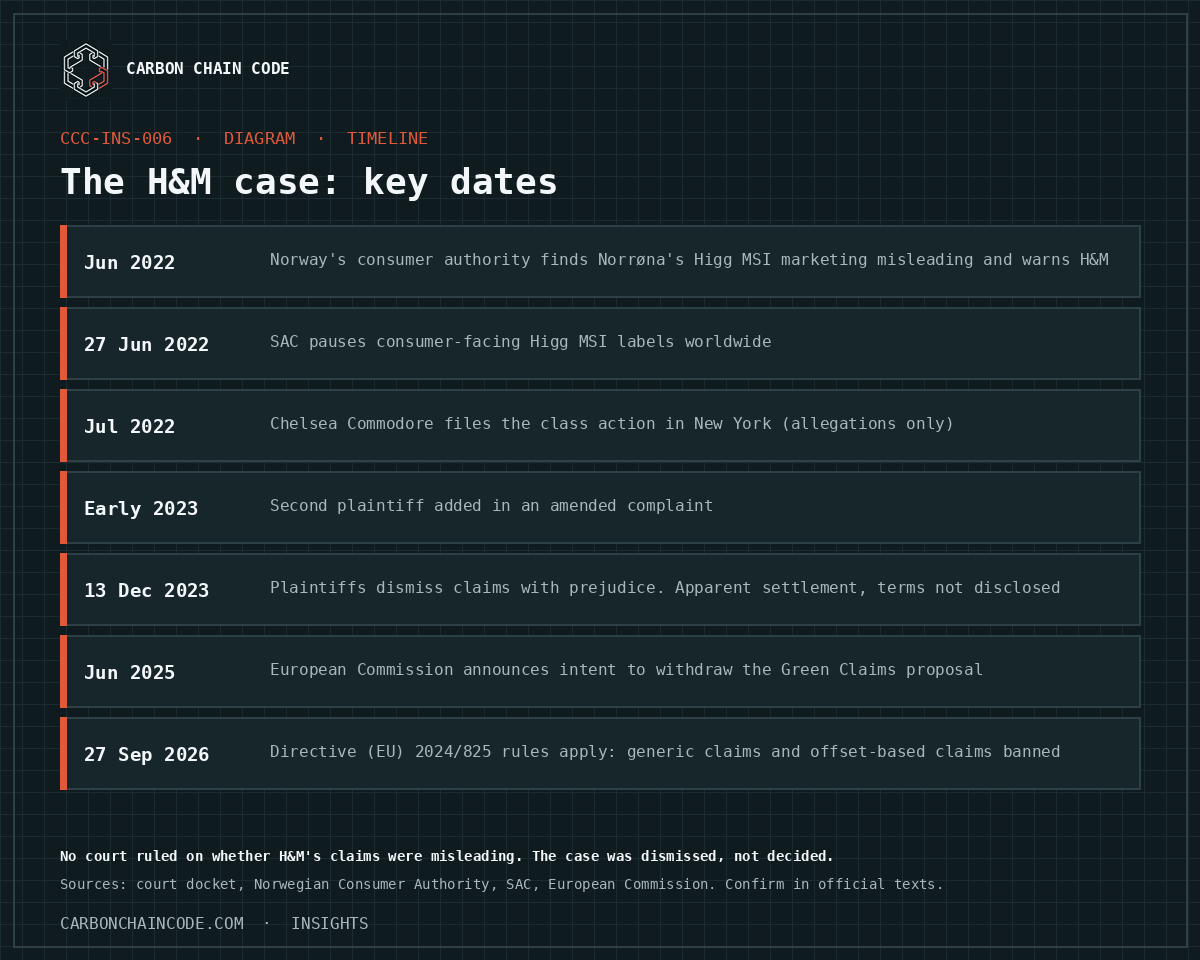
The case was Commodore v. H&M Hennes & Mauritz LP, in the US District Court for the Southern District of New York (case 7:22-cv-06247). A second plaintiff, Rakeedha Scarlett, was added in an amended complaint in early 2023. The claims were deceptive practices and false advertising under New York General Business Law, and unjust enrichment.
The plaintiffs argued that H&M's product pages and its "Conscious Choice" labelling gave shoppers an impression of lower environmental impact that the underlying data did not support. A widely reported example was a dress shown as using 20% less water, which a Quartz investigation reportedly found used about 20% more water than the comparison. The complaint also challenged "conscious" wording, the garment-recycling programme and a price premium on the products.
The scorecards drew on the Higg Materials Sustainability Index (MSI), a tool created by the Sustainable Apparel Coalition (SAC), now Cascale, to compare the environmental impact of materials. It is a serious industry tool, but it was designed for internal comparison and design decisions, not as a basis for consumer claims.
In June 2022, before the US lawsuit, the Norwegian Consumer Authority (Forbrukertilsynet) concluded that the outdoor brand Norrøna's marketing based on Higg MSI was misleading and asked it to change or remove the claims. It also warned H&M that using the Higg MSI as the basis for environmental claims would "easily be misleading and forbidden". That was a warning, not a formal finding against H&M. The authority said the index measures only up to the finished fabric and relies on average figures. It wrote to the SAC that it shared responsibility for how the tool was used, and said it could take action over breaches after 1 September 2022.
On 27 June 2022 the SAC paused consumer-facing use of the Higg MSI labels globally. This happened before the lawsuit was filed, not after it. I could not confirm the date on which H&M itself stopped showing the scores.
On 13 December 2023 the plaintiffs filed a notice dismissing their claims with prejudice. This is reported as an apparent settlement, but no terms were made public. So the case produced no judgment on whether H&M's claims were misleading, and anyone who says the court found H&M guilty of greenwashing is wrong.
Confirmed: the case was filed in July 2022 and dismissed with prejudice on 13 December 2023; Norway warned about Higg MSI claims in June 2022; the SAC paused consumer-facing Higg MSI labels on 27 June 2022. Not confirmed: that H&M's claims were false, the terms of any settlement, and the date H&M removed the scores.
Two EU measures matter here, and they are often mixed up.
The Green Claims Directive was proposed by the European Commission in March 2023 (COM(2023) 166). It would have required companies to substantiate environmental claims before making them. In June 2025 the Commission announced its intention to withdraw the proposal, so it is not in force and should not be described as upcoming law. Check the current status before relying on it.
Directive (EU) 2024/825, the Empowering Consumers for the Green Transition Directive, is the one that matters now. Member states had to transpose it by 27 March 2026, and its rules apply from 27 September 2026. It bans generic environmental claims such as "eco-friendly" or "green" when the trader cannot show recognised excellent environmental performance, bans claims that a product is neutral, reduced or positive for the climate when based on offsetting, and bans sustainability labels that are not based on a certification scheme or set by public authorities. Penalty levels are set by each member state; figures such as "up to 4% of turnover" appear in vendor summaries and I could not confirm them in the legal text.
The legal risk of a consumer claim sits with the brand. The data behind it often comes from you. If a customer wants to say a garment uses recycled polyester, you will be asked for the certificate and the chain of custody. If it wants to say a product has a lower footprint, you will be asked for measured data and the method behind it.
The H&M story also shows a second point: averages and partial boundaries are not a good basis for a product claim. The Norwegian authority objected that the Higg MSI covers only part of the life cycle and uses average figures. A figure for your own process, with a stated boundary, is more useful to a customer than a generic number.
What a supplier can prepare
No. The US case was dismissed with prejudice on 13 December 2023 after the plaintiffs filed notice, reportedly as a settlement with undisclosed terms. No court ruled on whether the claims were misleading.
Not as far as I could find. It concluded that Norrøna's Higg MSI based marketing was misleading and warned H&M that similar claims would easily be misleading and forbidden. I did not find a formal decision against H&M.
No one has said so. The criticism is about using a tool built for internal comparison as the basis of consumer claims, given its partial boundary and use of averages.
No. The Commission proposed it in 2023 and announced in June 2025 that it intended to withdraw it. The rules that apply are in Directive (EU) 2024/825, which applies from 27 September 2026, along with existing unfair commercial practices law.
Indirectly. Brands that make consumer claims will ask suppliers for evidence, so certificates, measured data and clear boundaries become part of the commercial relationship.
Court docket, Commodore v. H&M Hennes & Mauritz LP, S.D.N.Y. 7:22-cv-06247, and press coverage of the complaint and the December 2023 dismissal. Norwegian Consumer Authority statements on Norrøna and the Higg MSI (June 2022), as reported in the trade press. Sustainable Apparel Coalition announcement pausing consumer-facing Higg MSI labels (27 June 2022). European Commission, Green Claims proposal COM(2023) 166 and the June 2025 announcement. Directive (EU) 2024/825. Most of these are secondary summaries; confirm details in the official text before relying on them.
Free tool · Sustainability Frisk
FREE TOOL FROM SUSTAINABILITY FRISK
The CSRD Applicability Checker tells you which thresholds apply to your company and what timeline to follow — in under two minutes.
Need a CSRD gap analysis or hands-on implementation? Sustainability Frisk can help. www.sustainability-frisk.com
What each of the 12 European Sustainability Reporting Standards covers, which ones reach suppliers, and what the Commission's 2026 revision changes.
How software that detected emissions tests led to the biggest emissions fraud case in the car industry, what it cost Volkswagen, and what it does and does not tell us about verifying environmental data.