Patagonia: From Organic Cotton to Regenerative Farming
What Patagonia changed in its cotton supply chain between 1996 and today, what is documented, and what a supplier can learn from a brand that built its sourcing around supplier knowledge.
By Hufsa8 October 20266 min read
In 1996 Patagonia decided to use only organically grown cotton in its virgin cotton clothing. It is among the best-known examples of a brand changing how it sources a raw material, and it is often retold with details that are hard to confirm. This article keeps to what the company and independent sources document, and marks where I could not confirm a detail.
The 1996 Organic Cotton Decision
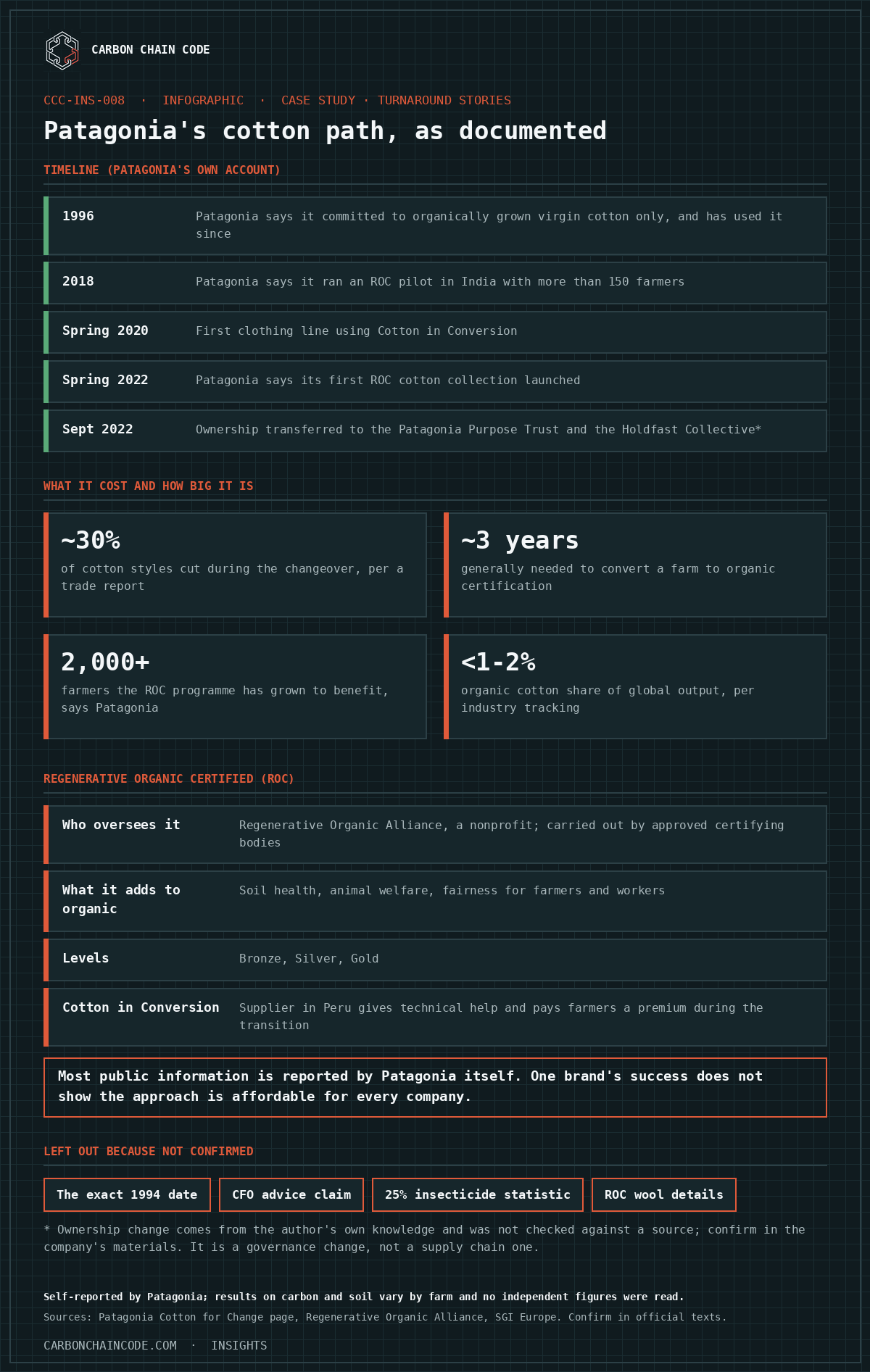
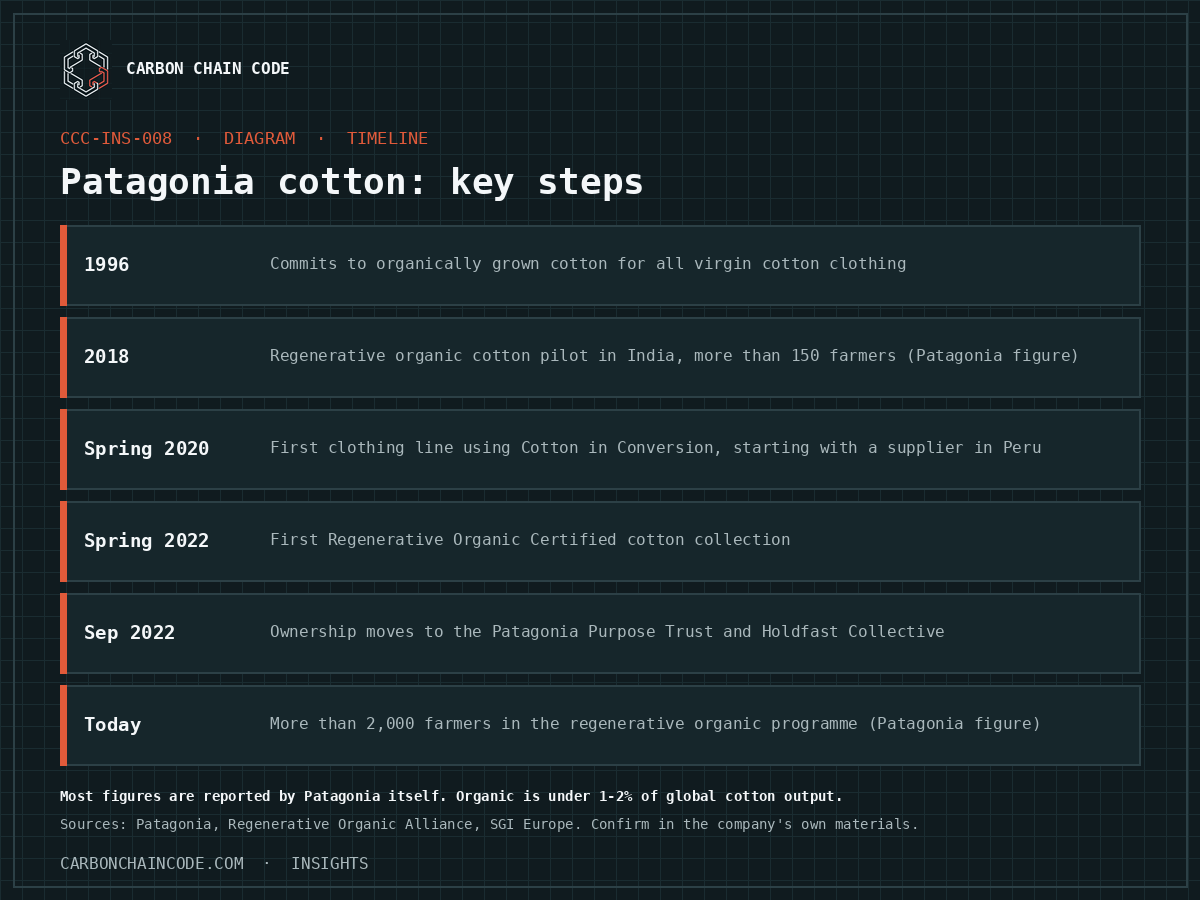
Patagonia says it began examining its cotton supply chain in the 1990s and found that conventional cotton farming caused harm to the environment. In 1996 it committed to using only virgin cotton grown without synthetic pesticides, herbicides or GMO seeds, and says that all its virgin cotton products have used organic cotton since then. Patagonia's own pages cite US cotton pesticide use peaking at nearly 86 million pounds in the 1990s.
Three details often repeated about this decision are not in the sources I could read, so I have left them out: the exact 1994 date of the decision, the claim that it was made against the advice of the CFO, and the statistic that cotton uses about 25% of the world's insecticides on 2.5% of farmland. That statistic is widely quoted, but I could not trace it to a primary source.
The transition did cost the company something. A trade report on the 30-year anniversary says that about 30% of cotton styles were cut during the changeover and that the line recovered through new fabric development. Organic cotton remains small globally: industry tracking generally puts it at under 1–2% of global cotton output.
Why Farmers Need Time
Illustrative summary
Converting a farm to organic certification generally takes about three years, during which the farmer bears organic costs without being able to sell at the organic price. Patagonia responded with its Cotton in Conversion programme. It began with a supplier in Peru that provides technical help and pays farmers a premium, and the first clothing line using it launched in Spring 2020.
Regenerative Organic Certified Cotton
Regenerative Organic Certified (ROC) is a certification overseen by the nonprofit Regenerative Organic Alliance and carried out by approved certifying bodies. It builds on organic farming and adds requirements in three areas: soil health, animal welfare and fairness for farmers and workers. It has three levels: Bronze, Silver and Gold.
Patagonia says it ran a pilot in India in 2018 with more than 150 farmers, that the programme has since grown to benefit more than 2,000 farmers, and that it launched its first ROC cotton collection in Spring 2022. I could not confirm details of its ROC wool programme, or the countries often listed for it, so I do not repeat them here.
Other Supply Chain Steps
From my own knowledge, not from the sources above: Patagonia introduced fleece made from recycled plastic bottles in 1993, earlier than the 2000s date given in some retellings, and launched its Footprint Chronicles in 2007 to show customers where products were made. Check the company's current pages for how those programmes are described today.
The 2022 Ownership Change
In September 2022 Yvon Chouinard and his family transferred ownership of Patagonia to two entities: the Patagonia Purpose Trust, which holds the voting stock, and the Holdfast Collective, a nonprofit that receives the company's profits after reinvestment to fight the environmental crisis. This is a governance change, not a supply chain one, and the article does not claim it caused the sourcing decisions that came earlier.
A caution on case studies
Most of what is public about Patagonia's programmes is reported by Patagonia itself. A single brand's success shows what is possible for that brand, with its pricing power and customer base. It does not show that the same approach is affordable for every company or that regenerative practices deliver a given amount of carbon removal on every farm.
What a Supplier Can Take From This
The record points to one practical lesson: Patagonia could change its materials because it knew who grew and processed them and could work with them over several years. The conversion programmes pay farmers a premium and give technical help, which suggests that sustainable sourcing is a financing and relationship problem as much as a certification one.
Practical points for a supplier
Know your own upstream: which farms, ginners or mills supply each material you use, and keep that traceable.
When a brand asks you to change material or process, ask what support it offers: premium, volume commitments, technical help and a transition period.
Check which certification a claim rests on, and what it covers. Organic, regenerative organic and recycled content are different claims with different evidence.
Keep certificates and transaction records for each claim, since the brand's marketing will rely on them.
Treat a brand's published case study as its account of its own results, and ask for the underlying data before relying on a number.
Frequently Asked Questions
When did Patagonia switch to organic cotton?
Patagonia says it committed in 1996 to using only organically grown virgin cotton, and that its virgin cotton products have used organic cotton since.
What is Regenerative Organic Certified?
A certification overseen by the Regenerative Organic Alliance that adds soil health, animal welfare and farmworker fairness requirements to organic farming. It has Bronze, Silver and Gold levels.
Is organic cotton common?
No. Industry tracking generally estimates it at under 1–2% of global cotton output.
Does this prove regenerative agriculture works at scale?
No. It shows one brand's programme and its self-reported progress. Results on carbon and soil vary by farm, and the sources I read did not give independent figures for them.
References
Patagonia, Cotton for Change page (organic cotton, Cotton in Conversion and Regenerative Organic Certified cotton). Regenerative Organic Alliance, regenorganic.org. SGI Europe, Patagonia: organic cotton 30 years on. The recycled polyester, Footprint Chronicles and 2022 ownership details come from my own knowledge and were not checked against a source for this article; confirm them in the company's own materials.
Free tool · Sustainability Frisk
FREE TOOL FROM SUSTAINABILITY FRISK
The Carbon Footprint Calculator walks you through Scope 1 and Scope 2 from energy records to a per-unit figure you can share with customers.
Need a CSRD gap analysis or hands-on implementation? Sustainability Frisk can help. www.sustainability-frisk.com
A US class action over H&M's sustainability scorecards ended without a ruling, but it sits inside a real shift in how environmental claims are policed. Here is what was alleged, what is confirmed, and what it means for supplier data.
How software that detected emissions tests led to the biggest emissions fraud case in the car industry, what it cost Volkswagen, and what it does and does not tell us about verifying environmental data.
 Carbon Chain Code