The Tier 1 Squeeze: Who Pays for Sustainability Requirements?
Brands ask factories for more certificates and data. What the evidence says about who pays, where purchasing practices are improving, and what the EU due diligence law actually requires.
By Hufsa8 October 20266 min read
Factories that supply brands are asked for more every year: certificates, audits, emissions data, chemical records. The question is who pays. The earlier version of this article answered with survey figures (71% of suppliers reporting more requirements, 18% receiving extra pay) that I could not verify, so I removed them. The evidence I could confirm shows a mixed picture: brands' purchasing practices are improving in some respects, while support for the cost of climate and compliance work is thin.
What the Evidence Shows
Finding
Source
Reading
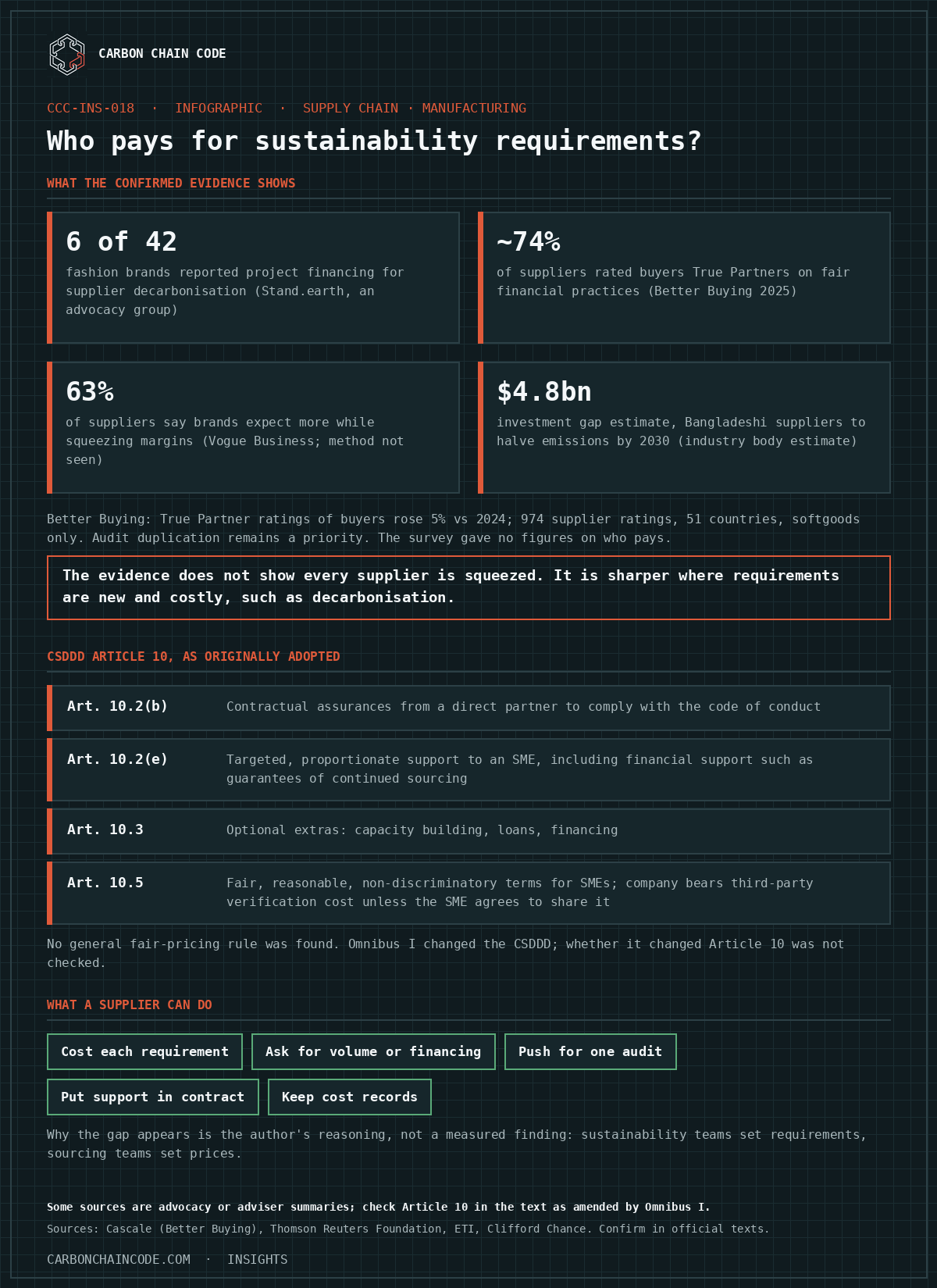
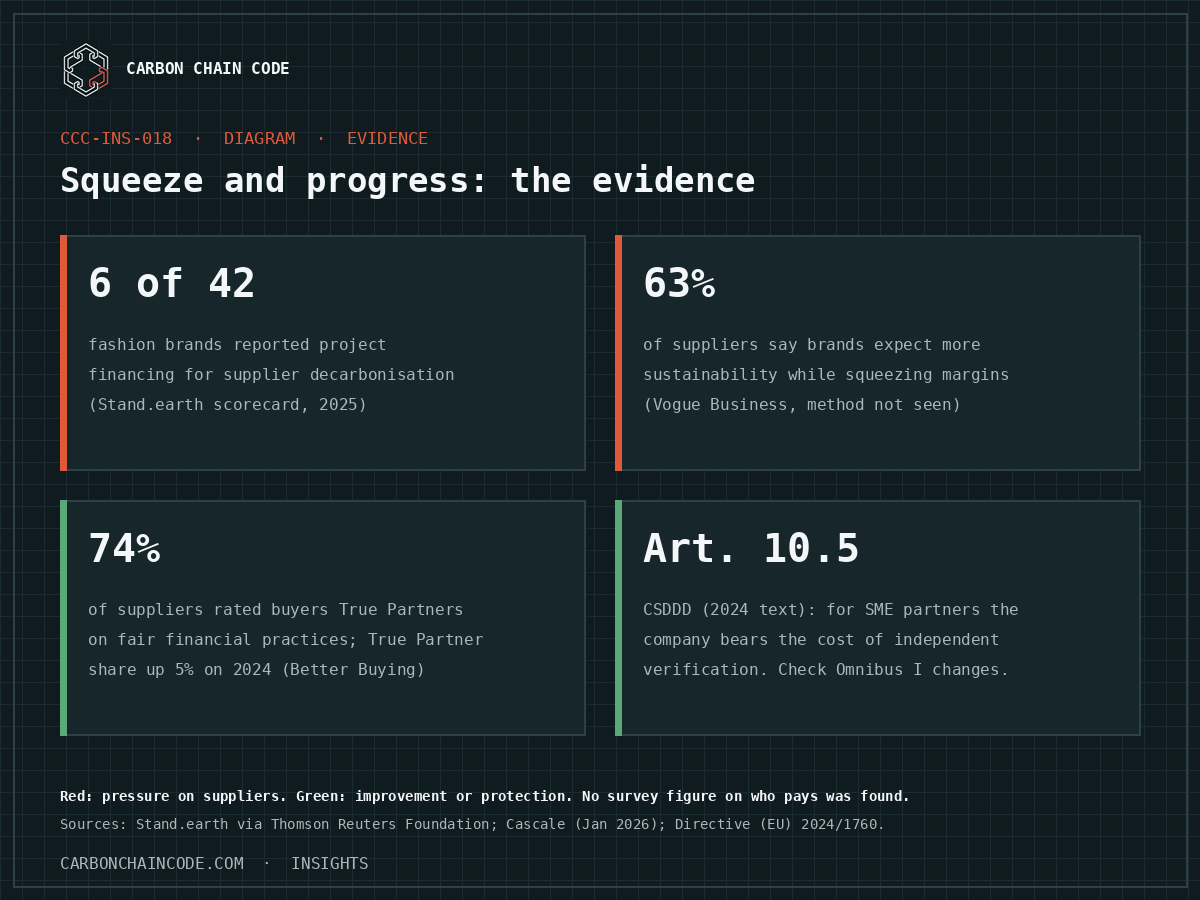
True Partner ratings of buyers rose 5% compared with 2024. Nearly 74% of suppliers rated buyers True Partners on fair financial practices. Audit duplication remains a priority
Better Buying Snapshot Survey 2025, published 30 January 2026: 974 supplier ratings from 51 countries, softgoods only
Purchasing practices are improving, and suppliers still want fewer duplicate audits
Only 6 of 42 fashion brands reported project financing for supplier decarbonisation. About half offered some support, mostly assessments, audits or small pilots
Stand.earth fashion scorecard, 2025, via Thomson Reuters Foundation
Few brands fund the supplier changes behind their climate targets. Stand.earth is an advocacy group
63% of suppliers say brands expect more sustainability while squeezing margins
Vogue Business survey, quoted on a Better Buying webinar page
Cost pressure is widely felt. I could not see the method
A $4.8 billion investment gap for Bangladeshi suppliers to halve emissions by 2030
Apparel Impact Institute estimate, as reported by the Thomson Reuters Foundation
An estimate by an industry body, not a measurement
Taken together, these do not show that every supplier is squeezed. Buyers rate better on fair payment and planning than before, according to suppliers who answered the Better Buying survey. The squeeze is sharper where the requirement is new and costly, such as decarbonisation, and where support is not part of the commercial terms. The Better Buying survey did not report figures on who pays for sustainability requirements, so I cannot say how often suppliers carry that cost. The earlier cost range of $25,000 to $40,000 a year for certifications also had no source, and I removed it.
Why the Gap Appears
Illustrative summary
A brand's sustainability team sets requirements, while sourcing and merchandising teams set prices and are judged on cost per unit. Unless there is a mechanism that carries the cost of a requirement into the purchase terms, the requirement arrives without payment. This is my reasoning about how procurement is organised, not a measured finding.
There is also a data quality risk. If a supplier does the minimum to pass an audit or complete a questionnaire, the data it gives will be coarse, for example annual energy totals instead of monthly records. That makes it less useful to a brand that needs primary data for its own reporting. This too is a reasoned argument, and I have no figures on how common it is.
Supplier Finance
Some brands link supply chain finance to supplier performance, offering cheaper financing to suppliers that meet sustainability criteria. The earlier version named Patagonia, H&M Group and Gap as running such programmes. I could not confirm this, so I removed the names. If a customer offers financing, check the terms: who provides it, which suppliers qualify, whether the rate is tied to a performance measure, and whether the discount is guaranteed on every order.
What the EU Due Diligence Law Says
The earlier version said Article 7 of the CSDDD requires fair pricing so that suppliers can meet the standards imposed on them. That is not what I found. In the original text of the directive (Directive (EU) 2024/1760), the prevention measures are in Article 10, and they include:
CSDDD Article 10, as originally adopted
Seeking contractual assurances from a direct business partner that it will comply with the company's code of conduct (Article 10.2(b)).
Targeted and proportionate support to an SME business partner, which can include financial support such as guarantees of continued sourcing where compliance would jeopardise the SME's viability (Article 10.2(e)).
Optional extra measures such as capacity building, loans or financing (Article 10.3).
For SME partners, terms must be fair, reasonable and non-discriminatory, and the company bears the cost of independent third-party verification (Article 10.5), unless the SME agrees to share it.
I did not find a general rule requiring "fair pricing". Recitals encourage responsible purchasing practices, and one recital mentions large food processors and retailers. Omnibus I has since changed the CSDDD: it now covers EU companies with more than 5,000 employees and more than €1.5 billion in turnover, with companies complying from 26 July 2029, and it limits information requests to smaller partners. I did not check whether Omnibus I changed the wording of Article 10, so check the consolidated text before quoting the numbers above.
What a supplier can do
Treat compliance costs as a commercial item. List certificates, audit fees, data systems and staff time for each customer, and raise the total in negotiations before the order is placed. If the customer is in CSDDD scope and you are an SME, the verification cost provision may be relevant to the conversation, subject to the final text.
Steps
Cost each customer requirement as a separate line: certification, audit, data, staff time.
Ask for volume commitments, price adjustments, financing or shared cost before you invest.
Push for one accepted audit instead of several duplicate ones. Audit duplication is a recurring supplier complaint in the Better Buying survey.
Put any agreed support in the contract or purchase terms, not in an email.
Keep records of the cost, so that you can show a customer or a regulator what compliance requires.
Invest first in measurement that cuts your own costs, such as energy monitoring.
Frequently Asked Questions
Are brands paying suppliers more for sustainability requirements?
The evidence I found shows limited financing: only 6 of 42 brands reported project financing for supplier decarbonisation in a 2025 scorecard. I could not find reliable figures on how often suppliers are paid more through prices.
Are purchasing practices getting better?
In one survey, yes. The Better Buying Snapshot Survey 2025 found the share of buyers rated True Partners rose 5% compared with 2024, and nearly 74% of suppliers rated buyers True Partners on fair financial practices.
Does the CSDDD require brands to pay suppliers more?
I did not find a general pricing requirement. The original text requires support for SME partners where compliance would threaten their viability, and says the company bears the cost of independent verification for SMEs. Check the text as amended by Omnibus I.
Should a factory absorb these costs?
I would not do it silently. Record the costs and raise them in negotiations, since you cannot recover a cost that no one has seen.
References
Cascale, Responsible Purchasing Practices Improving in Consumer Goods Supply Chains (30 January 2026), on the Better Buying Snapshot Survey 2025. Thomson Reuters Foundation (Context), Fashion brands drag feet on their green promises (30 June 2025), on Stand.earth's scorecard and the Apparel Impact Institute estimate. Innovation Forum, Better Buying 2025 insights, for the Vogue Business figure. Ethical Trading Initiative, Purchasing practices and European legislation, quoting Directive (EU) 2024/1760. Clifford Chance, Omnibus I summary (February 2026). Some sources are advocacy or adviser summaries; confirm each in the original.
Free tool · Sustainability Frisk
FREE TOOL FROM SUSTAINABILITY FRISK
The Carbon Footprint Calculator walks you through Scope 1 and Scope 2 from energy records to a per-unit figure you can share with customers.
Need a CSRD gap analysis or hands-on implementation? Sustainability Frisk can help. www.sustainability-frisk.com
Most brands estimate purchased-goods emissions from spend and averages. What that does to the numbers, what the CSRD and SBTi actually require, and what a supplier can provide.
The evidence on green premiums in B2B textile sourcing is thin and points to costs falling on suppliers. Here is what I could confirm, what I could not, and where a supplier's data does have a price.
 Carbon Chain Code