Do Buyers Pay More for Sustainable Suppliers? The Evidence
The evidence on green premiums in B2B textile sourcing is thin and points to costs falling on suppliers. Here is what I could confirm, what I could not, and where a supplier's data does have a price.
By Hufsa8 October 20266 min read
Does a supplier earn a higher price for lower emissions, certified materials or better data? The honest answer from the evidence I could find is: not reliably, and the cost of meeting brands' requirements often falls on the supplier. There is little hard data on B2B premiums, so this article sets out what is documented and marks where I cannot back a claim. The earlier version quoted a specific supplier survey figure that I could not verify, and it said CBAM covers textiles, which is wrong, so I removed both.
What the Evidence Shows
Finding
Source
What it means
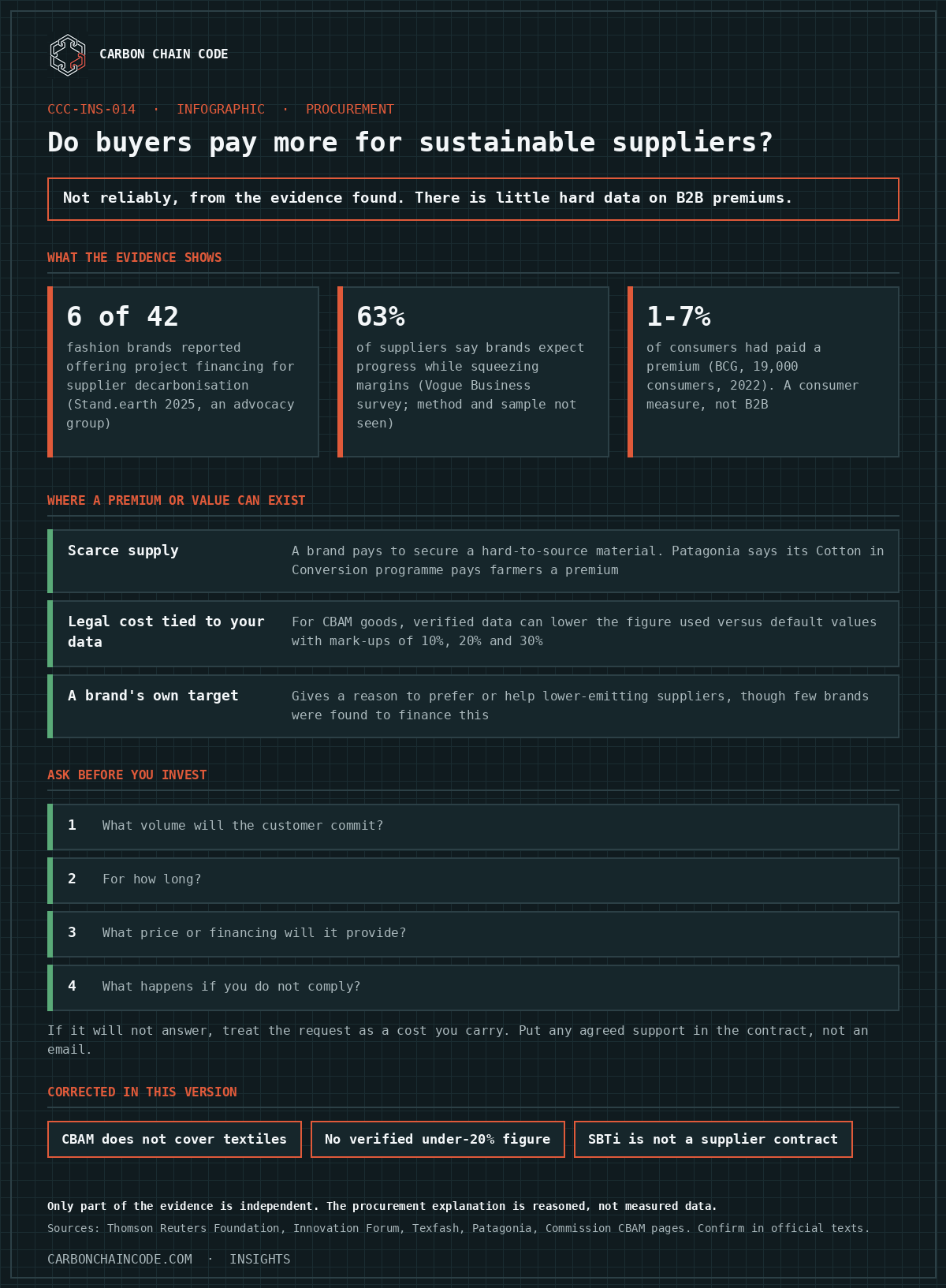
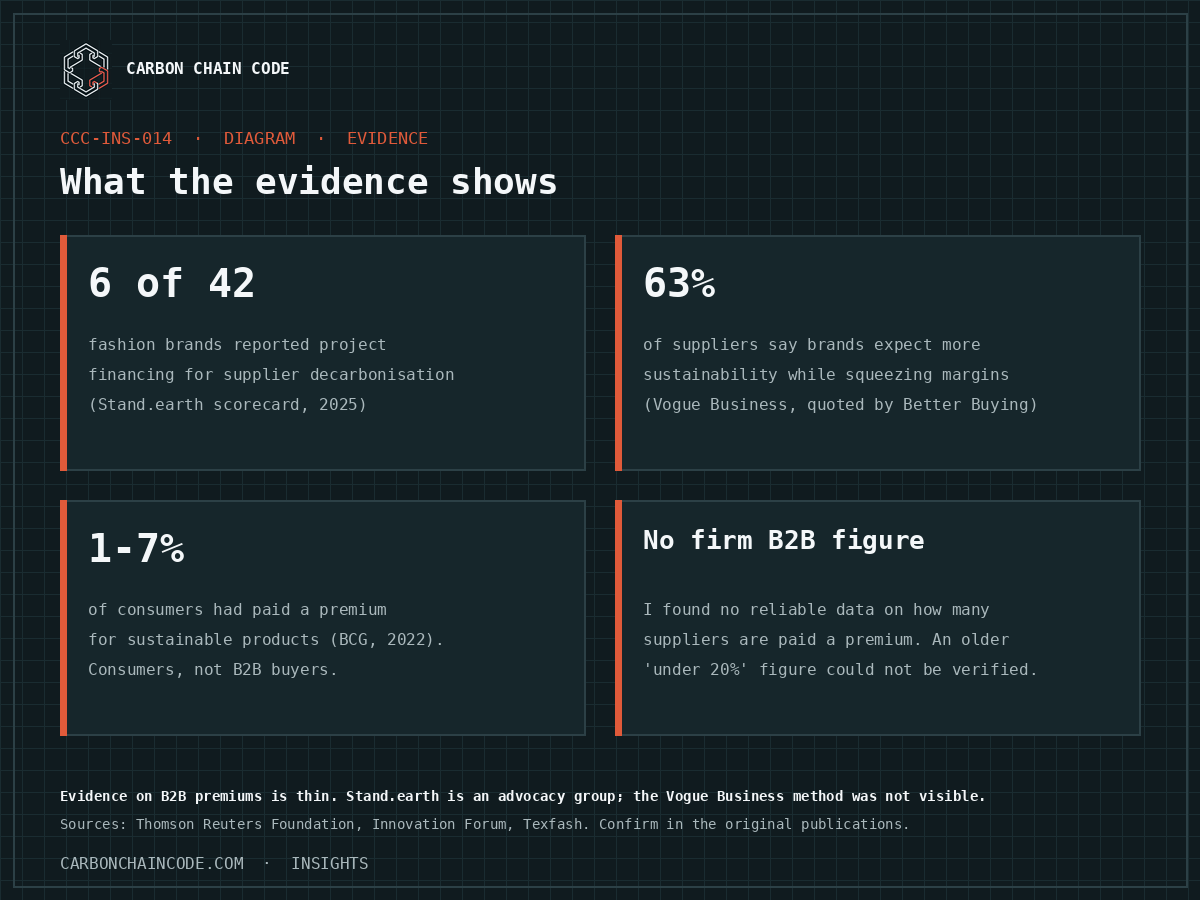
Only 6 of 42 fashion brands reported offering project financing for suppliers' decarbonisation. About half offered some support, mostly assessments, audits or small pilots
Brands set targets, but few fund the supplier changes behind them. Stand.earth is an advocacy group
63% of suppliers say brands expect them to advance sustainability while continuing to squeeze margins
Vogue Business survey, quoted on a Better Buying webinar page
Cost pressure is common; I could not see the survey method or sample
Between 1% and 7% of consumers had paid a premium for sustainable products
BCG survey of 19,000 consumers in eight countries, 2022
Consumer demand for a premium is limited. It is not a B2B measure
None of these directly measures how many B2B buyers pay a price premium. The original version of this article quoted the Better Buying Partnership as showing that fewer than 20% of suppliers received compensation for sustainability requirements in 2022 to 2025. I could not find that figure. Better Buying is now run under Cascale, and I could not read its 2025 findings, so I do not repeat any number from it.
Why Commitments Do Not Always Become Prices
Illustrative summary
A brand's sustainability team sets commitments, while sourcing teams are judged on cost per unit. Unless there is a mechanism that turns a commitment into purchase terms, such as a price premium, preferred supplier status or financing, the requirement can arrive without any payment attached. This is a reasoned account of how procurement is organised. I do not have measured data on how often it happens.
Where a Premium or Value Does Exist
Three situations in which a supplier's sustainability work has a price or a clear commercial value:
Where it shows up
Scarce supply: when a brand needs a material that is hard to source and pays to secure it. Patagonia's Cotton in Conversion programme, for example, pays farmers a premium and gives technical support, according to the company.
A legal cost that depends on supplier data: for goods covered by CBAM, the importer pays for embedded emissions, and verified data can lower the figure used compared with default values that carry mark-ups of 10%, 20% and 30%.
A brand's own target: a brand with a climate target has a reason to prefer lower-emitting suppliers or to help them, though the evidence I found shows few brands finance this.
On CBAM, the original said that some textiles and leatherwear are covered. They are not. The covered goods are iron and steel, aluminium, cement, fertilisers, electricity and hydrogen, so for a textile supplier the CBAM route is indirect at most. For a textile or leather supplier, the practical value of measured data is that customers and the CSRD ask for it, not that CBAM taxes the product.
On SBTi, the original said that brands are "contractually committed" to improving supply chain intensity. A validated target is the brand's own public commitment, not a contract with suppliers. The original also said that this influences preferred supplier programmes at several major brands, and I found no source for that, so it is out.
What a Supplier Should Do With This
I would not invest in sustainability mainly to win a premium, because the evidence for one is weak. Invest where the saving is yours: energy efficiency that lowers your own bills, and measured emissions data that customers increasingly ask for. Where a customer wants you to do more, ask what it will pay or finance, and get the answer in writing.
Ask before you invest
If a customer asks for a certification or a data system, ask four questions: what volume will it commit, for how long, what price or financing will it provide, and what happens if you do not comply. If it will not answer, treat the request as a cost you carry.
Steps
Cost out each customer requirement: certificate fees, audits, staff time, data systems.
Prioritise investments that pay back through your own operating costs.
Ask customers about volume commitments, premiums, financing or shared costs before you invest.
Put any agreed support in the contract or purchase terms, not in an email.
Measure emissions per product so that you can show customers a number, not a promise.
Frequently Asked Questions
Do buyers pay a premium for sustainable suppliers?
I could not find solid data that they usually do. What I found points to costs falling on suppliers: the 2025 Stand.earth scorecard found only 6 of 42 brands reporting project financing for supplier decarbonisation.
Does CBAM cover textiles?
No. It covers iron and steel, aluminium, cement, fertilisers, electricity and hydrogen. Check the covered list before assuming that a product is in or out.
Is there data on how many suppliers are compensated?
I could not find a reliable figure. The earlier figure of under 20% could not be verified.
Do consumers pay more for sustainable products?
A 2022 BCG survey found that 1–7% of consumers had paid a premium. That measures consumers, not business buyers.
References
Thomson Reuters Foundation (Context), Fashion brands drag feet on their green promises (30 June 2025), reporting Stand.earth's 2025 fashion scorecard. Innovation Forum, Better Buying 2025 insights (for the Vogue Business figure). Texfash, report on BCG's 2022 consumer survey. Patagonia, Cotton for Change page. Commission CBAM pages and Implementing Regulation (EU) 2025/2621. Only part of the evidence is independent; confirm each figure in the original publication.
Free tool · Sustainability Frisk
FREE TOOL FROM SUSTAINABILITY FRISK
The Carbon Footprint Calculator walks you through Scope 1 and Scope 2 from energy records to a per-unit figure you can share with customers.
Need a CSRD gap analysis or hands-on implementation? Sustainability Frisk can help. www.sustainability-frisk.com
Most brands estimate purchased-goods emissions from spend and averages. What that does to the numbers, what the CSRD and SBTi actually require, and what a supplier can provide.
Textiles are not covered by the EU Carbon Border Adjustment Mechanism, and they are not in the Commission's current extension proposal. This guide explains what CBAM does cover, how its costs are calculated, and what a Pakistani textile manufacturer should prepare.
 Carbon Chain Code