Scope 3 Category 1: Why Supplier Data Is Still Mostly Estimated
Most brands estimate purchased-goods emissions from spend and averages. What that does to the numbers, what the CSRD and SBTi actually require, and what a supplier can provide.
By Hufsa8 October 20266 min read
Scope 3 Category 1 covers the emissions from purchased goods and services, and for manufacturers, retailers and brands it is usually the largest Scope 3 category. Most companies do not measure it at the supplier level. They estimate it. An earlier version of this article stated that 87% of Category 1 emissions are estimated. I could not find a source for that number, so I removed it and use a figure I could source instead.
What the data shows
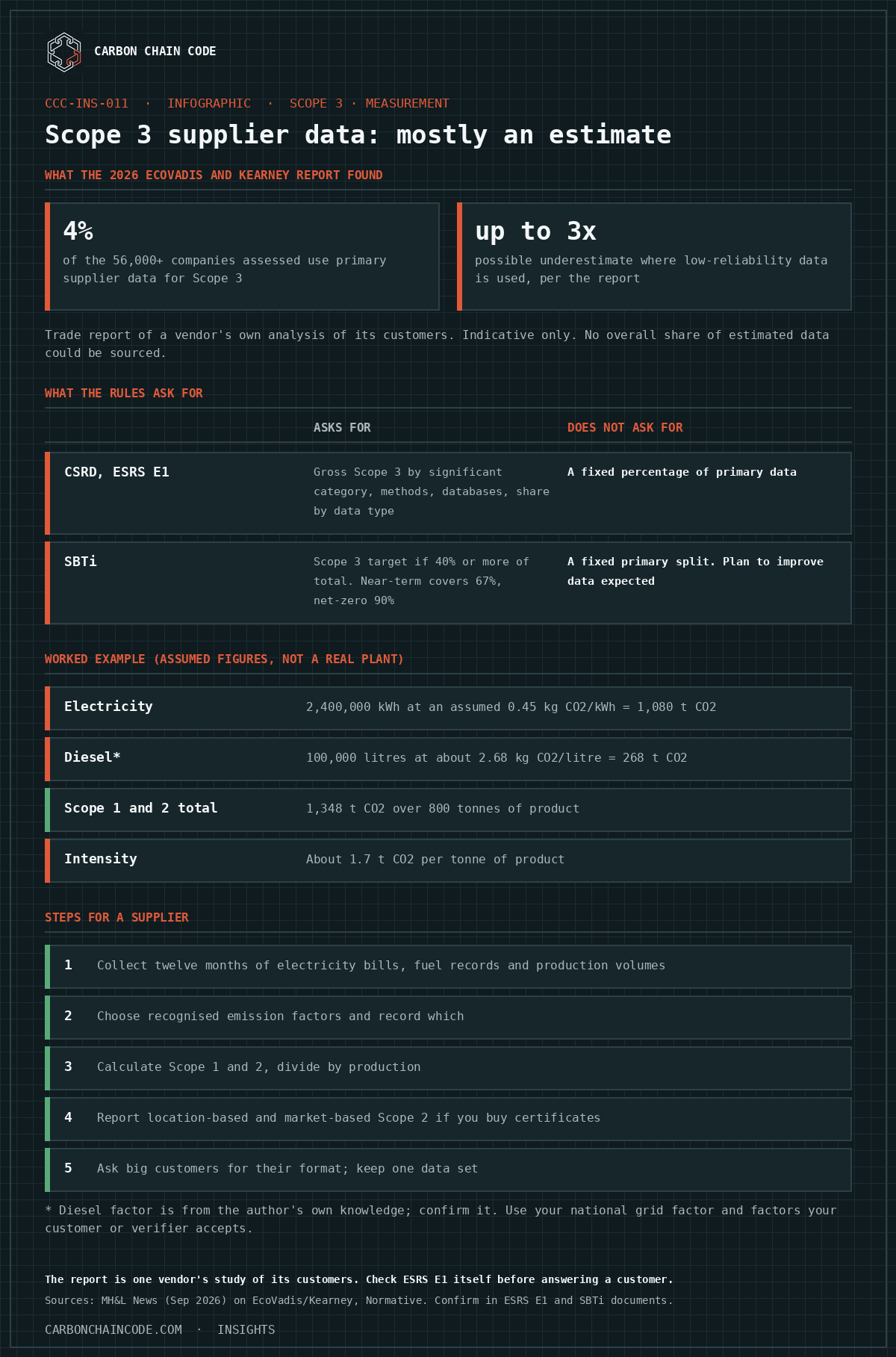
The 2026 Carbon Action Report by EcoVadis and Kearney, covering more than 56,000 companies assessed by EcoVadis, found that only 4% use primary supplier data to calculate their Scope 3 footprint. Most rely on industry averages or do not report Scope 3 at all. The report says companies relying on low-reliability data may be underestimating their true Scope 3 footprint by up to three times. This comes from a trade report of the study, and the study is a vendor's own analysis of its customers, so treat it as indicative.
How Category 1 Is Usually Estimated
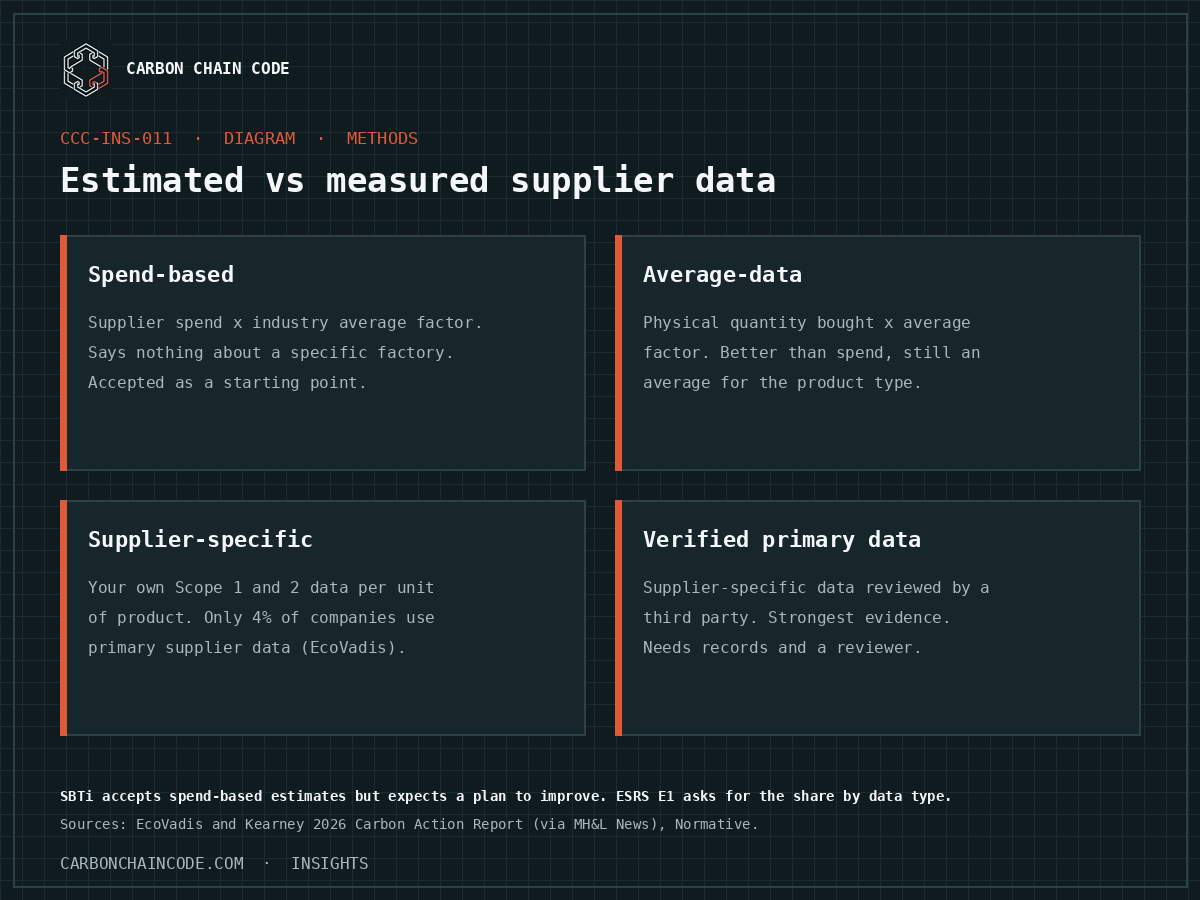
The common method is spend-based: a company multiplies what it paid a supplier by an average emissions factor for that industry and region, taken from a database such as ecoinvent, EXIOBASE or the US EPA's USEEIO. The GHG Protocol allows this when better data is not available. It says nothing about a particular factory. A mill that has installed solar panels or changed its boiler looks the same in a spend-based model as one that has not, because the model uses the average for the sector.
That works in both directions. A supplier that is cleaner than average is credited with emissions it did not cause, and a dirtier one is credited with less than it emitted. The study above suggests the net effect is underestimation. I do not give a percentage range for the gap, because the "40–70%" figure in the earlier version had no source.
What the Rules Actually Require
Illustrative summary
Framework
What it asks for
What it does not ask for
CSRD, ESRS E1
Gross Scope 3 emissions by significant category, the methods and emission factor databases used, and the share of each category based on each type of data
A fixed percentage of primary data
SBTi
A Scope 3 target when Scope 3 is 40% or more of total emissions. Near-term targets cover at least 67% of Scope 3, and net-zero targets at least 90%
A fixed primary/secondary split. Spend-based estimates are accepted, but reviewers expect a plan to move to better data
The earlier version said that SBTi and the ESRS require primary data from suppliers. That is not what the sources I read say. They ask companies to disclose how the data was made and to improve it. The classification of what counts as primary data differs between sources, so check the ESRS E1 text itself before answering a customer.
Note that Omnibus I narrowed the CSRD to companies with more than 1,000 employees and more than €450 million in turnover, and the value chain cap limits what such companies can ask of suppliers with 1,000 or fewer employees for CSRD purposes. Many suppliers will see data requests come through customer programmes rather than directly from the law.
What Primary Data Means for a Factory
For a supplier, the starting point is the facility's own emissions. Scope 1 is fuel burned on site, such as natural gas, diesel or coal. Scope 2 is purchased electricity, which can be calculated by the location-based method, using the average grid factor, or the market-based method, using contractual instruments. Express the total per unit of product, for example per tonne or per 1,000 metres of fabric. That intensity is what a customer can use in place of an average. It is facility-level data, not a full product footprint, so a customer will also need material and transport data.
Input (assumed figures)
Value
Emissions
Electricity purchased
2,400,000 kWh at an assumed 0.45 kg CO₂/kWh
1,080 t CO₂
Diesel burned on site
100,000 litres at about 2.68 kg CO₂/litre
268 t CO₂
Total Scope 1 and 2
1,348 t CO₂
Production for the year
800 tonnes of product
Intensity
1,348 ÷ 800
About 1.7 t CO₂ per tonne
These figures are assumptions to show the arithmetic. Use your national grid factor and the fuel factors your customer or verifier accepts.
Steps for a supplier
Collect twelve months of electricity bills, fuel purchase records and production volumes by facility.
Choose emission factors from a recognised source and write down which, so that a reader can repeat the calculation.
Calculate Scope 1 and Scope 2 and divide by production to get an intensity.
Report both location-based and market-based Scope 2 if you buy renewable certificates.
Ask your largest customers which format they want, and keep a single data set that answers all of them.
Have the figure reviewed or verified if a customer or the law asks for assurance.
Frequently Asked Questions
What share of Scope 3 data is estimated?
I could not find a reliable overall figure. The EcoVadis and Kearney 2026 report found that only 4% of the companies it assessed use primary supplier data. It is one vendor's study, so read it as an indication.
Does the SBTi require primary supplier data?
Not as a fixed share, according to the sources I read. It accepts spend-based estimates, but expects a plan to improve data quality.
Does the CSRD require primary data?
ESRS E1 requires disclosure of the share of each category that relies on each type of data. It does not set a minimum primary share.
Can a supplier's data lower a customer's Scope 3 number?
It can change it, in either direction. If your emissions are lower than the sector average, measured data can reduce the figure attributed to you. It can also raise it if you are above average.
References
MH&L News, Supplier Data Could Underestimate Emissions by Up to 3x (21 September 2026), reporting the 2026 Carbon Action Report by EcoVadis and Kearney. Normative, Scope 3 Reporting: CSRD and SBTi Requirements. The diesel emission factor is from my own knowledge; confirm it. Sources are adviser and trade summaries; confirm requirements in ESRS E1 and the SBTi documents.
Free tool · Sustainability Frisk
Want to calculate your factory carbon footprint?
Use the free Carbon Footprint Calculator — built for manufacturers, covers Scope 1 and 2.
Need a CSRD gap analysis or hands-on implementation? Sustainability Frisk can help. www.sustainability-frisk.com
Most brands still estimate the emissions of their factories from spend data. This guide explains why that is changing, what brands will ask suppliers for, and what a factory can measure now from records it already has.
How the EU ETS allowance price feeds into CBAM certificate prices, why price forecasts should be treated with caution, and what suppliers can do with the number.
 Carbon Chain Code