CBAM in 2026: What Is Known So Far in the Definitive Year
The definitive phase began on 1 January 2026, but the first declaration is not due until September 2027. What the 2026 price, the early registry figures and the downstream proposal actually show.
By Hufsa8 October 20267 min read
The Carbon Border Adjustment Mechanism entered its definitive phase on 1 January 2026. It is tempting to read that as the year in which early compliance data show how the tax works, and an earlier version of this article did. That reading is wrong. Under the amended rules, the first annual CBAM declaration and certificate surrender are due on 30 September 2027, for 2026 imports, and certificate sales only start on 1 February 2027. So there is no payment data yet. This article sets out what is known, what is not, and what a supplier in a covered sector should do.
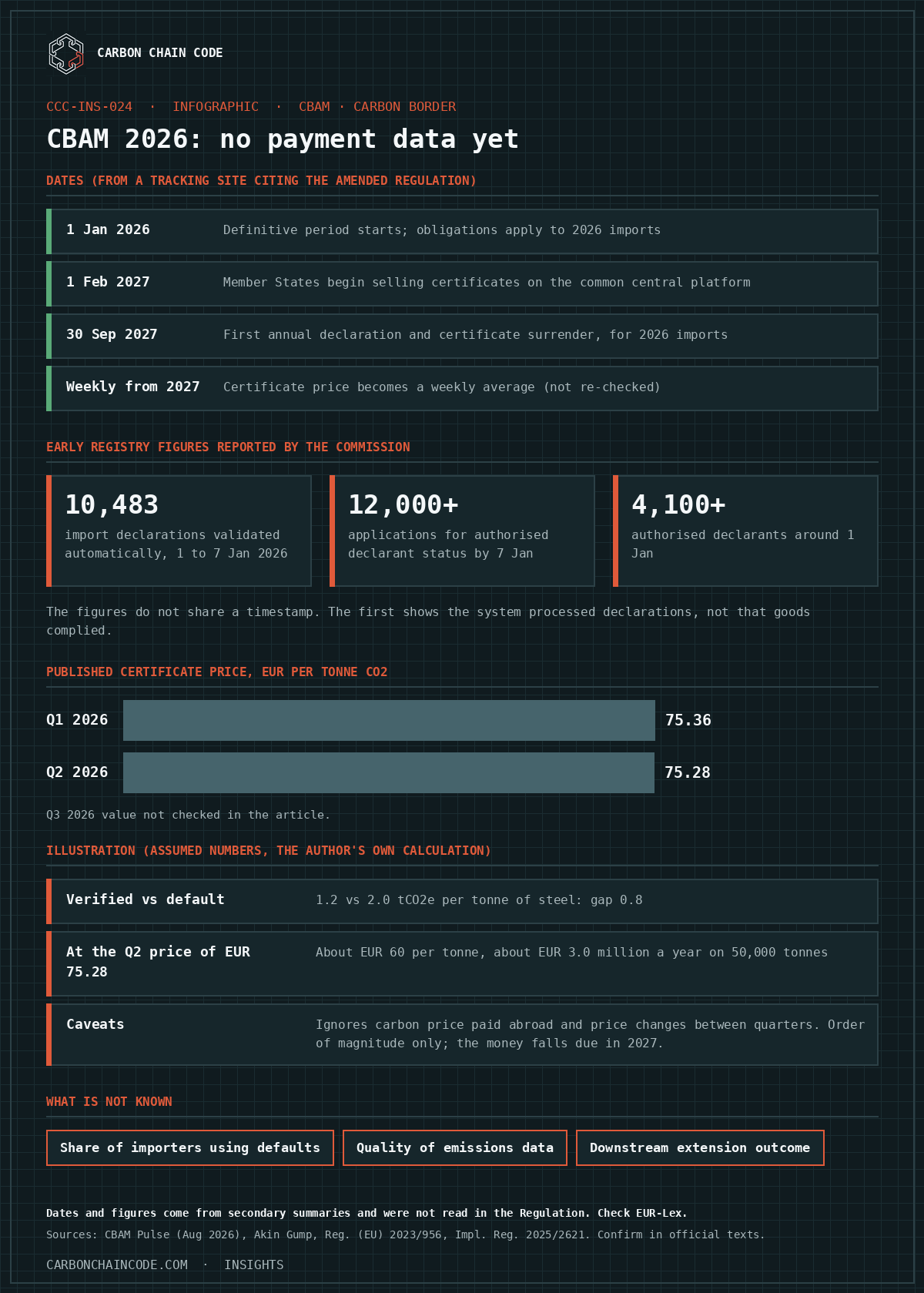
The Dates
Date
What happens
Basis
1 Jan 2026
Definitive period starts; obligations apply to 2026 imports
CBAM Regulation as amended
1 Feb 2027
Member States begin selling certificates on the common central platform
CBAM Regulation as amended
30 Sep 2027
First annual declaration and certificate surrender, for 2026 imports
CBAM Regulation as amended
Weekly from 2027
Certificate price becomes a weekly average of auction prices
Commission rules on pricing; I did not re-check this
These dates come from a CBAM tracking site that cites the amended Regulation, not from the Regulation itself, so check them on EUR-Lex. The earlier version of this article said importers had already filed annual declarations for 2024 in the first quarter of 2026. That is not the case: the transitional period ended with quarterly reports, and the first annual declaration is due in 2027.
What the Early Figures Show
Illustrative summary
The Commission reported that 10,483 import declarations containing CBAM goods were validated automatically between 1 and 7 January 2026. It also reported more than 12,000 applications for authorised declarant status by 7 January and more than 4,100 authorised declarants around 1 January. The two figures do not share a timestamp, and the first only shows that the system processed declarations, not that the goods complied. I found no published data on the quality of embedded emissions figures, the share of imports using default values, or abuse. The earlier version described patterns "in the Commission's preliminary compliance reporting", and I could not find such a report, so I removed that part.
The 2026 Price and What It Means
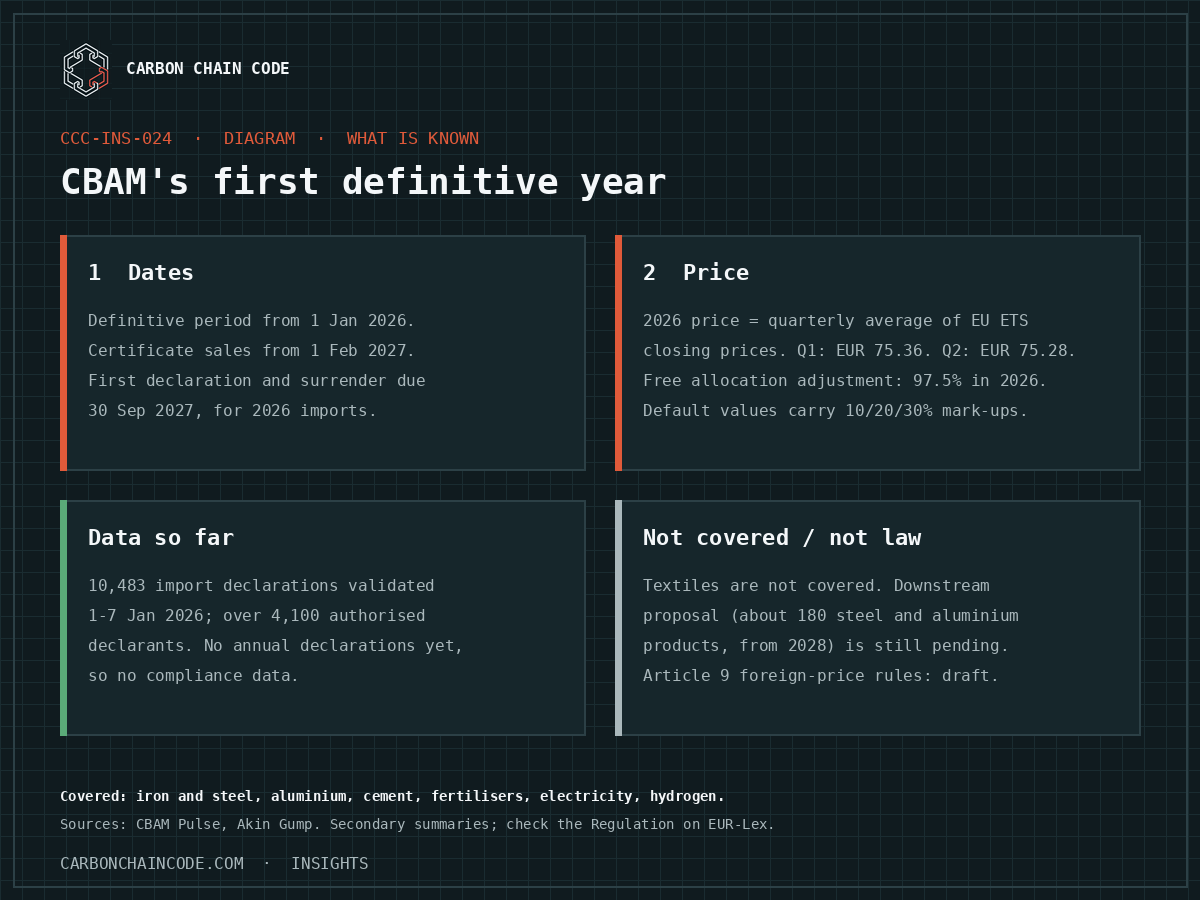
For 2026 emissions, the certificate price is the quarterly average of EU ETS closing prices for the quarter of importation. The Commission published €75.36 for the first quarter of 2026 and €75.28 for the second. I did not check the third-quarter value. The earlier version used €62, which was out of date and below the published prices.
The amount payable is reduced by a free-allocation adjustment, which is 97.5% in 2026 and is being phased out over time (my understanding is that it ends in 2034; check the Directive). The adjustment depends on EU benchmarks and does not depend on whether you use default or actual emissions, so the difference between the two routes is simple to estimate.
Default Values Versus Measured Data
For goods other than electricity, an importer can declare actual emissions or use the Commission's default values. Actual emissions need a CBAM-accredited verifier applying reasonable assurance, and site visits are the baseline, although virtual visits or waivers are allowed under risk-based conditions. Default values carry mark-ups of 10%, 20% and 30% (Implementing Regulation (EU) 2025/2621, which I noted in earlier research, not re-read now). The earlier version said defaults are set at about the 90th percentile of global emissions intensity. I could not confirm that description, so I removed it.
Here is an illustration with assumed numbers. Suppose a steel producer has verified emissions of 1.2 tCO₂e per tonne and the applicable default is 2.0. The gap is 0.8 tCO₂e per tonne. At the Q2 2026 price of €75.28, that is about €60 per tonne of steel, and about €3.0 million a year on 50,000 tonnes. This is my calculation. It ignores any carbon price paid abroad, which can reduce the amount, and any difference in the price between quarters. Treat it as an order of magnitude, and note that the money falls due in 2027, not in 2026.
The reasoning that follows is mine, not sourced. For a large exporter, verification is likely to pay back when the gap to the default is large. For a small one with emissions near the default, using the default may be cheaper than verifying.
Authorisation and the 50-Tonne Threshold
The annual obligation falls on the authorised CBAM declarant, the EU importer. An exemption applies to importers whose cumulative covered imports stay under 50 tonnes in a calendar year, excluding electricity and hydrogen. If an importer crosses 50 tonnes, the whole year's covered imports count. One law-firm summary says the exemption leaves out about 90% of importers while keeping about 99% of embedded emissions in scope. The earlier version said supply of steel and aluminium was disrupted in early 2026 by slow national authorities. I could not source that, so I removed it.
Carbon Already Paid Abroad
Article 9 of the Regulation allows a reduction for a carbon price effectively paid in the country of origin, net of rebates, with independent certification. As of 6 August 2026, the detailed implementing rules were still in draft. The earlier version said the Commission had published a list of recognised foreign carbon pricing mechanisms with deduction rates, including partial deductions for Korea and China. I found no evidence of that list, so I removed it. In practice, an exporter would need to document the price actually paid and have it certified.
The Downstream Extension and Textiles
The covered goods are iron and steel, aluminium, cement, fertilisers, electricity and hydrogen. The Commission's proposal COM(2025) 989 would add about 180 downstream products with high steel or aluminium content, such as vehicles for transporting goods and household washing machines, from 2028, counting the embedded emissions of the steel or aluminium inputs only. The Council reached a general approach on 12 June 2026, the Parliament's environment committee adopted its position on 6 July 2026, and the plenary vote was pending at the time of the source I used. It is not law yet. The proposal also adds anti-circumvention rules.
The earlier version said the next expansion could cover organic chemicals and polymers, including synthetic textiles. I found no proposal that does this. Textiles and clothing are not covered by CBAM today, and I did not see them in the downstream proposal. For a garment maker, the practical exposure is indirect, through suppliers of steel or aluminium products such as machinery parts or packaging. That is my reading and not a finding.
What is known, and what is not
Known: the definitive phase started on 1 Jan 2026, the published 2026 prices were €75.36 (Q1) and €75.28 (Q2), certificates go on sale from 1 Feb 2027, and the first declaration is due on 30 Sep 2027. Not known: how many importers use default values, how good the emissions data are, and how the downstream extension will end.
If you export covered goods to the EU
Ask each EU importer whether it is an authorised declarant or under the 50-tonne threshold.
Compare your measured emissions per tonne with the applicable default value, including the mark-up.
Work out the gap in tonnes of CO₂e and multiply by the certificate price to see what verification could save.
Find out what a CBAM-accredited verifier would charge and when a site visit could happen.
Keep records of any carbon price paid in your country, in case the Article 9 rules are finalised.
Follow the downstream proposal if you make steel or aluminium-intensive products.
Frequently Asked Questions
Do I pay CBAM in 2026?
The obligation applies to 2026 imports, but certificates go on sale from 1 February 2027 and the first declaration and surrender are due on 30 September 2027. The cost is borne by the EU importer in law, though it may pass it on in contracts.
What was the certificate price in 2026?
The Commission published €75.36 for Q1 and €75.28 for Q2 2026, as quarterly averages of EU ETS closing prices.
Are textiles covered by CBAM?
No. The covered goods are iron and steel, aluminium, cement, fertilisers, electricity and hydrogen. I found no proposal that adds textiles.
Is the downstream extension law?
Not yet. It is proposal COM(2025) 989. The Council agreed its position on 12 June 2026, the Parliament committee voted on 6 July 2026, and the plenary was pending.
Do I have to use a verifier?
Only if you want to use actual emissions instead of the default values. Actual emissions need a CBAM-accredited verifier.
References
CBAM Pulse, The State of CBAM 2026: law, data and impact (August 2026), which I used for the dates, prices, early registry figures, the 50-tonne rule and the downstream procedure. Akin Gump, EU Carbon Border Adjustment Mechanism financial obligations commence amid proposed scope expansion to include new downstream products. Regulation (EU) 2023/956 as amended, and Implementing Regulation (EU) 2025/2621 on default values. Both secondary sources summarise the law, so check the Regulation on EUR-Lex. The calculation in this article is mine. I did not check the Q3 2026 certificate price.
Free tool · Sustainability Frisk
Want to estimate your CBAM certificate cost?
Use the free CBAM Certificate Cost Calculator — input your goods, emissions, and volume.
Need a CSRD gap analysis or hands-on implementation? Sustainability Frisk can help. www.sustainability-frisk.com
Textiles are not covered by the EU Carbon Border Adjustment Mechanism, and they are not in the Commission's current extension proposal. This guide explains what CBAM does cover, how its costs are calculated, and what a Pakistani textile manufacturer should prepare.
How the EU ETS allowance price feeds into CBAM certificate prices, why price forecasts should be treated with caution, and what suppliers can do with the number.
 Carbon Chain Code