 Carbon Chain Code
CCC-SUS-001Sustainability/ESG · Workbook
CSRD Data Request Workbook
Decode EU customer sustainability questionnaires and build one reusable, evidence-backed answer set. PDF guide + Excel workbook for manufacturers.
A double materiality assessment is not a survey. It is a structured process with defined outputs. Here is what each step requires, what the ESRS actually asks for, and where manufacturers most often get stuck.
A double materiality assessment (DMA) determines which sustainability topics a company must report on under the CSRD. It has two dimensions: impact materiality — how the company's activities affect people and the environment — and financial materiality — how sustainability issues affect the company's financial position. ESRS 1 (General Requirements) sets the methodology. Every CSRD reporter must complete a DMA before it can determine which ESRS standards apply to it.
Impact materiality asks: what harm or benefit does this company cause or contribute to? It covers the company's own operations and its upstream and downstream value chain. A manufacturer is required to consider impacts on workers in its factories, impacts from its suppliers' practices, and impacts from the use and disposal of its products. The assessment of impact materiality uses two dimensions: severity (scope, scale and irremediability of the impact) and likelihood (for potential impacts).
Financial materiality asks: what sustainability-related risks and opportunities could affect this company's revenues, costs, assets or financing? A manufacturer facing rising energy costs, physical climate risk to its facilities, or a customer base that is shifting to verified-sustainable sourcing is experiencing financially material sustainability issues. ESRS 2 requires disclosure of both dimensions for each topic assessed as material.
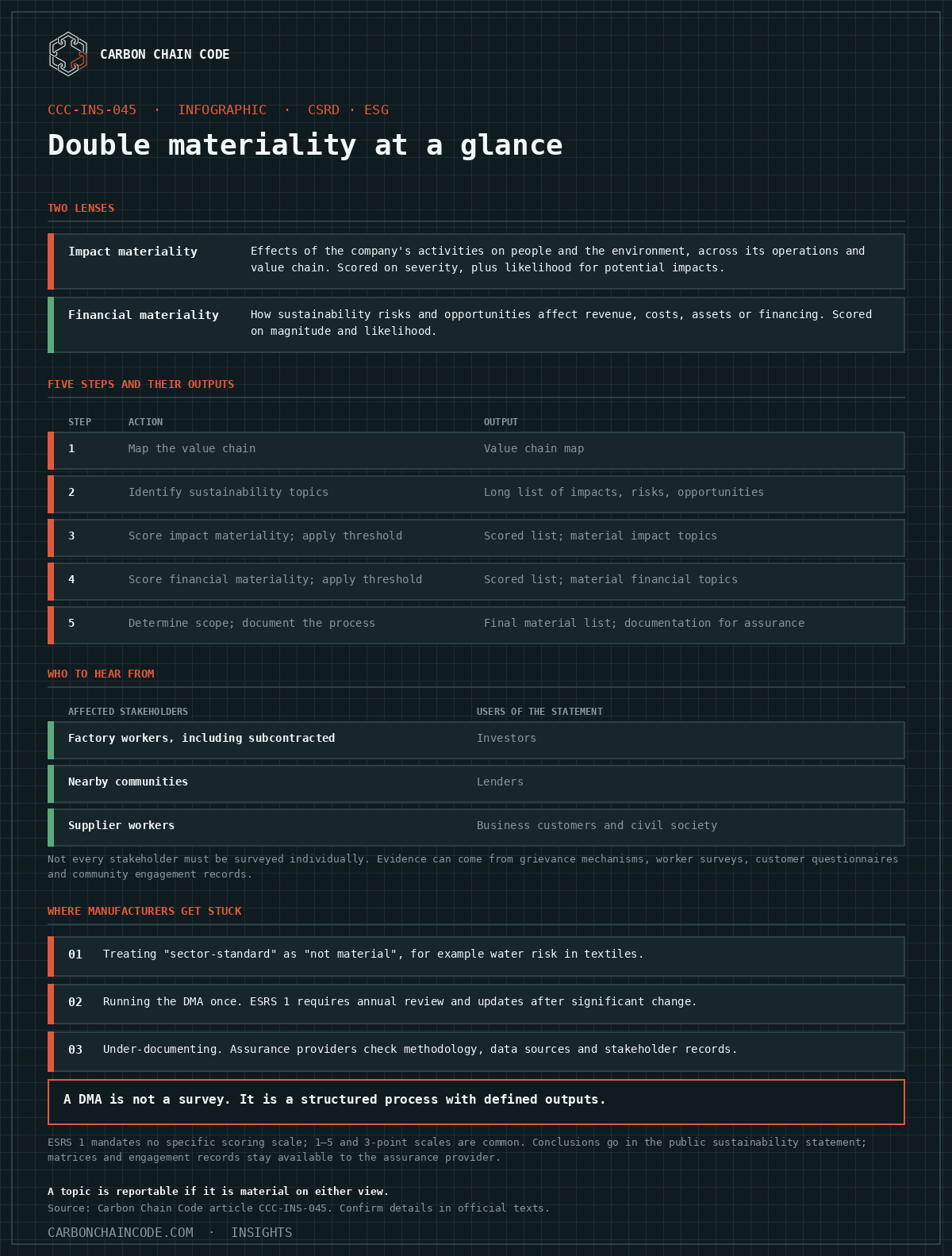
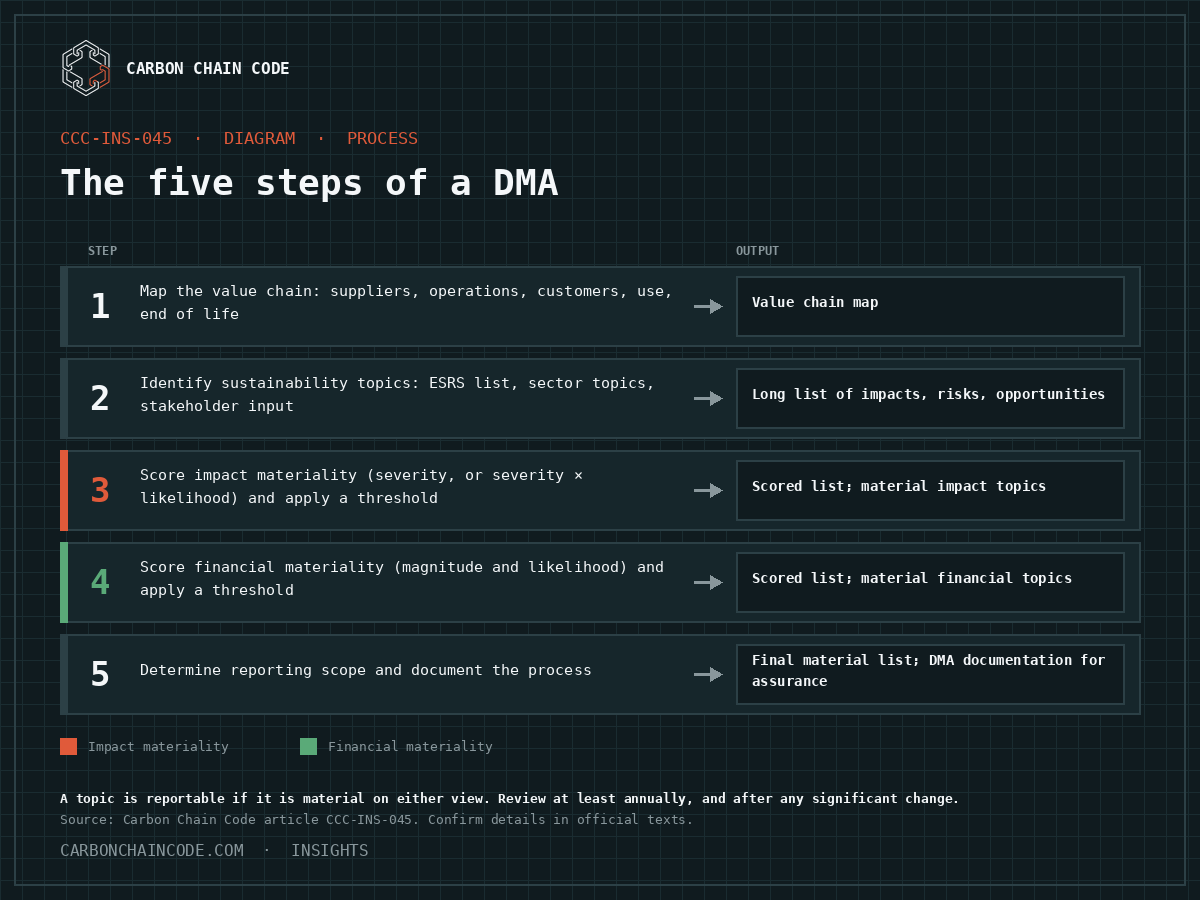
| Step | What you do | Output |
|---|---|---|
| 1. Map the value chain | Identify upstream suppliers (raw materials, inputs), own operations, and downstream (customers, use, end of life) | Value chain map with key actors and activities |
| 2. Identify sustainability topics | Use the ESRS list as a starting point; add sector-specific topics; conduct stakeholder engagement | Long list of potential impacts, risks and opportunities |
| 3. Score impact materiality | Rate each impact for severity (actual) or severity × likelihood (potential) on a scale; apply threshold to determine material topics | Scored list; material topics for impact materiality |
| 4. Score financial materiality | Rate each risk or opportunity for magnitude of financial effect and likelihood; apply threshold | Scored list; material topics for financial materiality |
| 5. Determine reporting scope | Any topic material on either dimension requires disclosure under the relevant ESRS; document the process and the conclusions | Final materiality list; reporting scope; DMA documentation for assurance |
ESRS 1 requires that the DMA process takes into account the views of affected stakeholders and users of the sustainability statement. For a manufacturer, affected stakeholders include workers (factory employees, including subcontracted workers), communities near production facilities, and suppliers' workers. Users of the statement include investors and lenders, business customers, and civil society. This does not mean every stakeholder must be individually surveyed. It means the process must be designed to capture their perspectives — through existing grievance mechanisms, worker surveys, customer sustainability questionnaires, and community engagement records.
Three recurring problems come up in DMA projects for manufacturers. First, confusing 'sector-standard' with 'not material': if every textile factory has water risk, that does not mean water is not material — it may be the most significant impact in the sector. Second, treating the DMA as a one-time exercise: ESRS 1 requires it to be reviewed and updated at least annually and when significant changes occur. Third, underdocumenting the process: the assurance provider will check not just the output (the material topic list) but the methodology, the data sources and the stakeholder engagement record.
ESRS 1 does not mandate a specific numerical scale. It requires that the methodology be consistent, documented and capable of distinguishing material from non-material topics. Many companies use a 1–5 scale for severity and likelihood; others use a 3-point scale. The assurance provider will check that the scale is applied consistently and that the thresholds are defensible.
The DMA conclusions — the list of material topics and the reasons — must be disclosed in the sustainability statement, which is public. The underlying scoring matrices and stakeholder engagement records do not need to be published but must be available to the assurance provider.
Omitting a material topic means the company does not report on it in the sustainability statement. If the omission is identified by the assurance provider, they will raise it as a finding — in limited assurance this may be flagged as a matter drawing attention or a qualification. If the omission is identified by regulators or third parties after publication, it is a potential compliance failure. Getting the DMA right — and documenting the process — is more important than the specific topic list.
Free tool · Sustainability Frisk
Need help scoping or running a double materiality assessment?
Sustainability Frisk provides hands-on CSRD support for manufacturers, including DMA facilitation and ESRS gap analysis.
Need a CSRD gap analysis or hands-on implementation? Sustainability Frisk can help. www.sustainability-frisk.com
Decode EU customer sustainability questionnaires and build one reusable, evidence-backed answer set. PDF guide + Excel workbook for manufacturers.

Omnibus I removed most companies from the CSRD, but it did not stop supplier data requests. Here is who still reports, what the value chain cap protects, and what a factory should prepare.

Two delays and one scope cut changed the CSRD calendar. Which companies report for which year, what became of listed SMEs, and when supplier data requests are likely to reach you.