EcoVadis, CDP, Higg and SMETA: What Each Measures and Who Sees It
A factory with EU customers may be asked for several ratings at once. What each one measures, how it is scored, who sees the result, and where one shared data set saves work.
By Hufsa8 October 20267 min read
A mid-size manufacturer with European customers may be asked to take part in an EcoVadis assessment, a CDP Supply Chain disclosure, Higg self-assessments, a SMETA audit and a customer's own questionnaire in the same year. They are different kinds of thing, and treating them as one pile of paperwork leads to wasted effort. This article sets out what each one is, based on the owners' own documents where I could read them. It replaces an earlier version that had the EcoVadis medal bands wrong, said CDP scores are public to every signatory, and linked a change in Higg verification to the H&M case without a source.
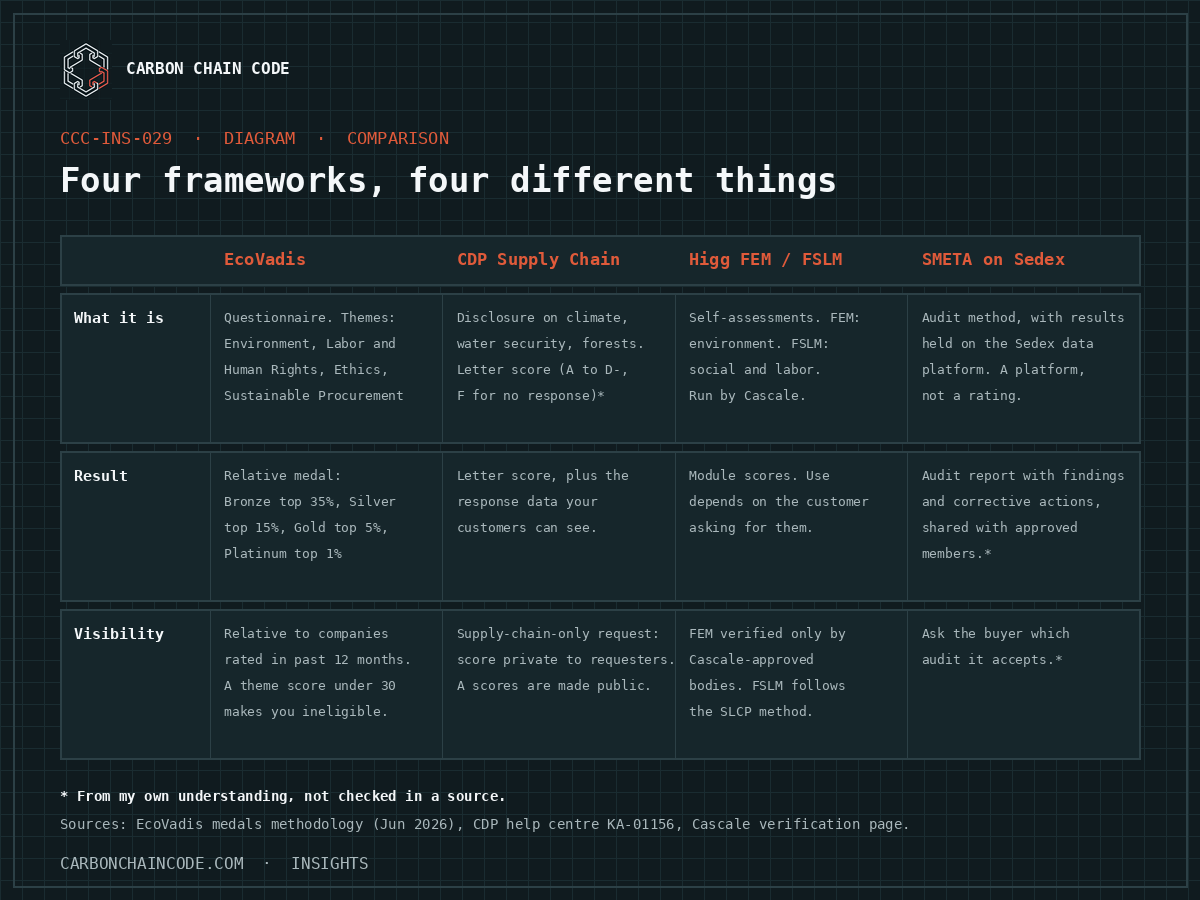
The Four at a Glance
Framework
What it is
How it is scored
Who sees the result
EcoVadis
Questionnaire on four themes: Environment, Labor and Human Rights, Ethics, Sustainable Procurement
Relative medal: Bronze top 35%, Silver top 15%, Gold top 5%, Platinum top 1%
Shared with customers; check the platform settings for who sees your scorecard
CDP Supply Chain
Disclosure on climate, water security and forests
Letter score
Scores stay private to requesters when only supply chain requests are made; A scores are made public
Higg FEM and FSLM
Self-assessments for environment (FEM) and social and labor (FSLM)
Module scores; verification is a separate step
Shared with customers you choose
SMETA on Sedex
An audit method, with results held on the Sedex data platform
Audit findings and corrective actions, not a score
Shared with Sedex members you approve
The last column mixes sourced and unsourced points. The EcoVadis medal bands and CDP visibility rules are from their owners' documents. The Higg and SMETA sharing rules are my understanding of how the platforms work, and the EcoVadis sharing point is too, so check each platform for its current settings.
EcoVadis
Illustrative summary
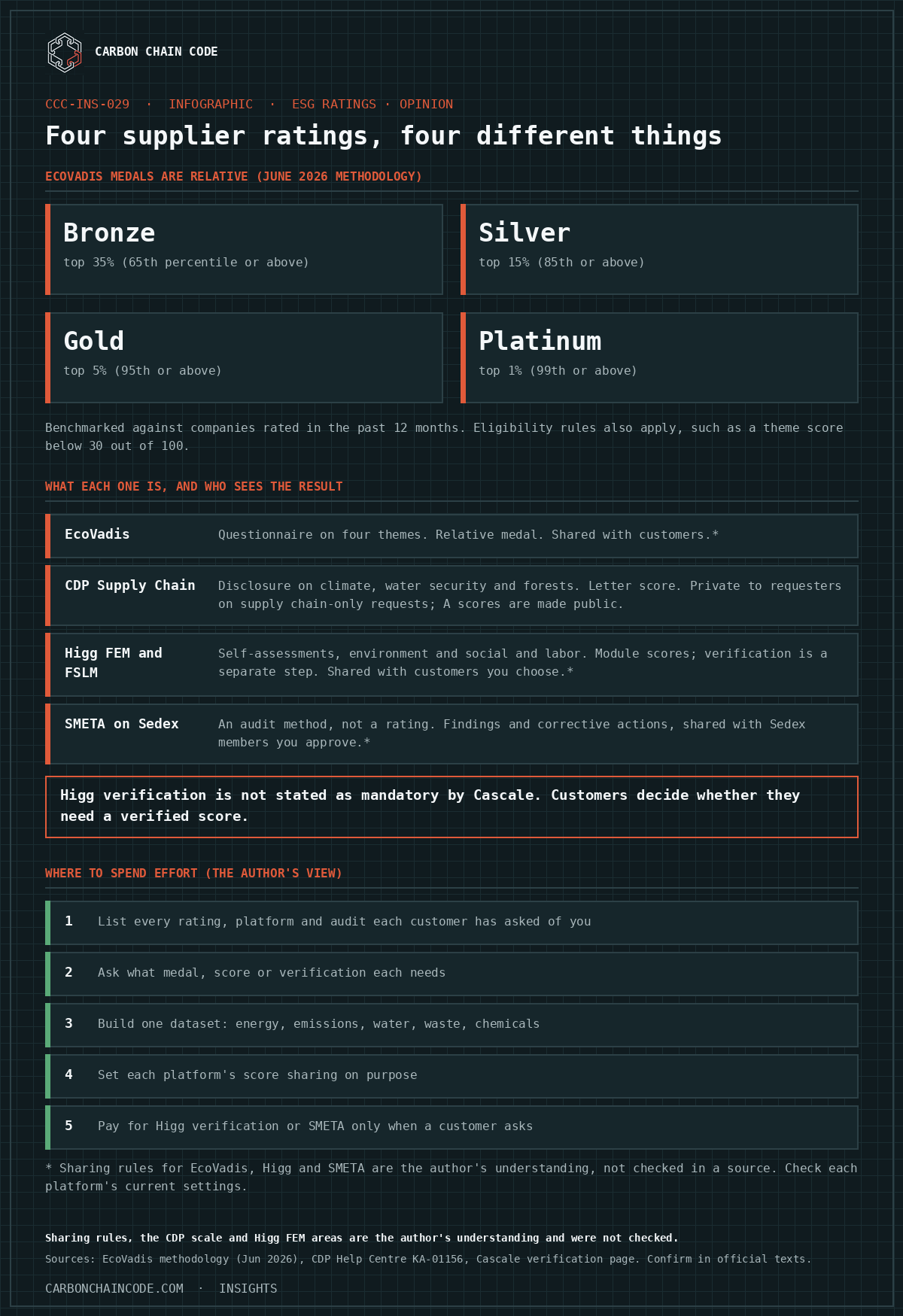
EcoVadis publishes a methodology document for its medals. According to the June 2026 version, the medal is relative, benchmarked against all companies rated in the past 12 months. Bronze is the top 35% (65th percentile or above), Silver the top 15% (85th or above), Gold the top 5% (95th or above) and Platinum the top 1% (99th or above), measured at the time the scorecard is published. There are also eligibility rules that apply whatever the percentile, such as a theme score below 30 out of 100. The earlier version of this article described Bronze as the 25th to 45th percentile and Silver as the middle of the peer group. That was wrong, and it made a Silver look average when it is in the top 15%.
The earlier version also said about 1,000 large brands use EcoVadis and that many require a Silver or better. I could not source either point and removed them. Some customers do set a minimum medal, so ask each one what it requires.
CDP Supply Chain
CDP's help centre says that when a supply chain member, a bank or a similar requester is the only one asking for your data, your score stays private, whether your response is public or not. It is shared with your requesters but not made publicly available, except that an A score is made public automatically. If a capital markets request is also made, the score becomes public. The earlier version said that CDP scores are visible to any CDP signatory, which is not what CDP says. In my understanding the scale runs from A to D-, with F for non-response, and the climate questionnaire is the one most relevant to manufacturers. I did not check the scale in a source.
Higg FEM and FSLM
The Higg Index tools are now run by Cascale, which was formerly the Sustainable Apparel Coalition. Cascale's verification page says only Cascale-approved verifier bodies can conduct valid Higg FEM verifications, and that FSLM verification follows the SLCP verification methodology. It does not say that verification is mandatory, and it gives no date for any requirement. The earlier version said the coalition moved to a verified self-assessment model in 2022 after the H&M case, and that scores need verification before use in consumer claims. I could not support that sequence or that rule, so I removed it. Whether you need a verified score depends on the customer asking. FEM covers areas such as energy, greenhouse gases, water, wastewater, waste and chemicals, based on my understanding, and I did not check the current list.
SMETA and Sedex
Sedex is a data platform, and SMETA is the audit method that many Sedex members use. It is not a rating. A SMETA report records findings and corrective actions, and members can share it with customers. The earlier version called SMETA the most widely used social audit format in the world. I could not source that and removed it. It is widely used, as far as I know, especially in UK supply chains, and its scope overlaps with the social module of Higg.
Investor ESG Ratings
ISS ESG, MSCI and Sustainalytics rate companies for investors, usually listed ones. For a private supplier they are normally not on the list. If your group has a listed parent, the parent's rating may draw on group data, so ask the parent's sustainability team what it needs from you.
One Data Set, Several Answers
The frameworks overlap in what they ask for: energy use, emissions, water, waste, chemical management and worker policies. It makes sense to keep one set of figures, with the evidence behind them, and adapt it to each request. The earlier version said this is "four times more efficient" than separate processes. That number is invented, and I removed it. I would not put a figure on the saving without measuring your own hours.
There is one related development. The voluntary sustainability standard for companies of up to 1,000 employees (Delegated Regulation (EU) 2026/1560, in force since 24 September 2026) defines a set of modules that you could use as the backbone of your shared data set. Its value chain cap, which applies from financial years starting on or after 1 January 2027, limits what CSRD reporters can require from you for their CSRD reports. It does not restrict a customer from asking you to take part in EcoVadis, CDP or Higg under its own supplier code. That is my reading and not a legal opinion.
Where to Spend Effort
This is my view. Start with whichever your largest customers actually request, in the order they request them, and ask what they do with the result. Build the shared data set first, since it serves every request. Treat a rating as a means of showing the data, not as the goal. If a customer asks for a medal, find out whether it asks for a minimum, and which medal your current practices would earn, before paying to be assessed.
The single data set approach
EcoVadis, CDP, Higg and SMETA all ask about overlapping topics: energy, emissions, water, waste, chemicals and worker policies. Keep one dataset with evidence, and adapt it for each request. Start with the data, not the questionnaire.
What to do this quarter
List every rating, platform and audit each customer has asked of you, and the deadline for each.
Ask each customer what medal, score or verification it needs, and what happens if you fall short.
Build one dataset for energy, emissions, water, waste and chemicals, with the source documents attached.
Check each platform's settings for who sees your scores, and set them on purpose.
Do not pay for Higg verification or a SMETA audit until a customer asks for it.
Frequently Asked Questions
What do the EcoVadis medals mean?
They are relative. According to EcoVadis's June 2026 methodology, Bronze is the top 35%, Silver the top 15%, Gold the top 5% and Platinum the top 1% of companies rated in the past 12 months.
Are CDP scores public?
Not for supply chain-only requests. CDP says those scores stay private to your requesters, except that an A score is made public automatically.
Is Higg verification mandatory?
Cascale's verification page does not say so. Customers decide whether they need a verified score.
Is SMETA a rating?
No. It is an audit method, and Sedex is the platform on which results are shared.
Do investor ESG ratings matter for a private factory?
Usually not directly. They matter if a listed parent uses your data.
References
EcoVadis, Medals Methodology disclosure document for the public, rating users and rated items (June 2026). CDP Help Centre, article KA-01156 on response and score privacy for supply chain requests. Cascale, Verification and Training Programs page. Delegated Regulation (EU) 2026/1560 as described in earlier articles in this series. The sharing rules for Higg, SMETA and EcoVadis scorecards, the CDP scale and the FEM impact areas are my own understanding and were not checked in a source.
Free tool · Sustainability Frisk
FREE TOOL FROM SUSTAINABILITY FRISK
The ISO 14001 Readiness Assessment scores your current environmental management system against the standard’s ten requirements in five minutes.
Need a CSRD gap analysis or hands-on implementation? Sustainability Frisk can help. www.sustainability-frisk.com
Most brands estimate purchased-goods emissions from spend and averages. What that does to the numbers, what the CSRD and SBTi actually require, and what a supplier can provide.
A certificate issued three weeks before a fire that killed more than 250 workers. What the case says about how social audits are bought and run, and what the due diligence laws now ask of companies.
 Carbon Chain Code