EU Textile Digital Product Passport: Standards and Pilots
The first European DPP standards are out and a textile pilot has opened to suppliers. Here is what is confirmed, what is not, and what a supplier can prepare.
By Hufsa8 October 20266 min read
The Digital Product Passport (DPP) is a digital record that goes with a product and can be read by scanning a data carrier such as a QR code. It comes from the Ecodesign for Sustainable Products Regulation (ESPR), and each product group gets its own rules through a delegated act. For textiles, those rules are not in force yet. This article covers what is confirmed in 2026, and corrects several claims in the earlier version, including a 2028 textile date and findings from pilots that I could not confirm.
What Is Confirmed
Item
Status
Source type
First DPP technical standards
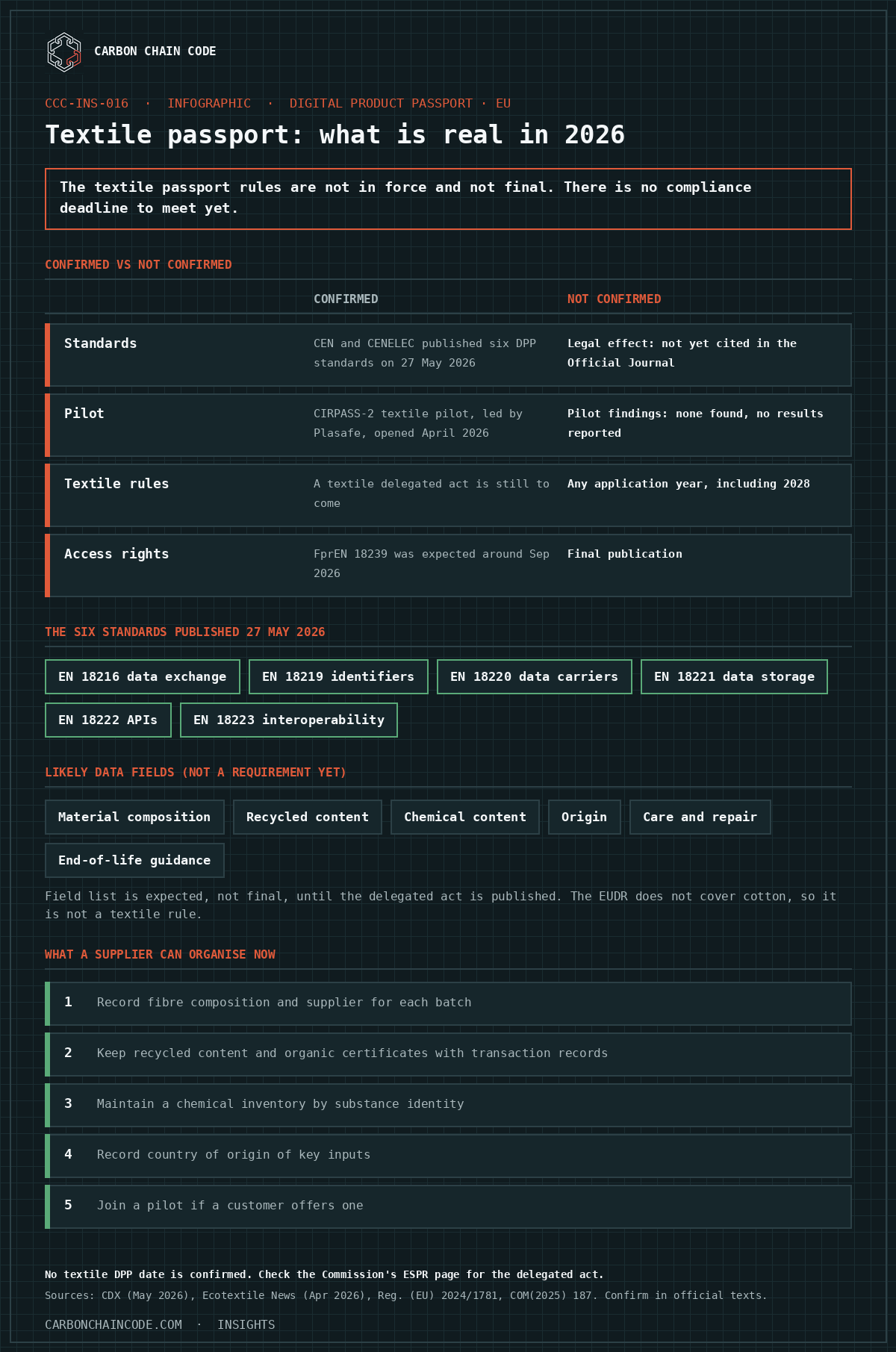
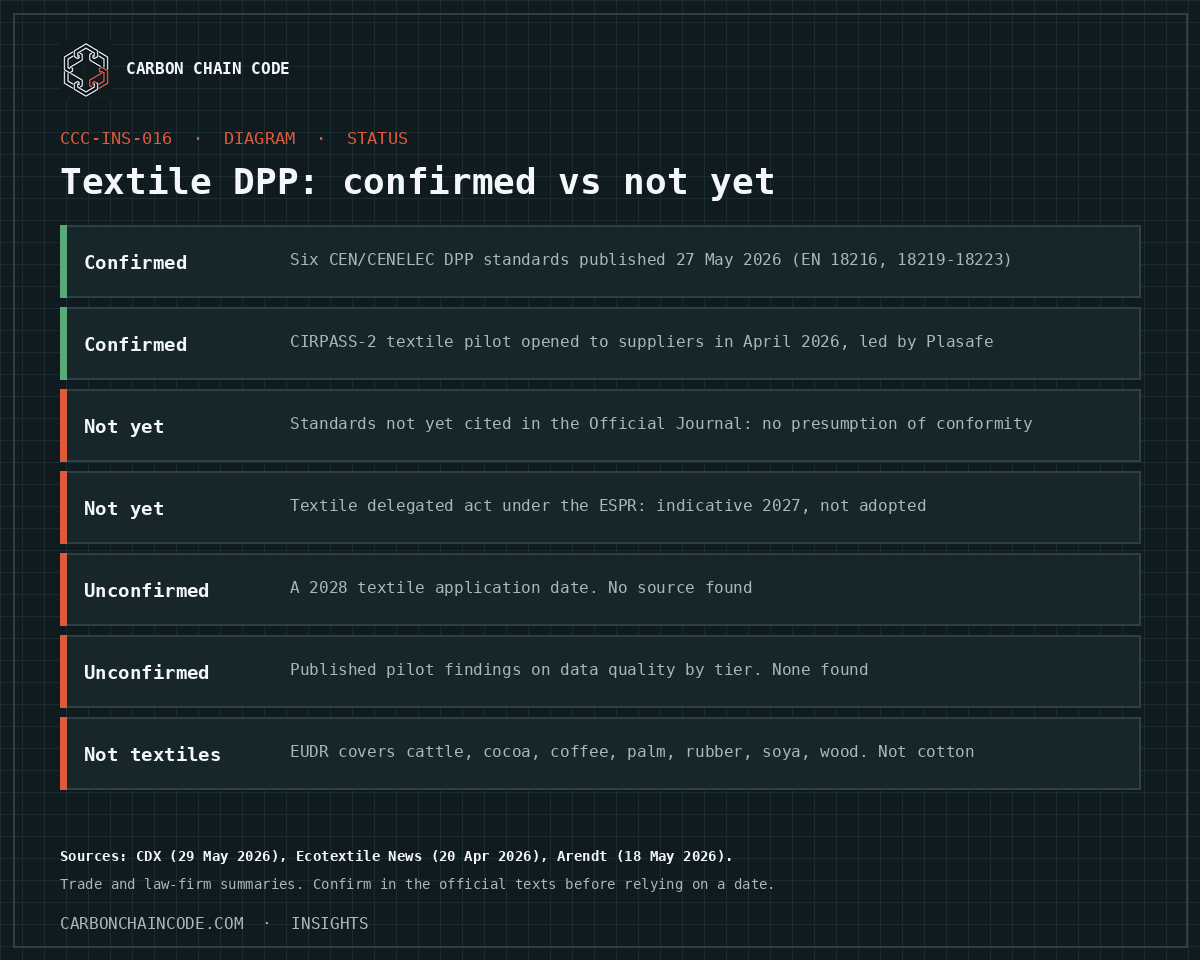
CEN and CENELEC published six standards on 27 May 2026: EN 18216 (data exchange protocols), EN 18219 (unique identifiers), EN 18220 (data carriers), EN 18221 (data storage and persistence), EN 18222 (APIs for lifecycle management and search) and EN 18223 (system interoperability)
Technical summary
Legal effect of the standards
Not yet cited in the Official Journal, so they do not yet give a presumption of conformity with the ESPR
Technical summary
Access rights and security standard
FprEN 18239, covering access rights, security and confidentiality, was expected around September 2026
Technical summary
Textile pilot
A DPP pilot on the EU-funded CIRPASS-2 platform, led by Plasafe, opened to textile and apparel suppliers in April 2026
Trade press, April 2026
Textile rules
A textile delegated act is still to come. The Commission's working plan gave an indicative date of 2027 for adoption
From my earlier research; check the Commission page
The earlier version said the textile DPP is "targeted for 2028 application". I could not confirm a 2028 application date. Application follows the delegated act and a transition period, so the date depends on when the act is adopted. Treat any specific year as unconfirmed until it is published.
What the Pilots Have Shown
Illustrative summary
The earlier version reported "CIRPASS-2 interim findings" from mid-2026 showing that data quality falls with each supply chain tier. I could not find any published findings. The trade report I found says only that the textile pilot had just opened and reported no results. I also could not find an "European Partnership for Textile Sustainability", so I removed that reference.
The tier problem is still a reasonable expectation, and I state it as my own reasoning, not as a pilot result. Direct suppliers usually have better records than fibre producers or chemical makers further upstream, and a passport that needs data from every stage will meet gaps where those records do not exist. A brand may have to use estimated or default values for some inputs, which weakens traceability.
What Data a Textile Passport May Ask For
The data fields for textiles are not final. Product-specific rules are expected to cover items such as material composition, recycled content, chemical content, origin, care and repair information and end-of-life guidance. Treat this as a likely list, not a requirement, until the delegated act is published.
For batteries the picture is clearer: the EU Battery Regulation requires a battery passport from 18 February 2027 for certain battery categories. I take this from my own knowledge, so check the regulation before relying on it.
Where EUDR Fits, and Where It Does Not
The earlier version called the EUDR a precursor for natural fibres. The EUDR covers cattle, cocoa, coffee, oil palm, rubber, soya and wood, and products made from them. Cotton is not one of the covered commodities. Cattle hides and leather were covered, but a delegated act adopted on 13 July 2026 removes hides, skins and leather from the scope (see the EUDR article for the commencement date). Application dates are 30 December 2026 for large and medium companies and 30 June 2027 for other micro and small enterprises. The EUDR does show how hard plot-level data collection is and how dates can slip, but it is not a textile rule.
Platforms
Several software vendors offer traceability tools that may support DPPs, including Circularise, TextileGenesis and Oritain. I did not verify which of them take part in any pilot, and the ESPR does not name a platform. The new CEN and CENELEC standards are intended to make systems interoperable, which should reduce lock-in over time.
What this means for a supplier
The textile passport rules are not final, so there is no compliance deadline to meet yet. What you can do now is organise the data any version is likely to need: fibre composition by batch, recycled content with certificates, chemical records, and a record of where each input came from.
Preparation steps
Record fibre composition and supplier for each batch, linked to the finished product.
Keep recycled content and organic certificates and the transaction records that link them to batches.
Maintain a chemical inventory by substance identity, not only hazard class.
Record country of origin of key inputs and keep the supplier declarations.
Join a pilot if a customer offers one, and use it to learn which fields are hard to supply.
Check the Commission's ESPR page for the textile delegated act before building anything large.
Frequently Asked Questions
When does the textile DPP start?
It is not fixed. It depends on adoption of a textile delegated act under the ESPR, which was indicatively expected in 2027, followed by a transition period. I could not confirm a 2028 date.
Have the pilots published findings?
I found none. A CIRPASS-2 textile pilot opened to suppliers in April 2026 and had reported no results in the source I read.
Does the EUDR cover cotton?
No. It covers cattle, cocoa, coffee, oil palm, rubber, soya and wood and their products, and their products. Cattle hides and leather were covered, but a 2026 delegated act removes them; check its commencement date.
Are there technical standards for the passport?
Yes. CEN and CENELEC published six on 27 May 2026, covering data exchange, identifiers, data carriers, storage, APIs and interoperability. They are not yet cited in the Official Journal.
References
CDX, First European Standards for the Digital Product Passport Published (29 May 2026). Ecotextile News, Digital Product Passport pilot opens to textile suppliers (20 April 2026). Arendt, EUDR simplification review published (18 May 2026). Regulation (EU) 2024/1781 (ESPR) and Commission working plan COM(2025) 187. The battery passport date is from my own knowledge. These are trade and law-firm summaries; confirm in the official text.
Free tool · Sustainability Frisk
FREE TOOL FROM SUSTAINABILITY FRISK
The CSRD Applicability Checker tells you which thresholds apply to your company and what timeline to follow — in under two minutes.
Need a CSRD gap analysis or hands-on implementation? Sustainability Frisk can help. www.sustainability-frisk.com
Most brands still estimate the emissions of their factories from spend data. This guide explains why that is changing, what brands will ask suppliers for, and what a factory can measure now from records it already has.
The EU Digital Product Passport will put product-level data requirements on textile supply chains, but the rules for textiles are not adopted yet. This guide separates what is in force, what is expected and what a factory can build now.
 Carbon Chain Code