EU Textile EPR: The New Rules and What France Charges Now
The revised Waste Framework Directive requires textile EPR schemes in every Member State. What the EU rules say, what France's Refashion charges per item in 2026, and what it means for factories.
By Hufsa8 October 20267 min read
Extended producer responsibility, or EPR, makes the companies that put textiles on the market pay for collecting, sorting and recycling them. The EU has now made it mandatory for textiles and footwear, and France's Refashion scheme already publishes what it charges. This article sets out what the EU rules say, what the French fees look like in 2026, and what that means for a factory. It replaces an earlier version that gave French fee levels I could not find in Refashion's own 2026 guide, and that attributed modulation criteria to Refashion that its guide does not list.
The EU Rules
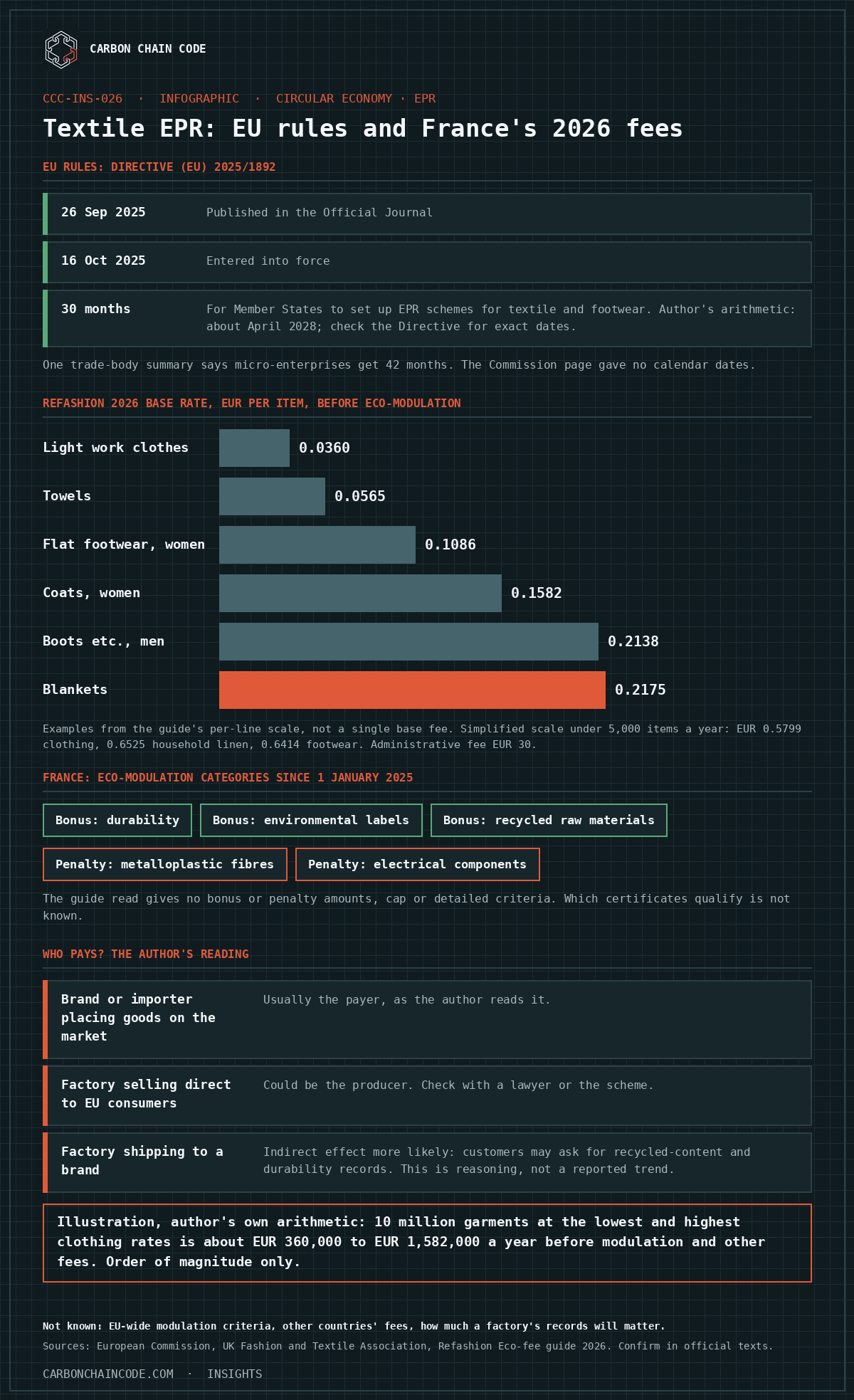
The revised Waste Framework Directive, Directive (EU) 2025/1892, was published in the Official Journal on 26 September 2025 and entered into force on 16 October 2025. According to the Commission, Member States have 30 months to set up EPR schemes for textile and footwear products and 20 months to transpose the Directive. I did not find calendar dates on the Commission page. By my arithmetic the 30 months run to about April 2028, and one trade-body summary says micro-enterprises get 42 months, which would be about April 2029. Check the Directive for the exact dates.
Producers pay a fee for each product they place on the market. The Commission says the fees finance collection and management of textiles, consumer information and research. The fees are to be adjusted by sustainability criteria, such as those under the Ecodesign for Sustainable Products Regulation, including durability and recyclability. A trade-body summary says that the producers covered include online sellers and non-EU entities placing textiles on the EU consumer market, and that the scope covers clothing, footwear, accessories, household linen and curtains, with mattresses left to Member States. All separately collected textiles are to be treated as waste, and social economy enterprises are exempt from EPR obligations. Separate collection of textiles has been required since 1 January 2025, from my own knowledge of the earlier Directive. The earlier version of this article called that the "first implemented pillar" of EPR, which is a fair description.
What France Charges in 2026
Illustrative summary
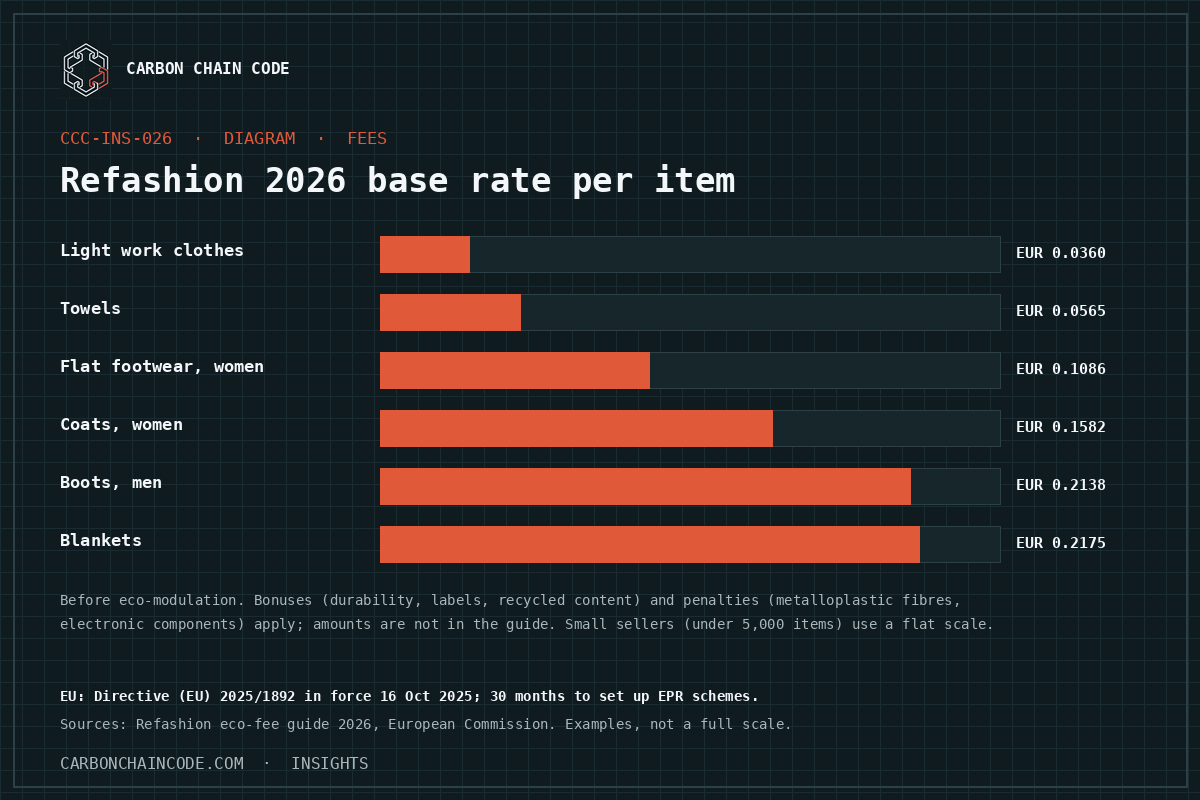
Refashion's 2026 guide lists a rate per product line, in euros per item. It does not give a single base fee. A few examples from its scale, before any eco-modulation:
Product line
2026 base rate per item
Light work clothes
€0.0360
Towels
€0.0565
Flat footwear, women (sizes 37 and over)
€0.1086
Coats, women (15 years and over)
€0.1582
Footwear such as boots, men
€0.2138
Blankets
€0.2175
For marketers under 5,000 items a year and without eco-modulated products, a simplified scale applies at a flat rate per item: €0.5799 for clothing, €0.6525 for household linen and €0.6414 for footwear. There is also an administrative fee of €30. The earlier version said the clothing base fee was €0.04 to €0.07 a unit, rising to €0.10 to €0.15 for poor performers and falling by up to 50% for the best. I could not find those figures or the 50% in the guide, so I removed them.
Here is an illustration with my own arithmetic. A brand selling 10 million garments in France, all at the lowest and highest of the clothing rates in the table above, would pay about €360,000 to €1,582,000 a year before modulation and other fees. The real figure depends on the mix of products and on the bonuses and penalties, so treat it as an order of magnitude.
Eco-Modulation in France
Refashion's guide lists the modulation categories that have applied since 1 January 2025: a bonus for durability, a bonus for certification with environmental labels, a bonus for recycled raw materials, a penalty for metalloplastic fibres and a penalty for electrical and electronic components. The guide I read gives no bonus or penalty amounts, no cap and no detailed criteria. The earlier version listed monomaterial construction, repairability scores and "strict bands tightening each year". None of those is in the guide, so I removed them. For the recycled-content and label bonuses, ask Refashion or your customer which certificates and documents it accepts. I cannot say whether GRS, GOTS or OEKO-TEX MADE IN GREEN qualify.
Who Pays, and What It Means for a Factory
Refashion says that all clothing, household linen and footwear marketers must contribute. The EU directive's producer covers brands and sellers placing products on the market, including some non-EU sellers. In my reading, a factory that ships to an importer or brand is usually not the payer, but a factory that sells directly to EU consumers under its own name could be. Check this with a lawyer or the scheme if it applies to you.
The indirect effect is more likely. Because the fee varies with product features, a brand has a financial reason to ask for them: recycled content with documents, durability evidence, and avoiding the materials that France penalises. That is my reasoning and not a reported trend. If your product qualifies for a bonus, a customer may pay more attention to your records.
Other Member States
The earlier version said the Netherlands, Belgium and Sweden were at different stages of legislative development and that Germany was consulting. I could not confirm any of that. As far as I know, France has had a textile scheme for many years and the Netherlands and Sweden have introduced their own, but I did not check dates or details. Each Member State will set its own requirements, so a producer selling in several countries should expect differences.
What is known and what is not
Known: Directive (EU) 2025/1892 is in force from 16 October 2025, with 30 months to set up EPR schemes. France's 2026 rates range from €0.036 to €0.2175 per item in the examples above, before modulation. Not known: the EU-wide modulation criteria, other countries' fee levels, and how much a factory's records will matter.
What a factory can do now
Ask each EU customer which EPR scheme it pays into, and what product data it needs from you.
Keep documents for recycled content, fibre composition and any durability testing, by style.
Record the use of metal-coated fibres and electronic parts in products, since France penalises them.
Find out whether you sell directly to EU consumers, which may make you the producer.
Read Refashion's eco-modulation guide for the criteria and accepted proof.
Frequently Asked Questions
Is textile EPR mandatory across the EU?
Yes. Directive (EU) 2025/1892 entered into force on 16 October 2025 and gives Member States 30 months to set up EPR schemes for textile and footwear products.
What does France charge per garment?
Refashion's 2026 scale is per product line. Examples run from €0.0360 for light work clothes to €0.1582 for women's coats, before eco-modulation.
Does the manufacturer pay the fee?
Usually the brand or importer that places the product on the market pays, as I read it. A seller that places goods on the EU market directly under its own name may be the producer.
Do GRS or GOTS certificates earn a discount?
Refashion has a bonus for certification with environmental labels and a bonus for recycled raw materials. I cannot say which certificates qualify. Check the scheme's list.
References
European Commission, Revised Waste Framework Directive enters into force (16 October 2025). UK Fashion and Textile Association, EU adopts and publishes the Revised Waste Framework Directive (September 2025), for the producer and micro-enterprise points. Refashion, Eco-fee guide 2026 (the per-item rates, simplified scale, administrative fee and modulation categories). The French modulation amounts, the Dutch and Swedish schemes and the 2025 separate-collection date were not in the sources I read. The calculation is mine.
Free tool · Sustainability Frisk
FREE TOOL FROM SUSTAINABILITY FRISK
The Carbon Footprint Calculator walks you through Scope 1 and Scope 2 from energy records to a per-unit figure you can share with customers.
Need a CSRD gap analysis or hands-on implementation? Sustainability Frisk can help. www.sustainability-frisk.com
The first European DPP standards are out and a textile pilot has opened to suppliers. Here is what is confirmed, what is not, and what a supplier can prepare.
A certificate and a batch-level record answer different questions. What GRS actually verifies, where its limits are, and what traceability adds, with the rules from the EU that push in that direction.
 Carbon Chain Code