Certification and Traceability: What Each One Can Prove
A certificate and a batch-level record answer different questions. What GRS actually verifies, where its limits are, and what traceability adds, with the rules from the EU that push in that direction.
By Hufsa8 October 20266 min read
The earlier version of this article argued that traceability is "more valuable" than certification and that certification is where greenwashing lives. That is an opinion, and the facts behind it were partly wrong. Certification and traceability are not opposites: certification schemes such as the Global Recycled Standard (GRS) already include a chain of custody. The useful question is what each can prove, and what a customer needs to know that a certificate does not tell them.
What GRS Actually Verifies
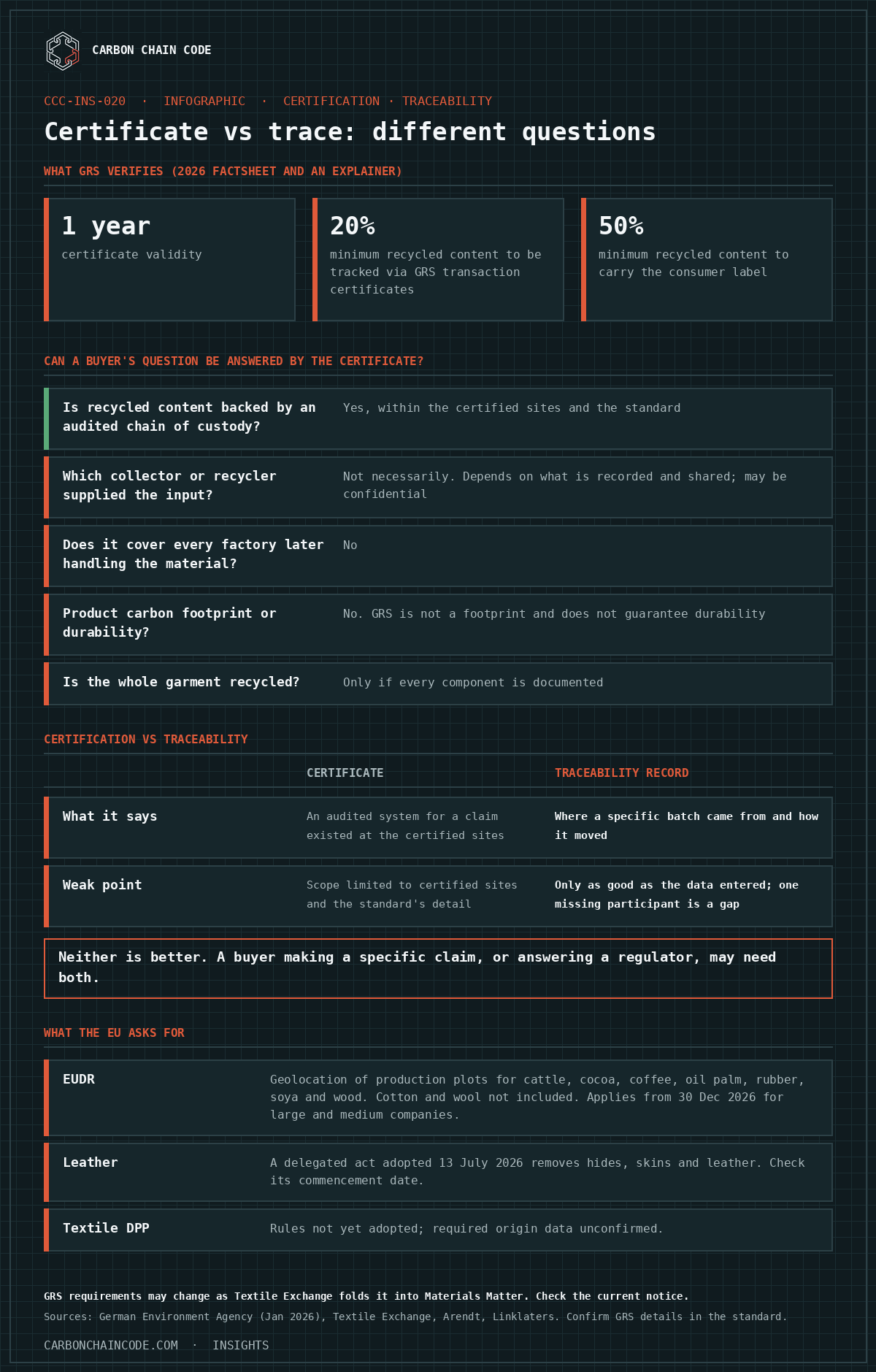
According to a 2026 factsheet from the German Environment Agency and an explainer I read, GRS works as follows. A certified company is audited by an approved certification body, not by its own claim. The certificate is valid for one year. Certified sites must document the origin and type of each recycled input, keep certified material separate from non-certified material, and reconcile volumes continuously by lot or batch, so that declared output cannot exceed certified input after conversion losses. Post-consumer and pre-consumer recycled shares are recorded separately for each batch. Products need at least 20% recycled content to be tracked through GRS transaction certificates, and at least 50% to carry the consumer label.
A transaction certificate covers a defined shipment or quantity of certified material being sold or transferred. Textile Exchange runs lookup pages where a scope certificate or a transaction certificate issued after 1 October 2022 can be authenticated. So the earlier claims that audits are every one to three years and that the certificate cannot link a shipment to the material behind it were too strong. Certification does record material flows batch by batch. It does so within the certified sites and at the level of detail the standard requires.
What a Certificate Does Not Tell You
Illustrative summary
Question a buyer may ask
Does the certificate answer it?
Is the claimed recycled content backed by a third-party audited chain of custody?
Yes, within the scope of the certified sites and the standard
Which specific collector or recycler supplied the input, and where?
Not necessarily; the detail depends on what is recorded and shared, and it can be commercially confidential
Does the certificate cover every factory that later handles the material?
No. A recycler's certificate does not automatically cover every factory further down the chain
Does it say anything about the product's carbon footprint or durability?
No. GRS is not a product carbon footprint, and it does not guarantee durability
Is the whole garment recycled?
Only if every component is documented; partial recycled content is common
The German Environment Agency also notes two gaps in the GRS documents it reviewed: there is no official definition of post-consumer or pre-consumer recycled material, and the treatment of chemically recycled material in the mass balance was not specified. Textile Exchange is also folding GRS into a combined standard called Materials Matter, so requirements may change. One source gives the effective date as 31 December 2026 and mandatory application from 31 December 2027; check Textile Exchange's current notice.
What Traceability Adds
Batch-level traceability links a specific shipment to the earlier steps that produced it, by record, by marker or by both. It can show more about origin and process than a certificate does. Digital records, platforms from vendors such as TextileGenesis, Aware and Sourcemap, QR codes and tracers are all used. Forensic methods can test the origin of some natural fibres, for example by isotope analysis. These methods come from my own knowledge, and I did not verify claims about any vendor.
Traceability has its own weakness. A record is only as good as the data entered into it, and a chain with one missing participant has a gap. Full traceability needs several tiers to take part, which is why the market is slow. The two approaches work best together: a certificate gives an independent check on the sites, and a traceability record shows how a specific batch moved.
The earlier version also said that GRS fraud has been documented in several cases, with virgin polyester sold under fraudulent certificates. I could not confirm specific cases in the sources I read, so I removed that claim. Textile Exchange's authentication pages exist so that buyers can check certificate validity, which is the practical safeguard against forged documents.
What the EU Is Asking For
The earlier version said the EUDR and the Digital Product Passport show that regulation is moving from certification to traceability. The picture is narrower. The EUDR requires geolocation data for the plots where covered commodities were produced. Covered commodities are cattle, cocoa, coffee, oil palm, rubber, soya and wood, so cotton and wool are not included, and leather was covered only because of cattle hides, and a delegated act adopted on 13 July 2026 removes hides, skins and leather from the scope (check its commencement date in the Official Journal). Application is from 30 December 2026 for large and medium companies. The textile Digital Product Passport rules are not yet adopted, and I could not confirm which origin data they will require. See the related article on the DPP for the current status.
The practical difference
A certificate says that an audited system for a claim existed at the certified sites. A traceability record says where a specific batch came from and how it moved. A buyer who wants to make a specific claim, or to answer a regulator, may need both.
For a supplier
Keep scope and transaction certificates current, and tell customers where they can authenticate them.
Link input purchase records to output production records by batch. This is the base of any traceability system and also what GRS reconciliation requires.
Record which supplier and which certificate each input batch came from.
Find out whether your customers use a traceability platform and which fields they will ask you for.
If you handle rubber, wood, cocoa, coffee, palm or soya derivatives, check whether your customers need geolocation or origin data from you. For leather, ask each customer in writing whether it still treats leather as in scope.
Avoid claims on your own products that go beyond what your certificates cover.
Frequently Asked Questions
Is traceability better than certification?
They answer different questions. Certification gives an independent audit of the sites and a chain of custody. Traceability gives batch-level provenance. The earlier claim that one is clearly better is an opinion that I do not support.
Does a GRS transaction certificate link to a specific shipment?
It covers a defined shipment or quantity of certified material. GRS also requires batch or lot reconciliation within certified sites.
How often is a GRS certificate audited?
The certificate is valid for one year, according to the German Environment Agency factsheet. The earlier claim of one to three years between audits was too long for GRS.
Has GRS been subject to fraud?
I could not confirm specific cases. Buyers can authenticate scope and transaction certificates on Textile Exchange's pages.
References
German Environment Agency (Umweltbundesamt), Steckbrief on certification systems for recycled plastics, covering GRS (January 2026). Intelligent Living, GRS certification: what it really verifies. Textile Exchange, Certificate authentication page. Arendt, EUDR simplification review (May 2026). World Footwear, European Commission formally removes leather from EUDR scope (July 2026). Linklaters, Commission adopts delegated act on EUDR product scope. The forensic and vendor examples are from my own knowledge. Some sources are secondary summaries; confirm GRS details in the current standard.
Free tool · Sustainability Frisk
FREE TOOL FROM SUSTAINABILITY FRISK
The ISO 14001 Readiness Assessment scores your current environmental management system against the standard’s ten requirements in five minutes.
Need a CSRD gap analysis or hands-on implementation? Sustainability Frisk can help. www.sustainability-frisk.com
Most brands still estimate the emissions of their factories from spend data. This guide explains why that is changing, what brands will ask suppliers for, and what a factory can measure now from records it already has.
The first European DPP standards are out and a textile pilot has opened to suppliers. Here is what is confirmed, what is not, and what a supplier can prepare.
 Carbon Chain Code