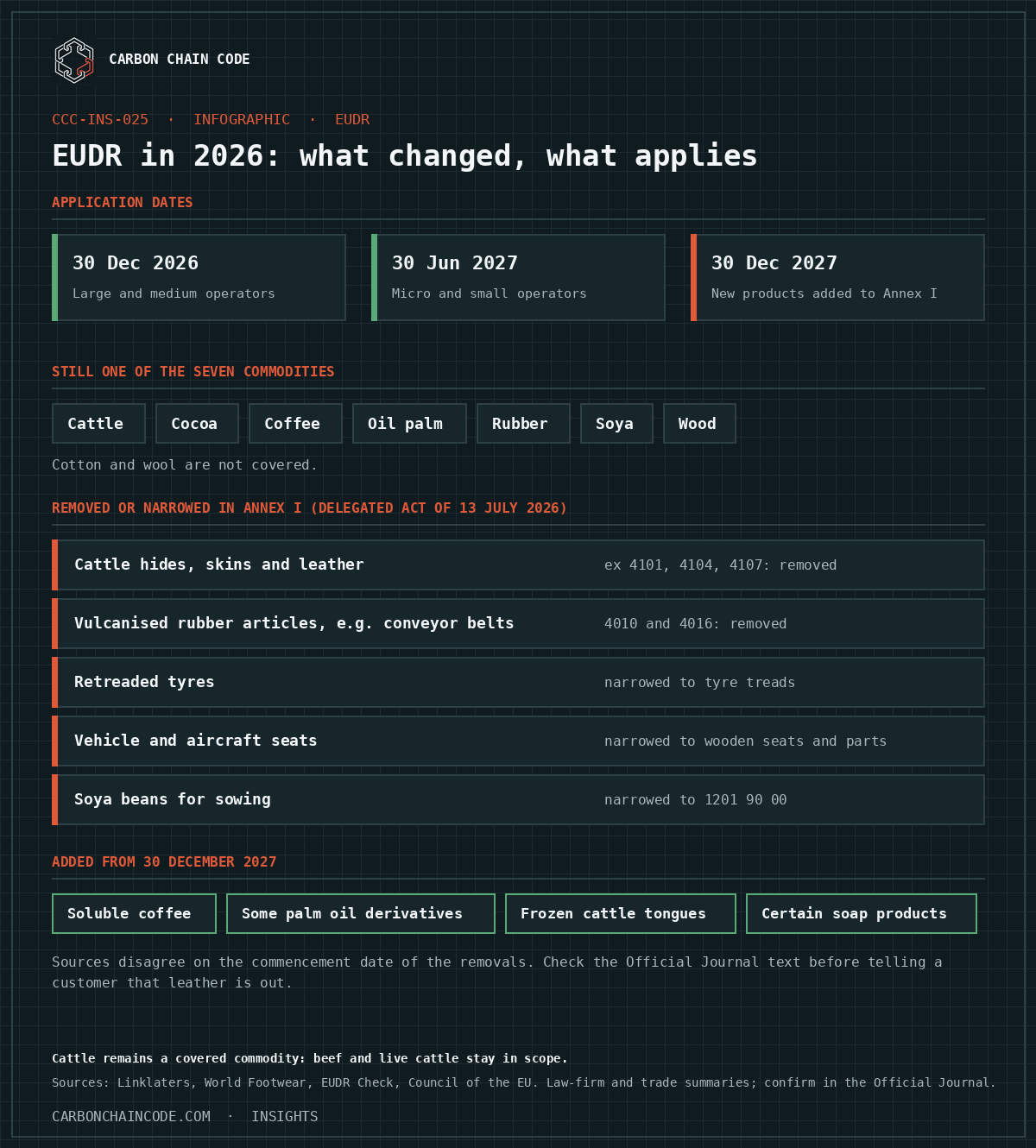
EUDR in 2026: Two Delays, Leather Removed, and What Still Applies
The EU Deforestation Regulation now applies from 30 December 2026 for large and medium operators. What was postponed, what the country benchmarking looks like, why leather has been taken out, and what is still covered.
By Hufsa8 October 20267 min read
The EU Deforestation Regulation (Regulation (EU) 2023/1115, the EUDR) has been postponed twice and trimmed once, and leather has been removed from its scope. That last change matters a great deal to footwear and accessory makers. This article sets out the current position on 8 October 2026, from regulator releases, law-firm summaries and trade press. It replaces an earlier version that said a second postponement was not expected, that the country benchmarking was still a draft, and that leather was the most relevant covered commodity. All three are now wrong.
The Dates
When
What happened
2023
Regulation adopted. Application originally set for 30 December 2024 (large operators) and 30 June 2025 (small)
Late 2024
First postponement by one year, to 30 December 2025 and 30 June 2026
May 2025
Commission adopted the country benchmarking
December 2025
Second postponement: all operators until 30 December 2026, with an extra six months for micro and small operators. Certain printed products removed from scope. A simplification review was due by 30 April 2026
4 May 2026
Commission published its simplification review and package, including a draft change to the product scope
13 July 2026
Commission adopted the delegated act on the product scope (Delegated Regulation (EU) 2026/2102, published in the Official Journal on 17 September 2026, according to one tracking site)
30 December 2026
Application for large and medium-sized operators, and for micro and small operators in the timber sector
30 June 2027
Application for other micro and small operators
The first postponement dates come from the earlier version of this article, and I know them as widely reported. The December 2025 and 2026 dates come from the Council's press release, Arendt's summary and trade press. Check them against the Official Journal.
Country Benchmarking: Adopted, Not a Draft
Illustrative summary
The earlier version said the benchmarking was still in draft in mid-2026, with indicative classifications published in early 2026. In fact the Commission adopted the classification in May 2025. According to a Fieldfisher summary, four countries are high risk (Russia, Belarus, Myanmar and North Korea), about 140 are low risk (including all EU Member States, the UK, the US, Canada, China, Japan, Australia and South Africa), and the rest are standard risk, including Brazil, Peru, Colombia and the Democratic Republic of Congo. The classification affects how often and how deeply authorities check. I did not check whether it has been revised since.
Leather Has Been Taken Out
On 4 May 2026 the Commission proposed excluding cattle hides, skins and leather. According to World Footwear, it formally adopted the delegated act in July. A tracking site reports that the removal covers HS codes 4101, 4104 and 4107, and also takes out re-treaded tyres, soya beans for sowing, vulcanised rubber articles such as conveyor and transmission belts, and vehicle and aircraft seats. It says the act was published on 17 September 2026 as Delegated Regulation (EU) 2026/2102. Sources disagree on when the removals take effect: one tracking site says 18 September 2026 and mentions a possible alternative of 7 October 2026, and a trade-press report mentions a two-month scrutiny period. Check the commencement article of the regulation.
Cattle remains one of the seven commodities. According to the sources, beef, live cattle and frozen cattle tongues stay in scope, and soluble coffee, frozen cattle tongues and some palm oil derivatives are added from 30 December 2027. Leather industry bodies welcomed the removal, and the campaign group Fern called it a mistake and said the Commission had bowed to lobbying. Those are their views, not findings. A 2030 review may revisit the exclusions, according to one tracking site.
The earlier article said leather was the most relevant EUDR commodity for footwear and accessory makers, and described a farm-to-tannery traceability problem for South Asian leather. With leather out of scope, that problem no longer arises under the EUDR. It may still matter for a customer's own sourcing policy or for other laws, so ask the customer.
What Is Still Covered
The seven commodities are cattle, cocoa, coffee, oil palm, rubber, soya and wood, with derived products listed in Annex I. Cotton and wool are not covered. Operators must show the goods are deforestation-free against a cut-off of 31 December 2020 and legal in the country of production, and must submit a due diligence statement through the EU Information System before placing or exporting products. Geolocation of the production plots is the core data requirement.
The earlier version said footwear midsoles, ball bladders and sporting goods are covered through rubber. I could not confirm that. The sources I read say vulcanised rubber articles under HS 4010 and 4016 are removed, and I did not find footwear or sporting goods listed in Annex I. Check your product codes against the current Annex I before assuming either way.
What Was Simplified
According to Arendt's summary of the May 2026 package, downstream operators and traders meet the "collect and keep" duty by retaining information they received through standard commercial documents such as invoices, without routinely verifying reference numbers. Micro and small primary operators need to submit only a one-time simplified declaration. A postal address may replace geolocation data where it clearly corresponds to the location of the plots or establishment. These details come from a summary of guidance, so I would read the Commission's text before relying on them. Separately, the Council said certain printed products such as books and newspapers were removed from scope in December 2025.
The earlier version said no further postponement was expected and that the Commission would hold the line. It had already been postponed a second time when that was written. I cannot say what will happen next. My view is that the 30 December 2026 date is now close enough that a customer with covered goods will already be asking for data.
What a supplier should do
First, check whether any of your products contain a covered commodity under the current Annex I, using the HS codes. If you make leather goods, leather is no longer covered, but ask your customer in writing. If you handle rubber, wood, cocoa, coffee, palm or soya derivatives, expect requests for plot-level origin data before 30 December 2026.
Checklist
List each product and its HS codes, and compare them to the current Annex I.
Ask each customer in writing whether leather and your other materials are still in its EUDR scope.
For covered materials, find out what origin and plot data your suppliers can provide.
Keep purchase documents that link each lot to its source.
Check the commencement date of Delegated Regulation (EU) 2026/2102 in the Official Journal.
Watch for further simplification measures before the December date.
Frequently Asked Questions
When does the EUDR apply?
From 30 December 2026 for large and medium-sized operators, and from 30 June 2027 for most micro and small operators, according to the Council and law-firm summaries.
Is leather still covered?
No, according to the sources I read. The Commission adopted a delegated act removing cattle hides, skins and leather (HS 4101, 4104 and 4107). Check the regulation's commencement date.
Is cotton covered?
No. The seven commodities are cattle, cocoa, coffee, oil palm, rubber, soya and wood.
Has the country benchmarking been adopted?
Yes, in May 2025. Four countries are high risk, about 140 are low risk and the rest are standard risk.
Will there be another delay?
I do not know. It has been postponed twice already, and a simplification review was completed in May 2026.
References
Council of the EU, Deforestation: Council signs off targeted revision to simplify and postpone the regulation (18 December 2025). Arendt, EUDR simplification review published (May 2026). Fern, Commission rules out re-opening EUDR but drops leather from goods covered by it. World Footwear, European Commission formally removes leather from EUDR scope (15 July 2026). EUDR Check, Annex I changes under Delegated Regulation (EU) 2026/2102. Fieldfisher, Commission classifies countries as high, low or standard risk (May 2025). The first postponement dates and the cotton and wool point are from my earlier notes. I have not read the Regulation or Annex I myself.
Free tool · Sustainability Frisk
Does EUDR apply to your supply chain?
Use the free EUDR Applicability Checker to find out which commodities and products are in scope.
Need a CSRD gap analysis or hands-on implementation? Sustainability Frisk can help. www.sustainability-frisk.com
The EU Digital Product Passport will put product-level data requirements on textile supply chains, but the rules for textiles are not adopted yet. This guide separates what is in force, what is expected and what a factory can build now.
A certificate and a batch-level record answer different questions. What GRS actually verifies, where its limits are, and what traceability adds, with the rules from the EU that push in that direction.
 Carbon Chain Code