Global Carbon Pricing in 2026: What the World Bank Report Shows
87 carbon pricing instruments cover 29% of global emissions. The headline figures, what changed in the EU, China, the UK and Canada, and why it matters to exporters.
By Hufsa8 October 20266 min read
The World Bank's State and Trends of Carbon Pricing 2026 report, with data as of 1 April 2026, is the best single source on how far carbon pricing has spread. Its figures are different from the ones in the earlier version of this article, which used 73 instruments covering 23% of emissions and several country prices I could not confirm. I rebuilt it from the report and a few news sources, and I mark where I could not find a number.
The Headline Numbers
Measure
2026 report
Carbon pricing instruments in force
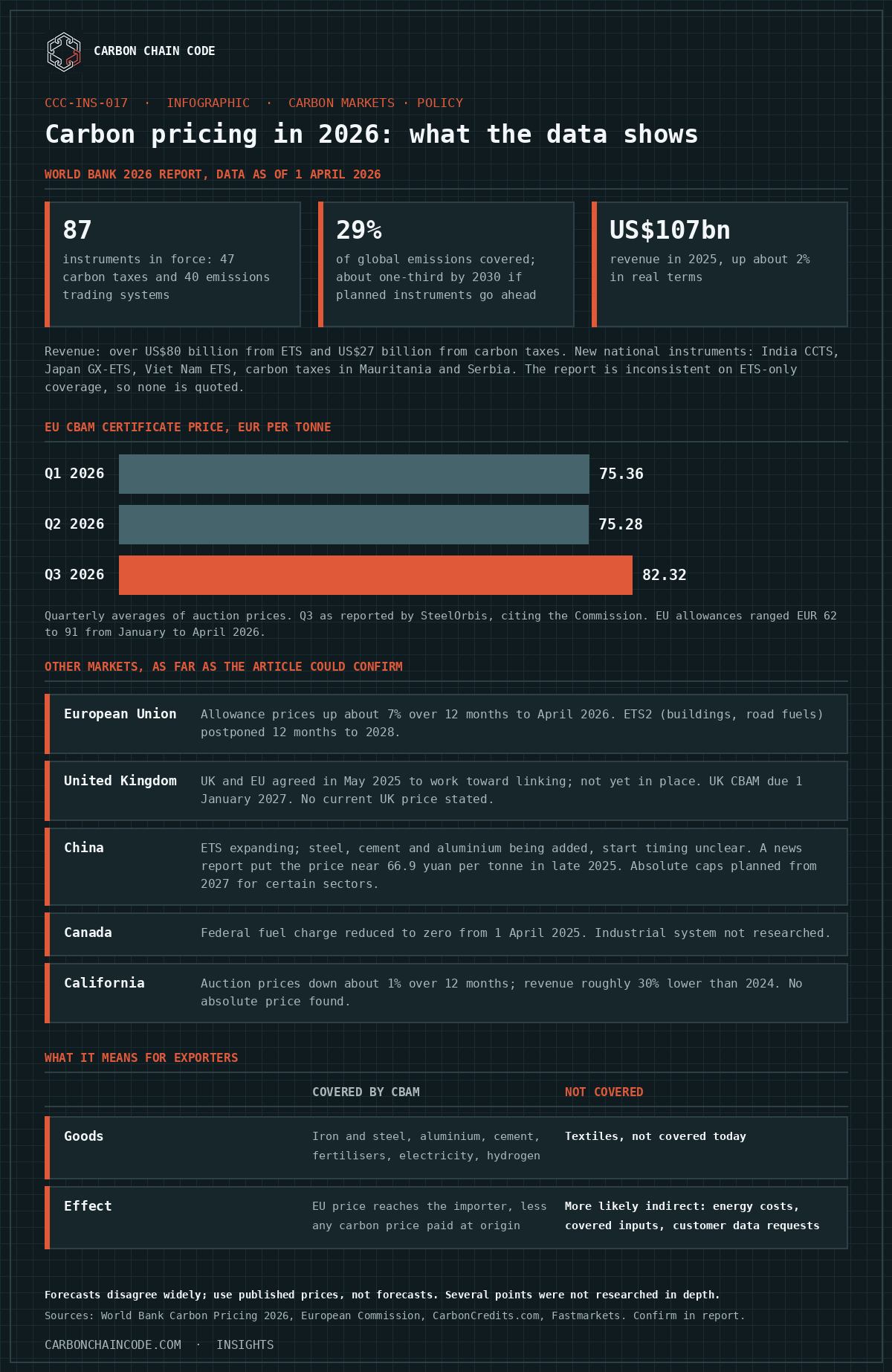
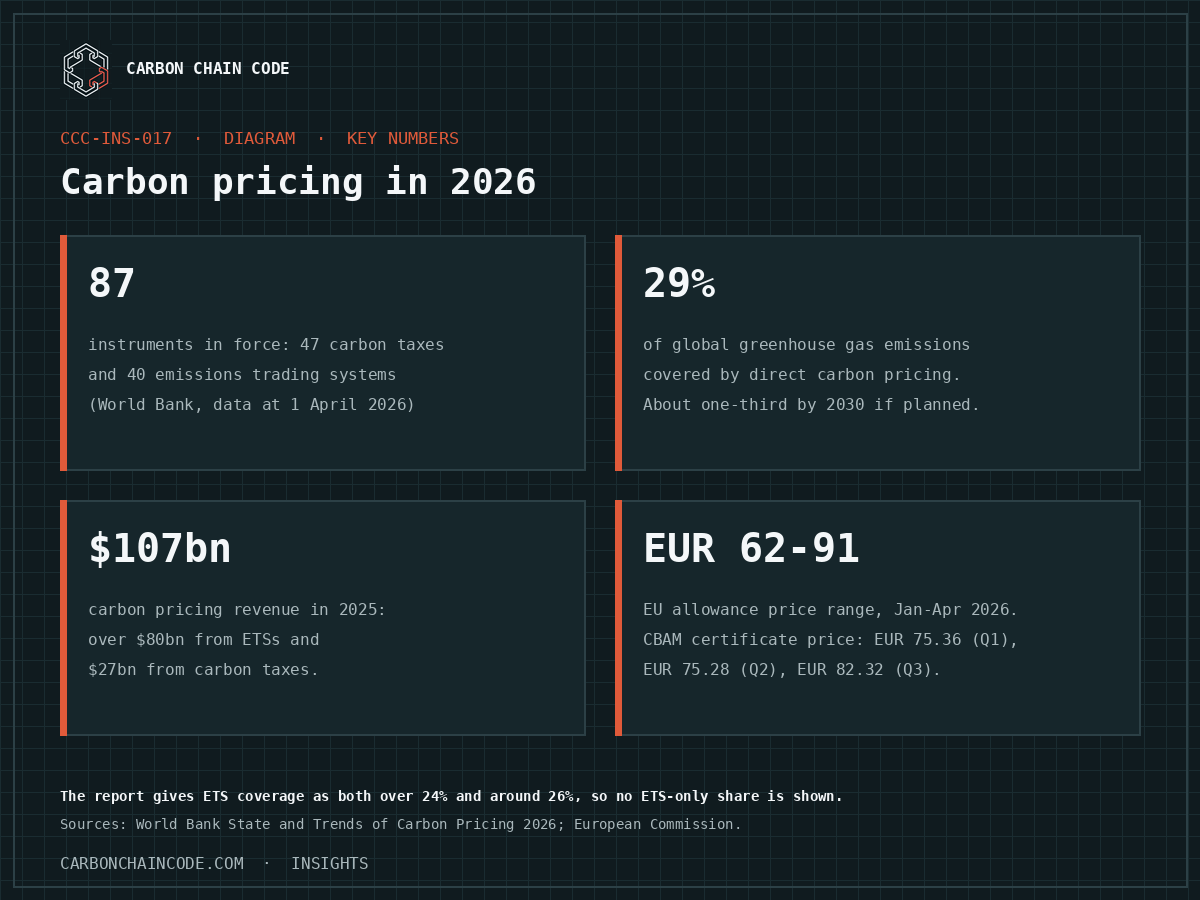
87: 47 carbon taxes and 40 emissions trading systems
Coverage of global greenhouse gas emissions
29% (about one-third by 2030 if planned instruments go ahead)
Revenue in 2025
US$107 billion, up about 2% in real terms
Of which emissions trading systems
Over US$80 billion
Of which carbon taxes
US$27 billion
New national instruments in the past 12 months
India's CCTS, Japan's GX-ETS, Viet Nam's ETS, and carbon taxes in Mauritania and Serbia
The report itself is inconsistent on emissions trading coverage, giving "over 24 percent" in the executive summary and "around 26 percent" in the chapter text, so I do not quote an ETS-only figure.
European Union
Illustrative summary
According to the report, EU allowance prices were up about 7% over the 12 months to April 2026 and fluctuated between €62 and €91 per tonne from January to April 2026. That means €62 was the bottom of the range, not a price at the start of May as the earlier version said. The official CBAM certificate prices, which are quarterly averages of auction prices, were €75.36 for Q1, €75.28 for Q2 and €82.32 for Q3 2026 (the Q3 figure as reported by SteelOrbis, citing the Commission). ETS2, the system for buildings and road transport fuels, has been postponed by 12 months to 2028.
The earlier version also quoted analyst forecasts of €65–72 for end-2026 and €80–110 for 2030, and a coverage of 1.8 billion tonnes. I could not confirm these. Other sources I found put end-2026 forecasts closer to €100, so forecasts disagree widely and should not be used for planning.
United Kingdom
The UK runs its own ETS alongside a carbon price floor for power. In May 2025 the UK and EU agreed a common understanding to work toward linking the two systems, which would allow mutual exemption from each other's carbon border measures. The link is not yet in place, and details such as free allocation and cap setting still had to be settled. A UK CBAM is due on 1 January 2027, according to the World Bank report and the draft legislation. UK allowance prices have been below EU prices since mid-2022. I only found a May 2025 reading of about £50, so I do not state a current UK price.
China
China's national ETS has expanded to industrial sectors since 2024, and regulators have confirmed that steel, cement and aluminium are being added, although the start timing was unclear in the report I read. It currently uses intensity-based rules with mostly free allocation, and officials plan to move toward absolute caps for certain sectors from 2027. A news report put the price at about 66.9 yuan per tonne in late 2025, within a usual range of 40 to 70 yuan. The earlier version's "90 yuan", "5.1 billion tonnes" and "150–200 yuan by 2030" had no source I could find, so they are out. The report says China does not auction allowances, so it earns no auction revenue.
Canada and California
Canada's federal fuel charge was reduced to zero from 1 April 2025, which the World Bank names as the largest contributor to the fall in carbon tax revenue. The earlier version said the charge reached CAD$80 in April 2026 on a path to CAD$170, which is not correct for the consumer fuel charge. I did not research the current status of the industrial pricing system, so I make no claim about its price. In California, auction prices fell about 1% over the 12 months and revenue was roughly 30% lower than in 2024. I could not find an absolute California price in the report text.
The United States has no federal carbon price. I removed the earlier version's claims about the Inflation Reduction Act credits acting as an implicit price, because US tax credit rules changed in 2025 and I did not verify the current position.
What It Means for Exporters
For goods covered by CBAM, the EU price is what reaches an importer, less any carbon price already paid in the country of origin. The covered goods are iron and steel, aluminium, cement, fertilisers, electricity and hydrogen. A cement exporter without domestic carbon pricing faces the full difference. A textile exporter is not covered by CBAM today. For textile suppliers the more likely effect is indirect: through energy costs, covered inputs, and customers' data requests.
The earlier version said the OECD projects 45% of global industrial emissions will be under some pricing by 2030 and listed several countries as developing schemes in response to CBAM. I could not confirm the OECD figure. The World Bank report supports a narrower statement: coverage could approach one-third of global emissions by 2030 if planned instruments are implemented.
What to take from this
Carbon pricing is spreading, but coverage is still 29% of global emissions, prices vary widely between systems, and forecasts disagree. For a manufacturer the useful step is to measure emissions per product now, so that you can answer a CBAM or customer request with your own data.
For a manufacturer
Check whether your products fall under a CBAM product code, and whether your country has a carbon price that could be credited.
Measure Scope 1 and 2 emissions per unit of product with documented factors.
Keep a record of any carbon price or levy you pay at home.
Use the published quarterly CBAM price, not a forecast, in customer discussions.
Check whether your main markets, such as the UK, are introducing their own border measures.
Frequently Asked Questions
How many carbon pricing instruments are there?
The World Bank's 2026 report counts 87 in force at 1 April 2026: 47 carbon taxes and 40 emissions trading systems.
How much of global emissions do they cover?
29%, according to the report.
What was the EU carbon price in 2026?
Between €62 and €91 per tonne from January to April 2026, according to the World Bank. The CBAM certificate price was €75.36 for Q1, €75.28 for Q2 and €82.32 for Q3.
Does China have a carbon price?
Yes, through its national ETS. A news report put it near 66.9 yuan per tonne in late 2025. It is expanding to steel, cement and aluminium, with absolute caps planned from 2027 for certain sectors.
References
World Bank, State and Trends of Carbon Pricing 2026. European Commission, price of CBAM certificates. CarbonCredits.com, China carbon prices rise as metals and cement enter the national trading scheme (21 November 2025). Fastmarkets, UK, EU agree to work toward linking Emissions Trading Systems (20 May 2025). The Canada industrial system, California price and US policy points were not researched in depth. Confirm against the original report.
Free tool · Sustainability Frisk
Does CBAM affect your exports?
Use the free CBAM Applicability Checker to see whether your goods are covered and what it means.
Need a CSRD gap analysis or hands-on implementation? Sustainability Frisk can help. www.sustainability-frisk.com
How the EU ETS allowance price feeds into CBAM certificate prices, why price forecasts should be treated with caution, and what suppliers can do with the number.
Textiles are not covered by the EU Carbon Border Adjustment Mechanism, and they are not in the Commission's current extension proposal. This guide explains what CBAM does cover, how its costs are calculated, and what a Pakistani textile manufacturer should prepare.
 Carbon Chain Code