Five Greenwashing Cases and What Each Actually Decided
Volkswagen, H&M, KLM, Mercer and DWS: what was alleged, who acted, what the outcome was, and what a supplier should take from each, with the limits of each case stated.
By Hufsa8 October 20268 min read
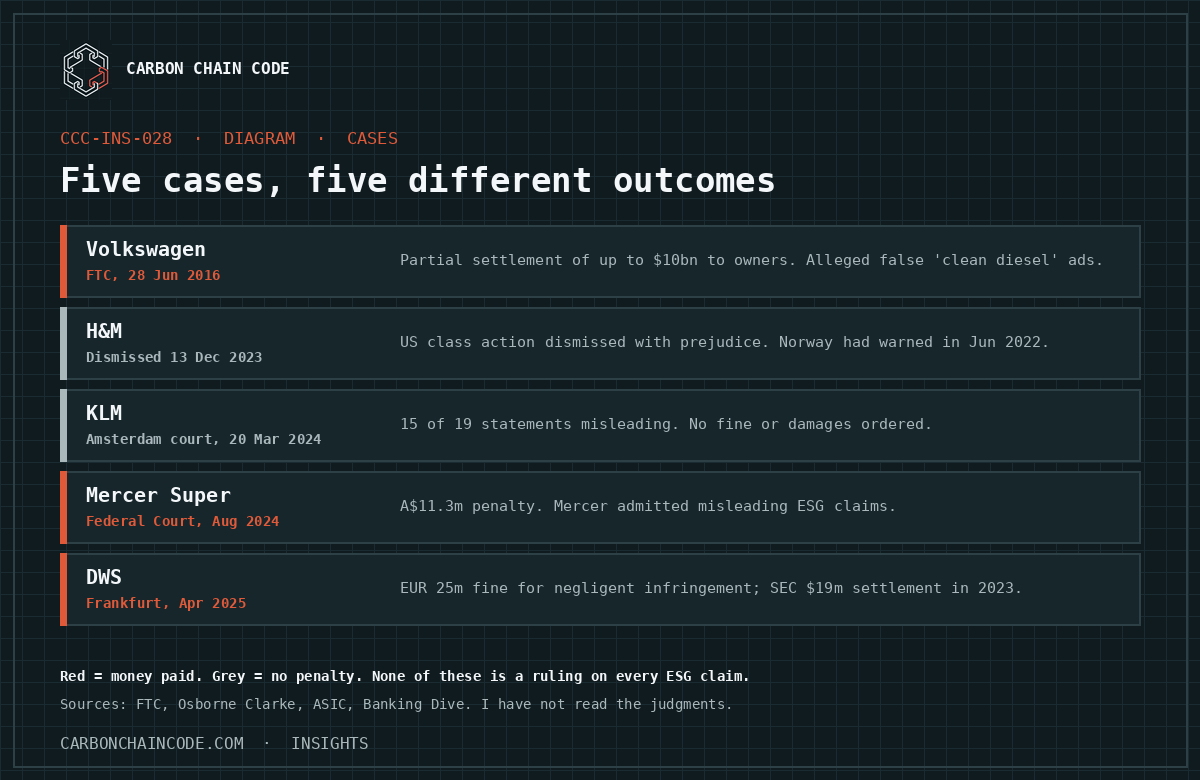
Greenwashing cases are often described as having "established standards", but most of them ended in a settlement, an admission or a dismissal, and few produced a ruling that binds anyone else. This article goes through five well-known cases and says what happened in each, who acted, and how far each one goes. It replaces an earlier version that got several facts wrong, including who decided the KLM case, how H&M ended and what the Volkswagen settlements covered. I have read regulator releases, law-firm summaries and press reports, not the judgments themselves.
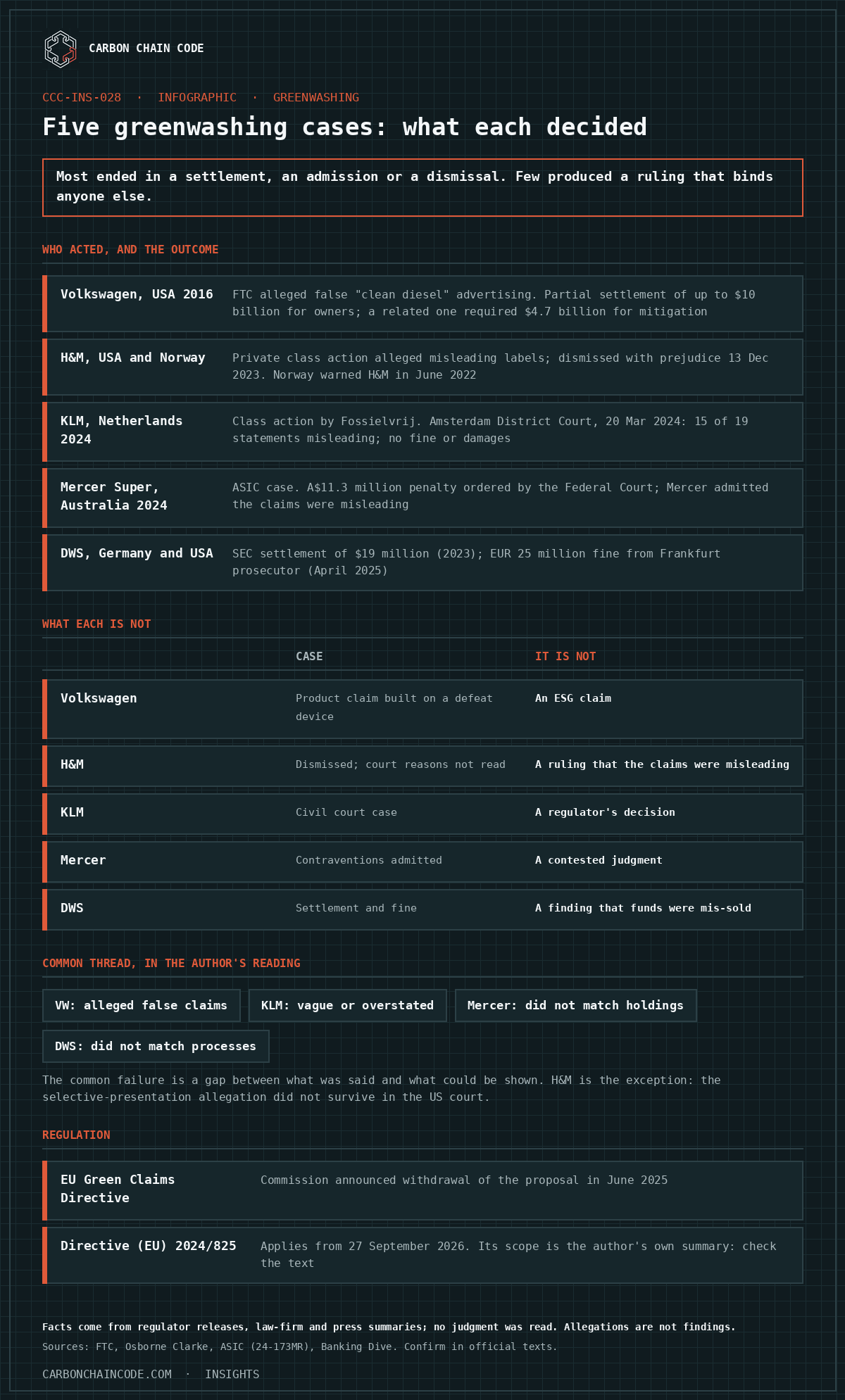
At a Glance
Case
Who acted
Outcome
What it is not
Volkswagen (USA, 2016)
Federal Trade Commission
Partial settlement of up to $10 billion for owners, over alleged false "clean diesel" advertising
An ESG claim. It is a product claim built on a defeat device
H&M (USA and Norway, 2022 to 2023)
Private class action; Norwegian consumer authority
US case dismissed with prejudice on 13 December 2023; Norway warned H&M in June 2022
A ruling that H&M's claims were misleading
KLM (Netherlands, 2024)
Fossielvrij, a foundation, in a class action
Amsterdam District Court, 20 March 2024: 15 of 19 statements misleading; no fine or damages
A regulator's decision. It was a civil court case
Mercer Super (Australia, 2024)
ASIC
A$11.3 million penalty, ordered by the Federal Court; Mercer admitted the claims were misleading
A contested judgment. Mercer admitted the contraventions
DWS (Germany and USA, 2023 to 2025)
SEC; Frankfurt public prosecutor
SEC settlement of $19 million (2023); €25 million fine in Germany (April 2025)
A finding that DWS's funds were mis-sold
Volkswagen: The Advertising Claim (2016)
Illustrative summary
The Federal Trade Commission alleged that Volkswagen marketed its diesel cars as "clean diesel" for environmentally conscious buyers while the cars used a defeat device to pass emissions tests. On 28 June 2016 it announced a partial settlement that could return up to $10 billion to owners and lessees of the affected 2.0 litre cars, which it called the largest false advertising case in its history. A related partial settlement required a further $4.7 billion for pollution mitigation and zero-emission investment. The earlier version of this article put US class action settlements at about $30 billion. I could not confirm that figure, so I use the FTC's numbers. The case is from 2016, outside the 2022 to 2026 window the earlier version claimed, and it concerns a cheating device and not a vague sustainability claim. Its lesson is narrower: a product environmental claim that the company knows to be false is advertising fraud.
H&M: Allegations, Then a Dismissal
In July 2022 a consumer filed a class action in the Southern District of New York (Commodore v. H&M), alleging that H&M's sustainability labels based on Higg Material Sustainability Index data misled shoppers. The court dismissed the case with prejudice on 13 December 2023. I have not read the order, so I cannot state the court's reasons. In June 2022 the Norwegian Consumer Authority warned H&M about its claims, and the Sustainable Apparel Coalition paused consumer use of the Higg MSI on 27 June 2022. The earlier version said the US case was challenged and that Norway "found" a violation, and it described the case as setting a "selective presentation standard". It did not. The US case ended in dismissal and the Norwegian step was a warning, so this case is a caution about relying on third-party index scores in consumer labels and not a legal precedent.
KLM: A Court Case, Not a Regulator's Ruling
The Dutch foundation Fossielvrij brought a class action against KLM on 6 July 2022, challenging 19 advertising statements under the Unfair Commercial Practices Act. On 20 March 2024 the District Court of Amsterdam found 15 of them misleading. It held that many "Fly Responsibly" statements were vague about how the benefits would be achieved, that the offset product name "CO2ZERO" overstated what a customer's payment achieves, and that "sustainable fuel" was too absolute. It found some general calls to act together not misleading. It ordered no fine or damages. It dismissed the claims to ban the statements and have them removed because KLM no longer used them, and it dismissed a rectification claim for lack of evidence that consumers still relied on them. The earlier version attributed the decision to the Dutch Authority for Consumers and Markets and described it as a finding on carbon neutrality. Both are wrong. I have not checked whether KLM appealed.
Mercer Super: Claims Against Holdings
ASIC's first greenwashing case before the Federal Court concerned seven "Sustainable Plus" options in the Mercer Super Trust. According to ASIC's release of 2 August 2024, Mercer's website said the options excluded carbon-intensive fossil fuel companies and alcohol and gambling companies, but they held 15 carbon-intensive fossil fuel companies, 15 alcohol producers and 19 gambling companies. Mercer admitted the misleading claims, the court ordered an A$11.3 million penalty, and the judge said the admitted contraventions were serious. The court identified that Mercer lacked adequate systems to ensure its ESG claims were accurate and to monitor and enforce the exclusions it advertised. The earlier version said the court "found in ASIC's favour"; the contraventions were admitted.
DWS: Two Regulators, One Whistleblower
Desiree Fixler, DWS's former group sustainability officer, alleged in 2021 that DWS had overstated its ESG credentials and said she was fired for raising it. DWS agreed to pay $19 million in 2023 to settle SEC allegations about misleading statements on how it integrated ESG factors into research and investment recommendations. In April 2025 the Frankfurt public prosecutor fined DWS €25 million for negligent infringement over its ESG marketing statements, documentation and control processes, after a three-year investigation. The prosecutor pointed to statements such as describing itself as an "ESG leader" and ESG as part of its "DNA". DWS said it had previously acknowledged that its marketing was sometimes "exuberant" and that it cooperated fully. The earlier version said DWS faced an ongoing BaFin investigation, which I could not confirm.
What Connects Them
These cases did not turn on environmental harm. They turned on whether customers or investors were misled, and the actors differ: a consumer protection agency, a civil court, a securities regulator and a prosecutor. In my reading, the common failure is a gap between what was said and what could be shown. VW's claims were false, KLM's were vague or overstated, Mercer's did not match its holdings, and DWS's did not match its own processes. The H&M case is the exception that shows the limits: an allegation of selective presentation did not survive in the US court.
On regulation, the earlier version said the EU Green Claims Directive would require pre-verification of claims. In June 2025 the Commission announced it was withdrawing that proposal, so I would not rely on it. Separately, Directive (EU) 2024/825 on empowering consumers applies from 27 September 2026. From my own knowledge it restricts generic environmental claims, claims of neutral or reduced impact based on offsets, and sustainability labels not based on a certification scheme or public authority. Check the text before you rely on that summary.
What a supplier should take from this
Brands are exposed when a claim cannot be matched to evidence, and the evidence often comes from the factory: recycled content, carbon footprints, chemicals, and exclusions. Give your customer data you can document, say what it covers and what it does not, and ask how it will be used.
If a customer uses your data in a claim
Ask which claim your data supports, and in what words.
State the scope and the period of any figure you give, such as the site, product and year.
Keep the source records so you can reproduce the figure on request.
Do not let a product name or label imply more than the data shows.
Note any exclusions you promise, such as banned substances, and how you check them.
Frequently Asked Questions
Did the H&M case set a legal standard?
No. The US class action was dismissed with prejudice on 13 December 2023, and the Norwegian authority issued a warning in June 2022.
Who decided the KLM case?
The District Court of Amsterdam, on 20 March 2024, in a class action brought by Fossielvrij. It found 15 of 19 statements misleading and ordered no fine.
How big was the Mercer penalty?
A$11.3 million, ordered by the Federal Court in a case brought by ASIC. Mercer admitted the contraventions.
Is the EU Green Claims Directive in force?
No. The Commission announced the withdrawal of the proposal in June 2025. Directive (EU) 2024/825 is a separate law and applies from 27 September 2026.
Was the Volkswagen case about greenwashing?
It was an advertising case. The FTC alleged false "clean diesel" claims tied to a defeat device, and the settlement of 2016 is outside the 2022 to 2026 period.
References
US Federal Trade Commission, Billions back to consumers from VW's false clean diesel claims (28 June 2016). Osborne Clarke, District Court of Amsterdam declares green claims of KLM misleading and unlawful (March 2024). ASIC, Media release 24-173MR, ASIC's first greenwashing case results in landmark $11.3 million penalty for Mercer (2 August 2024). Banking Dive, report on the Frankfurt public prosecutor's fine on DWS (April 2025). The H&M details are from earlier research for article 006. The description of Directive (EU) 2024/825 is from my own knowledge. I have not read any of the judgments.
Free tool · Sustainability Frisk
FREE TOOL FROM SUSTAINABILITY FRISK
The CSRD Applicability Checker tells you which thresholds apply to your company and what timeline to follow — in under two minutes.
Need a CSRD gap analysis or hands-on implementation? Sustainability Frisk can help. www.sustainability-frisk.com
A US class action over H&M's sustainability scorecards ended without a ruling, but it sits inside a real shift in how environmental claims are policed. Here is what was alleged, what is confirmed, and what it means for supplier data.
What Patagonia changed in its cotton supply chain between 1996 and today, what is documented, and what a supplier can learn from a brand that built its sourcing around supplier knowledge.
 Carbon Chain Code