Pakistan's GSP+: The 2026 EU Report and the 2027 Reapplication
The Commission's July 2026 report on Pakistan was critical, and the new GSP rules from 2027 require reapplication. What GSP+ is worth, what the report said, and what exporters can do now.
By Hufsa8 October 20267 min read
GSP+ is the EU trade preference that gives most Pakistani textile and clothing exports duty-free entry. Two things happened in 2026 that every exporter should know about. In July the European Commission published its assessment of Pakistan for 2023 to 2025, and it was critical. And the EU adopted a new GSP regulation that applies from 1 January 2027 and requires current GSP+ countries to reapply. This article replaces an earlier version that referred to a "2024 review" and listed specific findings I could not find in any source.
What GSP+ Is Worth
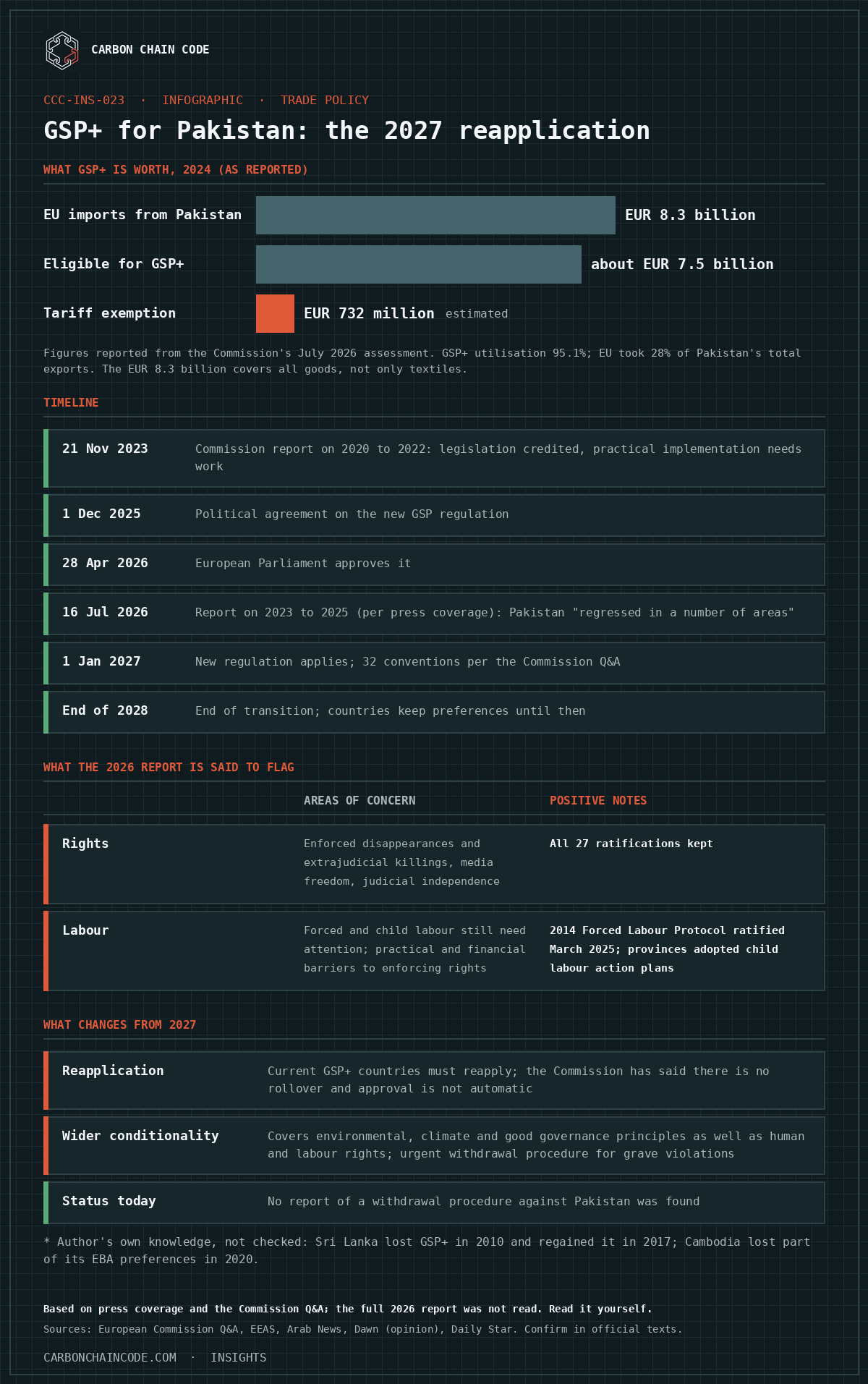
According to figures reported from the Commission's July 2026 assessment, EU imports from Pakistan were €8.3 billion in 2024, of which about €7.5 billion were eligible for GSP+. The estimated tariff exemption was €732 million, GSP+ utilisation was 95.1%, and the EU took 28% of Pakistan's total exports. Pakistan has used GSP+ since 1 January 2014 and is its largest beneficiary. Textiles and clothing dominate the trade. The earlier version of this article gave a saving of €300 to 500 million and a sector export value of €2.5 billion. Neither matches the Commission's figures, so I have removed them. Note that the €8.3 billion covers all goods and not only textiles.
The 2023 Commission report said GSP+ gives Pakistan zero or preferential tariffs on nearly 66% of tariff lines. From my own knowledge, the standard EU duty on most clothing is around 12%, which is the rate GSP+ removes. Check the exact rate for your product codes in the EU's Access2Markets tool.
What the Commission Reports Said
Illustrative summary
The EU publishes a report on each GSP+ country every two years. The previous one came out on 21 November 2023 and covered 2020 to 2022. It credited Pakistan's legislative progress but said practical implementation needed work. The earlier version of this article called this a "2024 review" and listed findings on ILO Conventions 87 and 98, provincial union registration, essential-service strike limits and export processing zones, ILO Convention 169 and torture. I could not find those findings in the sources I read, and Convention 169 is not one of the 27 GSP+ conventions as far as I know, so I removed them.
The latest report came out on 16 July 2026 and covers 2023 to 2025. According to press coverage of it, the Commission said Pakistan "has regressed in a number of areas while positive change was limited". The areas it highlighted were enforced disappearances and extrajudicial killings, media freedom and judicial independence. On labour, commentary on the report says Pakistan ratified the 2014 Protocol to the ILO Forced Labour Convention in March 2025, that provinces adopted child labour action plans, and that forced and child labour still need attention, with workers facing practical and financial barriers to enforcing their rights. Pakistan also kept all 27 ratifications. I have not read the full report. These points come from press articles, one of which is an opinion piece, so read the Commission's text for the exact wording.
What Changes From 2027
The new GSP regulation reached political agreement on 1 December 2025 and was approved by the European Parliament on 28 April 2026. It applies from 1 January 2027. According to the Commission's Q&A page, the list of GSP-relevant conventions grows to 32, five are added (children in armed conflict, persons with disabilities, ILO Conventions 81 and 144, and transnational organised crime) and the Paris Agreement replaces the Kyoto Protocol. The page elsewhere refers to "six new conventions", so I am not certain of the exact count of new GSP+ conventions. Negative conditionality now covers environmental, climate and good governance principles as well as human and labour rights, and there is an urgent withdrawal procedure for grave violations.
Current GSP+ countries must reapply under the new rules. A Commission spokesperson, quoted by Arab News, said there is no rollover and approval is not automatic, and that the application must include a forward-looking plan of action. Countries keep their preferences during a transition until the end of 2028. A separate procedural regulation will set out the reapplication process.
I found no report of a withdrawal procedure against Pakistan, and the Commission's regular approach is engagement before withdrawal. But the 2026 assessment is the evidence base for the reapplication, and it was not positive. My view is that the risk is real and that the timing is the reapplication, not a sudden suspension.
Precedents
These two examples come from my own knowledge and not from the sources above, so check them. Sri Lanka lost GSP+ in 2010 over human rights concerns and regained it in 2017. Cambodia lost part of its EBA preferences in 2020, covering a fraction of its exports, after the Commission found serious rights problems. The earlier version said Cambodia was removed from EBA, which overstates it. In both cases the effect lasted years.
Competition From Bangladesh
Bangladesh sells clothing to the EU duty-free under EBA, the scheme for least developed countries. It is due to graduate from LDC status in November 2026, though it has asked for a deferral to 2029 and the outcome was not settled in the article I read. The Commission says graduating countries receive a three-year transition, and that graduates can apply for GSP+. So Bangladesh may be competing with Pakistan under the same conditions in the longer run. This is a reason for Pakistani exporters to keep the preference.
Date
Event
Source
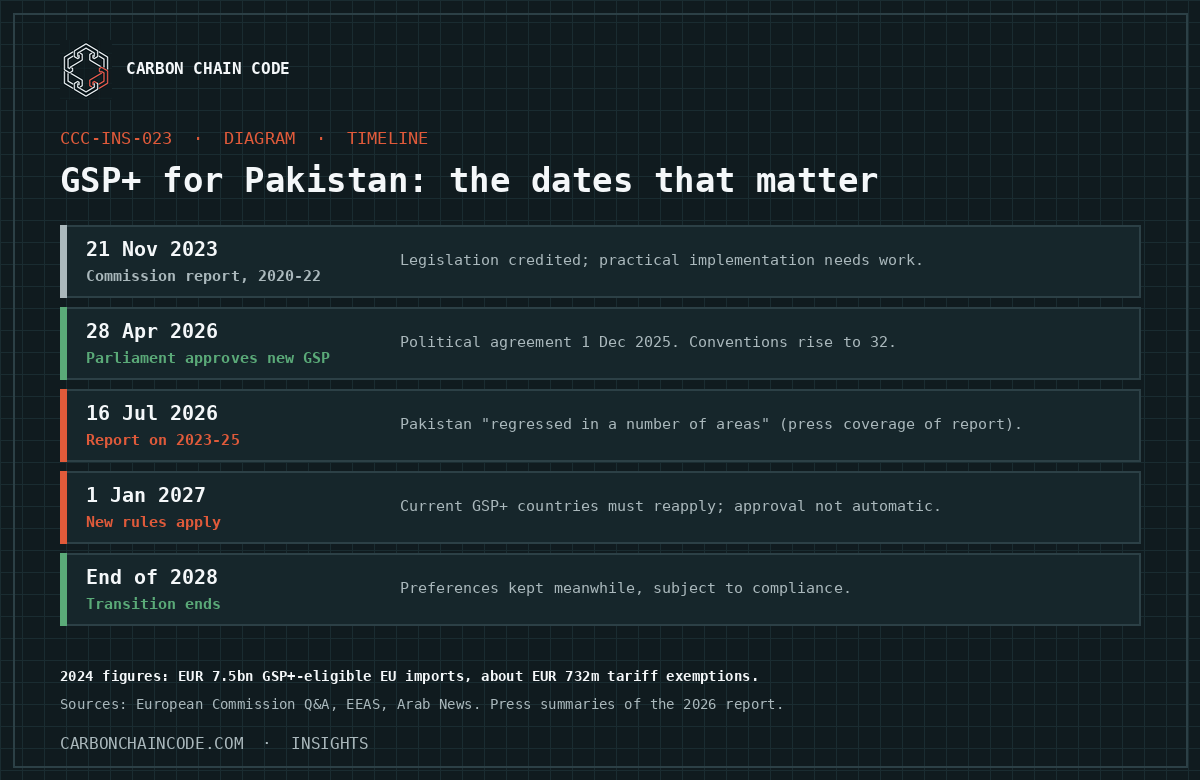
21 Nov 2023
Commission report on 2020 to 2022: legislation credited, practical implementation needs work
EEAS
1 Dec 2025
Political agreement on the new GSP regulation
European Commission Q&A
28 Apr 2026
European Parliament approves it
European Commission Q&A
16 Jul 2026
Report on 2023 to 2025: Pakistan "regressed in a number of areas"
Press coverage of the Commission report
1 Jan 2027
New regulation applies, 32 conventions
European Commission Q&A
End of 2028
End of transition: GSP+ countries must have reapplied
European Commission Q&A
What the exporter should take from this
GSP+ is judged at country level, not factory level. But the issues the Commission names for labour are forced labour, child labour and enforcement of workers' rights, and a factory can show good practice on exactly those. From 2027 the preference depends on a reapplication that the Commission has said is not automatic.
What a factory can do now
Check the duty on your top EU products without GSP+, using Access2Markets, and model the margin effect.
Write down how you check age and employment documents for all workers, including agency and seasonal staff.
Document your grievance channel and how many cases were raised and resolved.
Be ready to show evidence on freedom of association: worker committees and the unions present in your factory.
Read the Commission's July 2026 report for Pakistan yourself, not only press summaries.
Follow the procedural regulation on reapplication when it is published.
Frequently Asked Questions
Has Pakistan lost GSP+?
No. I found no report of a withdrawal procedure. Preferences continue, including through the transition to the end of 2028, subject to compliance.
Do Pakistani exporters need to reapply?
The government does. Under the new GSP rules, current GSP+ countries must reapply, and the Commission has said approval is not automatic. Individual exporters continue using GSP+ proof of origin as before.
What did the July 2026 report say?
According to press coverage, the Commission said Pakistan regressed in a number of areas, with enforced disappearances, media freedom and judicial independence named. It also noted the forced labour protocol ratification and said forced and child labour need attention.
How much is GSP+ worth to Pakistan?
Reported figures for 2024: €7.5 billion of EU imports eligible for GSP+ and about €732 million in tariff exemptions, with 95.1% utilisation.
How many conventions will GSP+ countries need to meet from 2027?
The list rises to 32, according to the Commission's Q&A page, though that page is inconsistent on how many are new.
References
European Commission, Questions and answers on the new EU Generalised Scheme of Preferences. EEAS, EU releases fourth GSP report evaluating implementation of 27 international conventions (21 November 2023). Arab News, EU says Pakistan regressed on rights despite legal reforms under GSP+ review (July 2026). Arab News Pakistan, Pakistan's GSP+ approval will not be automatic as scheme expands to 32 conventions (12 September 2026). Dawn, opinion piece on the Commission's GSP+ review (July 2026). The Daily Star, New trade deals vital before LDC graduation (2 June 2026). The duty rate of about 12% and the Sri Lanka and Cambodia precedents are from my own knowledge. I have not read the Commission's 2026 report in full.
Free tool · Sustainability Frisk
FREE TOOL FROM SUSTAINABILITY FRISK
The CSRD Applicability Checker tells you which thresholds apply to your company and what timeline to follow — in under two minutes.
Need a CSRD gap analysis or hands-on implementation? Sustainability Frisk can help. www.sustainability-frisk.com
Textiles are not covered by the EU Carbon Border Adjustment Mechanism, and they are not in the Commission's current extension proposal. This guide explains what CBAM does cover, how its costs are calculated, and what a Pakistani textile manufacturer should prepare.
87 carbon pricing instruments cover 29% of global emissions. The headline figures, what changed in the EU, China, the UK and Canada, and why it matters to exporters.
 Carbon Chain Code