ISO 50001 Energy Management: What the Standard Requires and What Auditors Check
ISO 50001 uses the same Annex SL structure as ISO 14001, so factories with one certificate have a shorter path to the other. Here is what the standard actually requires and where audits focus.
By Hufsa17 October 20266 min read
ISO 50001:2018 is the international standard for energy management systems. It follows the same high-level structure as ISO 14001 — Plan, Do, Check, Act — which means a factory with one certificate already has most of the management system infrastructure. The standard requires an energy review, a baseline, energy performance indicators, and improvement objectives. It does not specify how much energy you must save.
Why ISO 50001 Matters in 2026
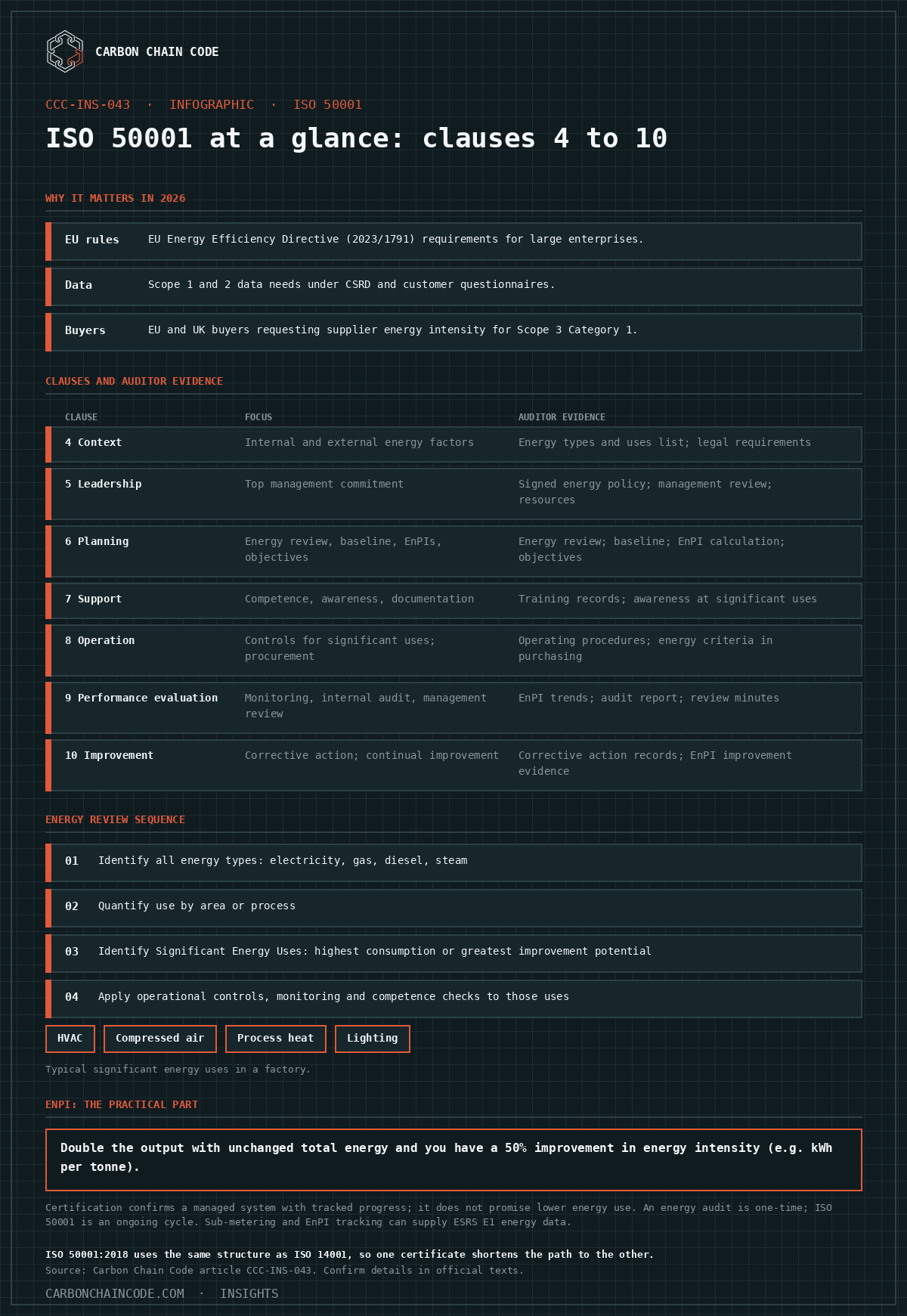
Three pressures are converging. First, the EU Energy Efficiency Directive (2023/1791) requires large enterprises to conduct energy audits every four years or implement an energy management system certified to ISO 50001. Second, Scope 1 and Scope 2 reporting under CSRD and customer questionnaires both require energy consumption data — ISO 50001 creates the data system that produces it reliably. Third, buyers in the EU and UK are increasingly asking suppliers for energy intensity data as part of their Scope 3 Category 1 calculations. [VERIFY: confirm Energy Efficiency Directive 2023/1791 ISO 50001 exemption clause]
What the Standard Requires: The Six Core Elements
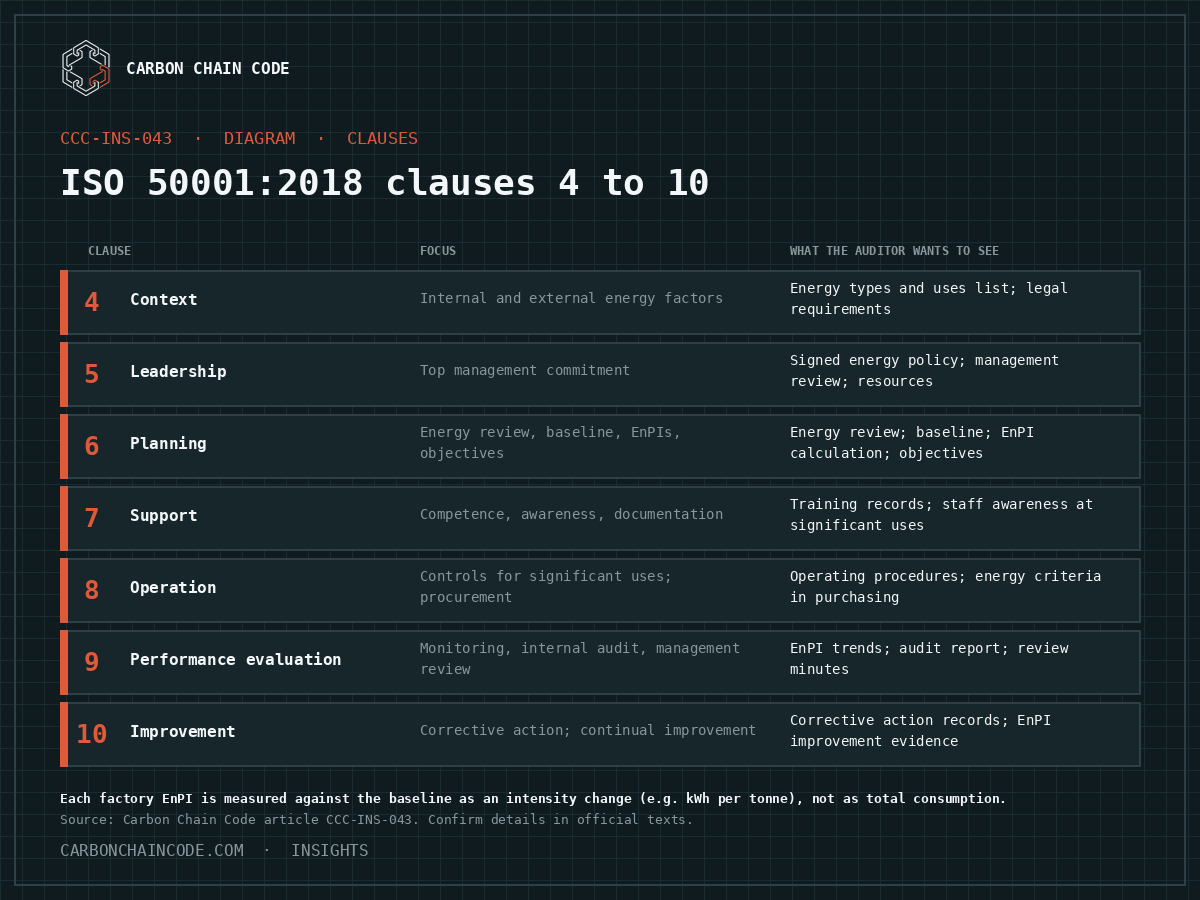
Illustrative summary
Clause
Requirement
What an auditor looks for
4 — Context
Understand internal and external factors affecting energy use
List of energy types and uses; legal and regulatory requirements identified
5 — Leadership
Top management commitment; energy policy
Signed energy policy, management review records, resources allocated
6 — Planning
Energy review; significant energy uses; baseline and EnPIs; objectives
Energy review document; baseline data; EnPI calculation; documented improvement objectives
7 — Support
Competence, awareness, documented information
Training records; staff at significant energy uses aware of their contribution
8 — Operation
Operational controls for significant energy uses; procurement criteria
Procedures for operating significant equipment; energy criteria in procurement for major equipment
EnPI trend data; internal audit report; management review minutes with energy performance on the agenda
10 — Improvement
Nonconformities corrected; continual improvement of energy performance
Corrective action records; evidence that EnPIs are improving or that targets are met
Energy Review and Significant Energy Uses
The energy review is the diagnostic that drives the whole system. It identifies all energy types used (electricity, natural gas, diesel, steam), quantifies current use and consumption by area or process, and identifies the Significant Energy Uses — the equipment or processes that consume the most energy or offer the greatest improvement potential. Typical significant energy uses in manufacturing include HVAC and air conditioning, compressed air systems, process heat (ovens, steam), and lighting. Once identified, significant energy uses require operational controls, monitoring and competence checks for the people who operate them.
Energy Performance Indicators: The Practical Part
An Energy Performance Indicator (EnPI) is a measurable value that tracks energy performance. The most common factory EnPI is energy intensity: energy consumed per unit of production output. For example, kWh per tonne of finished product, or kWh per pair of shoes. The baseline is the EnPI calculated from historical data at the start of the system. Improvement is measured as the change in the EnPI over time against that baseline — not just a reduction in total consumption, because output volume changes. A factory that doubles production and uses the same total energy has improved its intensity by 50% even though absolute consumption is unchanged.
Frequently Asked Questions
Does ISO 50001 certification mean a factory has reduced its energy use?
Not necessarily. Certification confirms that a management system is in place and that the factory is monitoring and working toward improvement. It does not require a specific level of reduction. A factory can be certified while its EnPI is still declining toward its target. Auditors check that targets are set and that progress is tracked, not that a particular saving has been achieved.
How is ISO 50001 different from an energy audit?
An energy audit is a one-time diagnostic: it surveys current energy use and recommends improvements, then ends. ISO 50001 is a management system: it is an ongoing cycle of planning, implementation, monitoring and review. The EU Energy Efficiency Directive offers ISO 50001 certification as an alternative to repeated energy audits because the system produces equivalent or better ongoing rigour.
Can ISO 50001 data feed into a CSRD energy disclosure?
Yes. The monitoring and measurement system required by ISO 50001 — sub-metering by area, monthly consumption records by energy type, EnPI tracking — produces exactly the data needed for ESRS E1 energy consumption and intensity disclosures. Factories with ISO 50001 in place are generally in a much stronger position when their customers start asking for Scope 1 and 2 data.
Need a CSRD gap analysis or hands-on implementation? Sustainability Frisk can help. www.sustainability-frisk.com
Most ISO 14001 preparation focuses on building the documentation. Auditors focus on something different: whether your system actually works. A TÜV-certified Lead Auditor explains the six things that determine your certification outcome.
ISO 45001 and ISO 14001 share the same harmonized structure, so one management system can serve both. This guide maps clause by clause what you can run once, what must stay separate, and how to run a combined internal audit without gaps.
 Carbon Chain Code