 Carbon Chain Code
CCC-SUS-006Sustainability/ESG
CSRD for Suppliers: Guide + Response Workbook
Practical CSRD guide and Excel workbook for manufacturers answering EU customer sustainability requests. Value chain cap, Annex II decoder, reply templates.
Most ISO 14001 preparation focuses on building the documentation. Auditors focus on something different: whether your system actually works. A TÜV-certified Lead Auditor explains the six things that determine your certification outcome.
ISO 14001 certification audits follow a clause-by-clause structure, but experienced lead auditors do not spend equal time on every clause. They follow a thread — a traceability chain from your significant environmental aspects through to management review — and test whether each link holds. If it does not, the documentation behind it does not matter. Most certification consultants prepare organisations for the documentation; this article covers what auditors actually test.
ISO 14001:2015 is a management system standard, not a technical performance standard. It does not require a factory to achieve a specific emissions level or to use specific technologies. What it requires is that the organisation has a system that identifies its environmental impacts, controls the significant ones, monitors whether those controls are working, and continuously improves. An auditor's job is to verify that this cycle is real — not that a procedure document exists, but that the procedure is followed, that deviations are caught, and that the system learns from them.
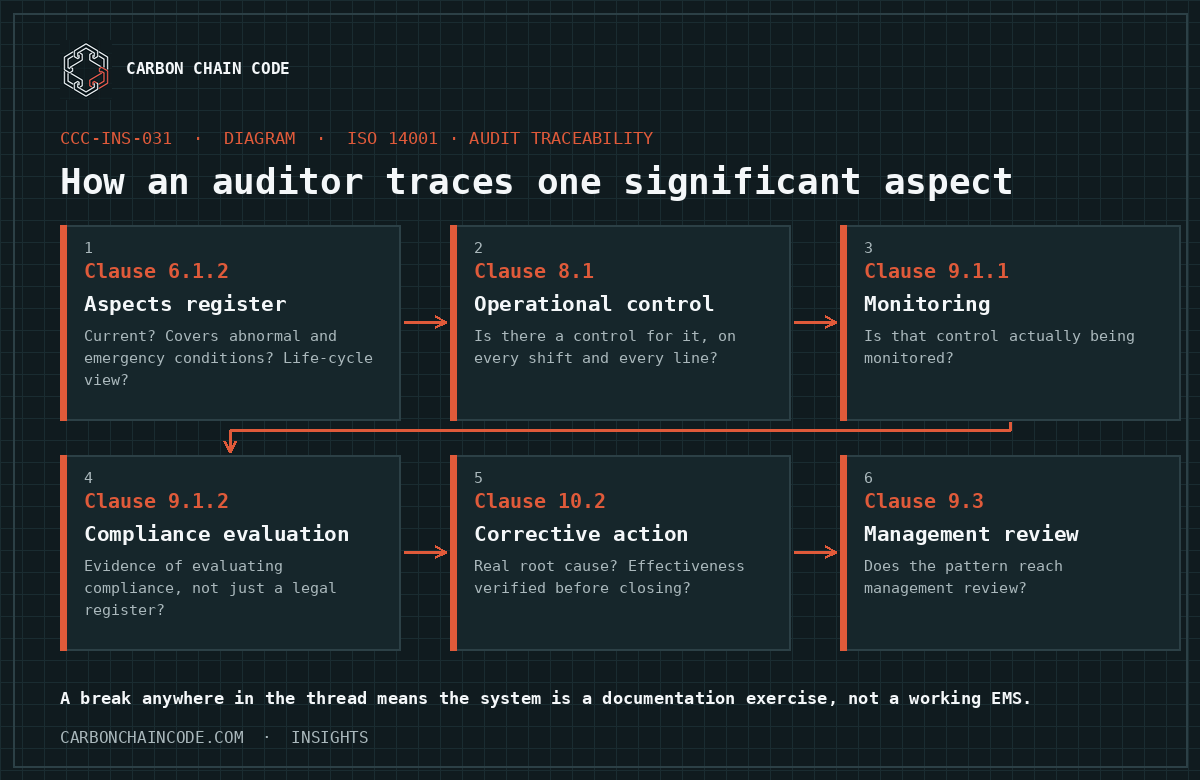
The single most useful frame for understanding what an auditor does is the traceability thread. Starting from your environmental aspects and impacts register (Clause 6.1.2), a lead auditor will trace each significant aspect forward through the system: Is there an operational control for it (Clause 8.1)? Is that control being monitored (Clause 9.1.1)? Are monitoring results reviewed against compliance obligations (Clause 9.1.2)? When a control fails, is there a corrective action (Clause 10.2)? Is the corrective action actually effective? Does the pattern reach management review (Clause 9.3)? A system that passes this trace for every significant aspect is a functioning EMS. A system that breaks the trace anywhere is a documentation exercise.
The aspects register is the foundation of the entire system. Auditors check three things that consultants often underemphasise: completeness (does the register cover abnormal operating conditions and emergency scenarios, not just normal operations?), currency (was it reviewed after any significant change — new equipment, new chemical, new process — or is it two years old and unchanged?), and the life-cycle perspective (does it extend beyond the factory gate to upstream inputs and downstream product disposal, as required by Clause 6.1.2)? A register that covers only normal operations and was last updated before the last major equipment change will typically generate at least a minor nonconformance.
This is the clause most commonly misunderstood by organisations and most consistently probed by auditors. Having a legal and regulatory register is not compliance evaluation. Clause 9.1.2 requires that the organisation periodically evaluates whether it is actually complying with each applicable obligation — and retains documented evidence of that evaluation. An auditor will ask to see the compliance evaluation record, not the legal register. If you can show a register with 47 obligations but cannot show when you last confirmed compliance against any of them, expect a nonconformance.
Auditors check operational controls for two failure modes that consultants rarely address. The first is cross-shift and cross-site consistency: a control that exists in the day shift procedure but is absent from the night shift, or that applies to one production line but not an identical adjacent one, is treated as an absence of control. The second is the link back to significance: if a control exists for an aspect that is not on the significant aspects list, and an aspect that is on the list has no control, the system has a gap regardless of how much documentation surrounds it.
Most organisations document environmental objectives. Auditors verify whether those objectives are measured. An objective to 'reduce water consumption' without a baseline figure, a target, a measurement method, and a timeline is not an objective — it is an aspiration. The clause requires specific, measurable objectives with documented progress monitoring. An auditor will ask to see the most recent progress review against each objective. If there is no review record, expect a finding.
Two common findings in Clause 10.2: corrective actions closed without effectiveness verification, and root causes stated as 'human error.' On the first: a corrective action is not complete when the immediate fix is implemented — it is complete when evidence confirms the nonconformance has not recurred. On the second: auditors are trained to challenge 'human error' as a root cause because it is almost always a system failure in disguise (inadequate procedure, missing training, poor process design). A corrective action record that attributes a nonconformance to human error and closes with 'retrained operator' is likely to be questioned.
Surveillance audits get far less attention than initial certification, and this is where certification silently degrades. Surveillance audits are shorter than initial certification audits but they carry the same weight. An organisation that invests heavily in preparation for initial certification and then treats the EMS as static until the re-certification audit will typically show evidence of system degradation — outdated registers, compliance evaluations that were done once and not repeated, corrective actions with no effectiveness checks. Auditors are specifically looking for whether the system has been maintained, not just whether it was built.
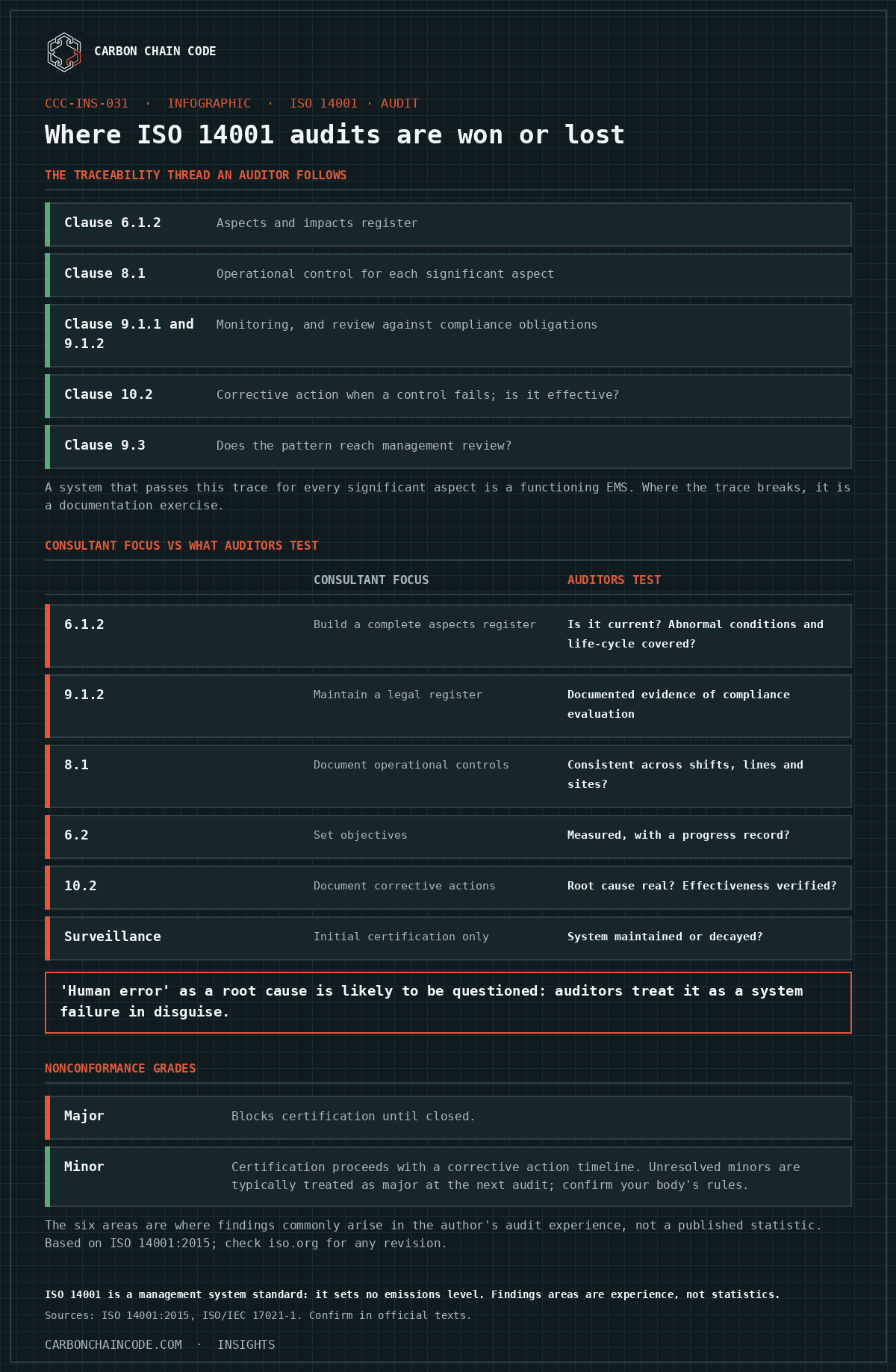
This article covers ISO 14001:2015, the version in force when it was written; check iso.org for any revision before your audit. The six areas below are where findings commonly arise in the author's audit experience, not a published statistic: 6.1.2 (aspects register), 9.1.2 (compliance evaluation), 8.1 (operational controls), 6.2 (objectives), 10.2 (corrective action), and maintenance of the system between audits (surveillance). Major nonconformance: blocks certification until closed. Minor nonconformance: allows certification with a corrective action timeline. Certification bodies typically treat unresolved minors as major at the next audit; confirm your own body's rules.
| Area | Typical consultant focus | What auditors actually test |
|---|---|---|
| Clause 6.1.2 | Build a complete aspects register | Is it current? Does it cover abnormal conditions and life-cycle perspective? |
| Clause 9.1.2 | Maintain a legal register | Can you show documented evidence of compliance evaluation against each obligation? |
| Clause 8.1 | Document operational controls | Are controls consistent across shifts, lines, and sites? Do they match the significant aspects list? |
| Clause 6.2 | Set environmental objectives | Are objectives measured? Is there a progress record? Are they linked to significant aspects? |
| Clause 10.2 | Document corrective actions | Were root causes properly identified? Was effectiveness verified before closing? |
| Surveillance | Initial certification only | Has the system been actively maintained, or has it decayed since the last audit? |
Pre-audit checklist
ISO 14001:2015, Environmental management systems: Requirements with guidance for use (clauses 6.1.2, 6.2, 8.1, 9.1.1, 9.1.2, 9.2, 9.3 and 10.2). ISO/IEC 17021-1, Requirements for bodies providing audit and certification of management systems, which sets the framework certification bodies follow; each body applies its own nonconformity rules. Check iso.org for current editions.
A major nonconformance is a failure that indicates the management system is not implemented, not maintained, or unlikely to achieve its intended outcomes — for example, no compliance evaluation has ever been conducted, or a significant environmental aspect has no operational control. A major nonconformance blocks certification until it is resolved. A minor nonconformance indicates a partial failure — a single instance where the system fell short of the requirement. Certification proceeds with a corrective action timeline. Most certification bodies treat unresolved minors as major at the next audit, but the rule is set by your certification body, so confirm it with them.
No. ISO 14001 is a management system standard, not a performance standard. It requires that you have a system for identifying and controlling environmental impacts and that you commit to continual improvement — but it does not set minimum emissions levels, energy consumption targets, or technology requirements. What auditors verify is whether your system is real and functioning, not whether you have achieved a specific environmental outcome.
ISO 14001:2015 does not specify a fixed review interval, but requires that the register be kept current and that it reflects the organisation's activities, products, and services. Best practice is an annual review at minimum and an immediate update whenever a significant change occurs — new or modified equipment, new chemicals or materials, changes in production processes, new legal requirements, or expansion to new areas or subcontracted operations. An auditor who finds a register that was last updated two years ago and notes that significant process changes have occurred since then will treat it as a nonconformance.
A surveillance audit is a shorter follow-up audit a certification body carries out between initial certification and re-certification, normally in years two and three of the cycle. It checks that the environmental management system has been maintained and is still working: current registers, repeated compliance evaluations, and corrective actions with verified effectiveness. Timing and scope are set by your certification body.
Free tool · Sustainability Frisk
How ready is your factory for ISO 14001 certification?
Take the free ISO 14001 Readiness Assessment — 10 questions, instant gap report.
Need a CSRD gap analysis or hands-on implementation? Sustainability Frisk can help. www.sustainability-frisk.com
Practical CSRD guide and Excel workbook for manufacturers answering EU customer sustainability requests. Value chain cap, Annex II decoder, reply templates.
CSRD tells large companies to report on sustainability. CSDDD tells them to act on adverse impacts across their chains of activities. After Omnibus I, both cover only the largest companies, on different timelines, and the old civil liability and transition plan points no longer work as this article first described them.

ISO 14001 tells you to set an environmental objective. Six Sigma's DMAIC gives you a structured method to reach it. Here is how each phase maps to a Scope 1 and Scope 2 carbon reduction project, with an illustrative worked example.