 Carbon Chain Code
CCC-SUS-006Sustainability/ESG
CSRD for Suppliers: Guide + Response Workbook
Practical CSRD guide and Excel workbook for manufacturers answering EU customer sustainability requests. Value chain cap, Annex II decoder, reply templates.
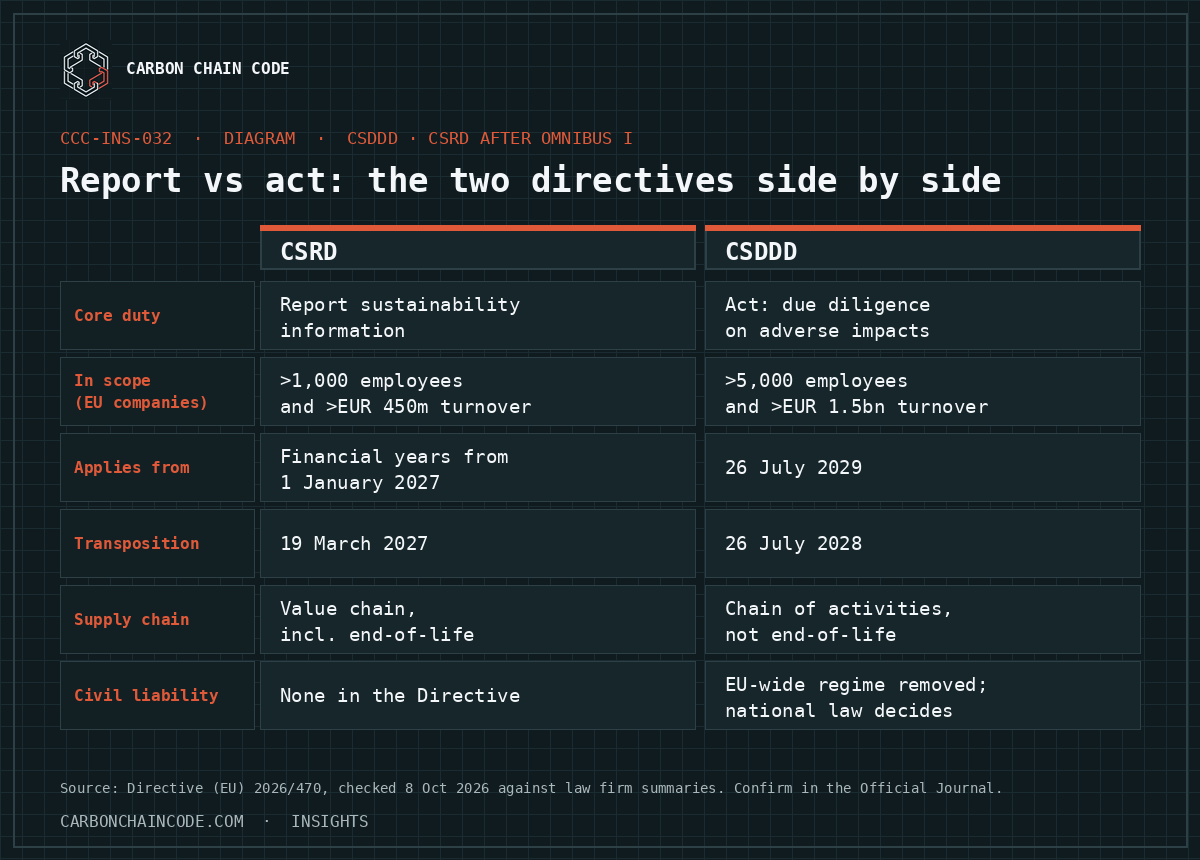
CSRD tells large companies to report on sustainability. CSDDD tells them to act on adverse impacts across their chains of activities. After Omnibus I, both cover only the largest companies, on different timelines, and the old civil liability and transition plan points no longer work as this article first described them.
CSRD (Corporate Sustainability Reporting Directive, Directive (EU) 2022/2464) requires large companies to disclose sustainability information in a standard format. CSDDD (Corporate Sustainability Due Diligence Directive, Directive (EU) 2024/1760) requires large companies to identify and address adverse human rights and environmental impacts across their chains of activities. One is a reporting obligation. The other is a due diligence obligation. Both were amended by Directive (EU) 2026/470, known as Omnibus I, and several points commonly repeated about them are now out of date. Complying with CSRD does not mean complying with CSDDD.
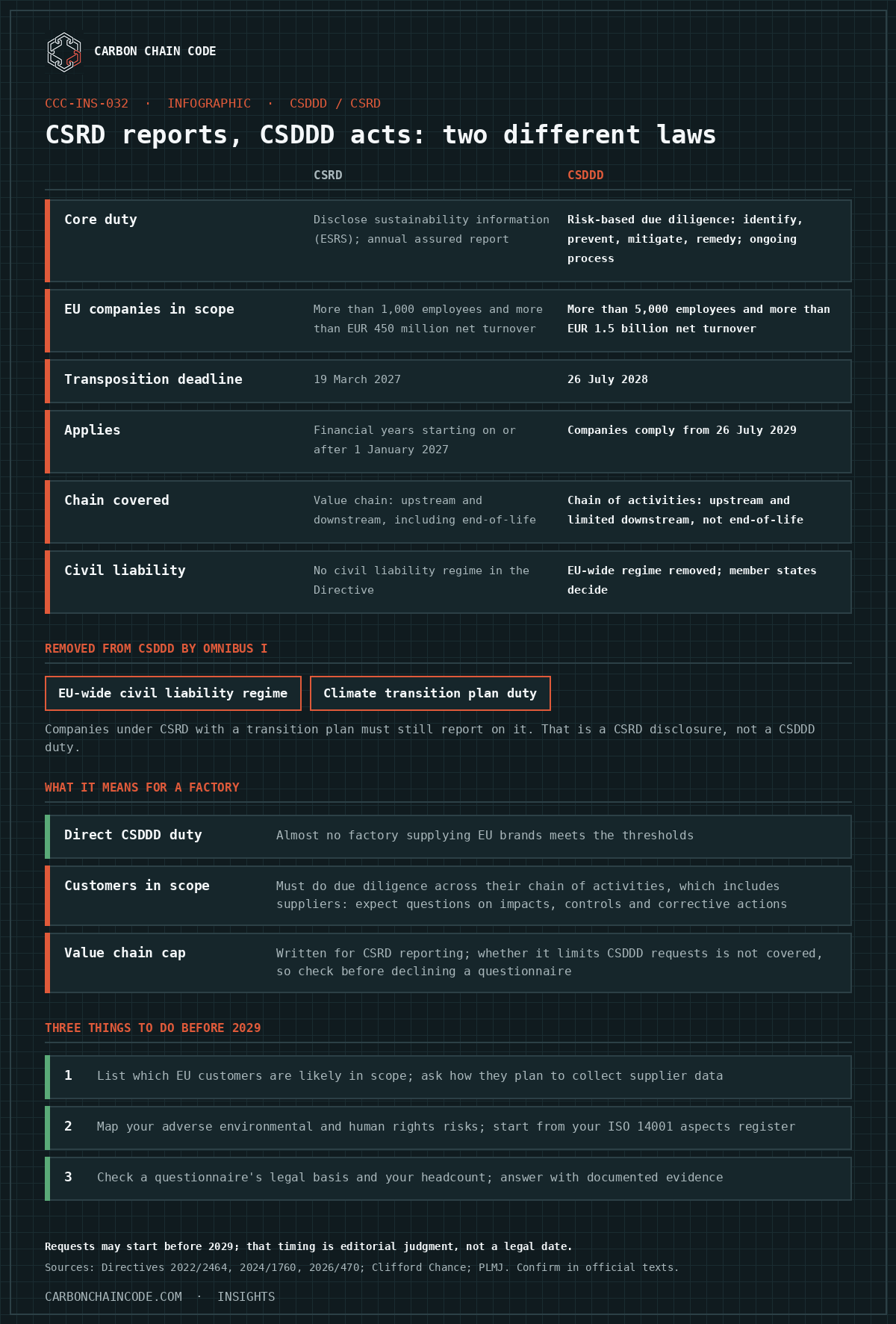
| CSRD | CSDDD | |
|---|---|---|
| Legal citation | Directive (EU) 2022/2464, amended by Directive (EU) 2026/470 | Directive (EU) 2024/1760, amended by Directive (EU) 2026/470 |
| Core obligation | Disclose sustainability information (ESRS) | Conduct risk-based due diligence: identify, prevent, mitigate and remedy adverse impacts |
| Output | Annual sustainability report, assured | Ongoing due diligence process, with monitoring and complaints handling |
| Who is in scope (EU companies) | More than 1,000 employees and more than EUR 450 million net turnover | More than 5,000 employees and more than EUR 1.5 billion net turnover |
| Application | New scope applies from financial years starting on or after 1 January 2027 | Companies must comply from 26 July 2029 |
| Member state transposition deadline | 19 March 2027 | 26 July 2028 |
| Supply chain scope | Value chain: upstream and downstream, including product end-of-life | Chain of activities: upstream and limited downstream, not end-of-life |
| Civil liability | No civil liability regime in the Directive | The EU-wide civil liability regime was removed; member states decide whether non-compliance creates civil liability |
After Omnibus I, CSRD applies to EU companies with more than 1,000 employees and more than EUR 450 million in net turnover, at individual or consolidated level. Non-EU groups are in scope if they generate more than EUR 450 million in net turnover in the EU in each of the last two consecutive financial years and have an EU subsidiary or branch with more than EUR 200 million in net turnover. Listed small and medium-sized companies were removed from scope. The new scope applies from financial years starting on or after 1 January 2027. Member states must transpose the changes by 19 March 2027.
Omnibus I also changed CSDDD. It now covers EU companies with more than 5,000 employees and more than EUR 1.5 billion in net worldwide turnover, and non-EU companies with more than EUR 1.5 billion in net turnover in the EU. Companies must comply from 26 July 2029, and the transposition deadline moved to 26 July 2028. The earlier thresholds of 1,000 employees and EUR 450 million, and the earlier phased start dates, no longer describe current law. If you read a source that quotes them, it predates Omnibus I.
Two points widely quoted about CSDDD no longer hold. First, the EU-wide civil liability regime was removed. Member states now decide whether failing to meet the due diligence duty creates civil liability under national law, so exposure depends on the country where a claim is brought. Second, the obligation to adopt and put into effect a climate transition plan was removed. Companies that fall under CSRD and have a transition plan must still report on it, but that is a CSRD disclosure, not a CSDDD duty.
The real overlap is practical. A large customer may need supplier information for CSRD reporting and for CSDDD due diligence, and the same questionnaire often serves both purposes. The two directives use different concepts of scope. CSRD's value chain covers all operations upstream and downstream, including product end-of-life. CSDDD's chain of activities covers upstream suppliers and limited downstream activities such as distribution, and does not include end-of-life. A company mapping its value chain for ESRS S2 (workers in the value chain) covers more than CSDDD due diligence requires.
CSRD scope after Omnibus I: more than 1,000 employees and more than EUR 450 million net turnover; applies from financial years starting on or after 1 January 2027; transposition 19 March 2027. CSDDD scope after Omnibus I: more than 5,000 employees and more than EUR 1.5 billion net turnover; compliance from 26 July 2029; transposition 26 July 2028. EU-wide civil liability and the climate transition plan duty were removed from CSDDD. Figures checked 8 October 2026 against law firm summaries of Directive (EU) 2026/470; confirm against the Official Journal text before relying on them.
Almost no factory supplying EU brands meets the CSDDD thresholds. But a customer that is in scope must carry out due diligence across its chain of activities, which includes its suppliers. Expect questions about your impacts, your controls and your corrective actions. These requests can start before 2029 as customers build their processes. That timing is editorial judgment, not a legal date.
Omnibus I also introduced a value chain cap for CSRD reporting. In-scope companies generally cannot ask undertakings with an average of no more than 1,000 employees for more than the voluntary sustainability reporting standard for SMEs (VSME), and they can generally rely on those suppliers' self-declarations. Contract terms that undermine the cap are not binding. Whether the same cap limits CSDDD due diligence requests is not covered here, so check it before declining a CSDDD questionnaire.
The ISO 14001 framework helps with either type of request. CSDDD calls for risk-based prioritisation of adverse impacts, which resembles the significant aspects method in ISO 14001. A factory with a working environmental management system already holds the data customers ask for: an aspects register, compliance evaluation records and operational controls. A factory without one will have to build that evidence under customer pressure.
Directive (EU) 2022/2464 (CSRD). Directive (EU) 2024/1760 (CSDDD). Directive (EU) 2026/470 (Omnibus I), which amends both. Summaries consulted on 8 October 2026: Clifford Chance, Omnibus I: The European Union concludes CSDDD and CSRD reforms (February 2026), and PLMJ, CSRD and CS3D reviewed. Always confirm figures and dates in the Official Journal text.
Almost certainly not. After Omnibus I, CSDDD covers EU companies with more than 5,000 employees and more than EUR 1.5 billion net turnover, and non-EU companies with more than EUR 1.5 billion net turnover in the EU. Your in-scope customers will still carry out due diligence across their chain of activities, which includes your facility, so you may receive requests for information and corrective action.
Not under an EU-wide regime. Omnibus I removed the EU-wide civil liability provision. Member states decide whether failure to meet the due diligence duty creates civil liability, so the position depends on national law once CSDDD is transposed.
Companies must comply from 26 July 2029. Member states must transpose the Directive by 26 July 2028. These dates come from Omnibus I and replace the earlier phased dates.
The cap is written for CSRD reporting: in-scope companies generally cannot ask undertakings with an average of no more than 1,000 employees for more than the VSME standard. Whether it limits CSDDD due diligence requests is not settled in this article, so check the rules that apply and the purpose of each request before declining.
Free tool · Sustainability Frisk
Not sure if CSRD applies to your business?
Use the free CSRD Applicability Checker — answer 5 questions and get a clear in/out result.
Need a CSRD gap analysis or hands-on implementation? Sustainability Frisk can help. www.sustainability-frisk.com
Practical CSRD guide and Excel workbook for manufacturers answering EU customer sustainability requests. Value chain cap, Annex II decoder, reply templates.
Omnibus I removed most companies from the CSRD, but it did not stop supplier data requests. Here is who still reports, what the value chain cap protects, and what a factory should prepare.
The scope, the value chain cap, assurance and sector standards, and what the 61% figure really refers to. A plain summary for manufacturers and their suppliers.