 Carbon Chain Code
CCC-SUS-001Sustainability/ESG · Workbook
CSRD Data Request Workbook
Decode EU customer sustainability questionnaires and build one reusable, evidence-backed answer set. PDF guide + Excel workbook for manufacturers.
The scope, the value chain cap, assurance and sector standards, and what the 61% figure really refers to. A plain summary for manufacturers and their suppliers.

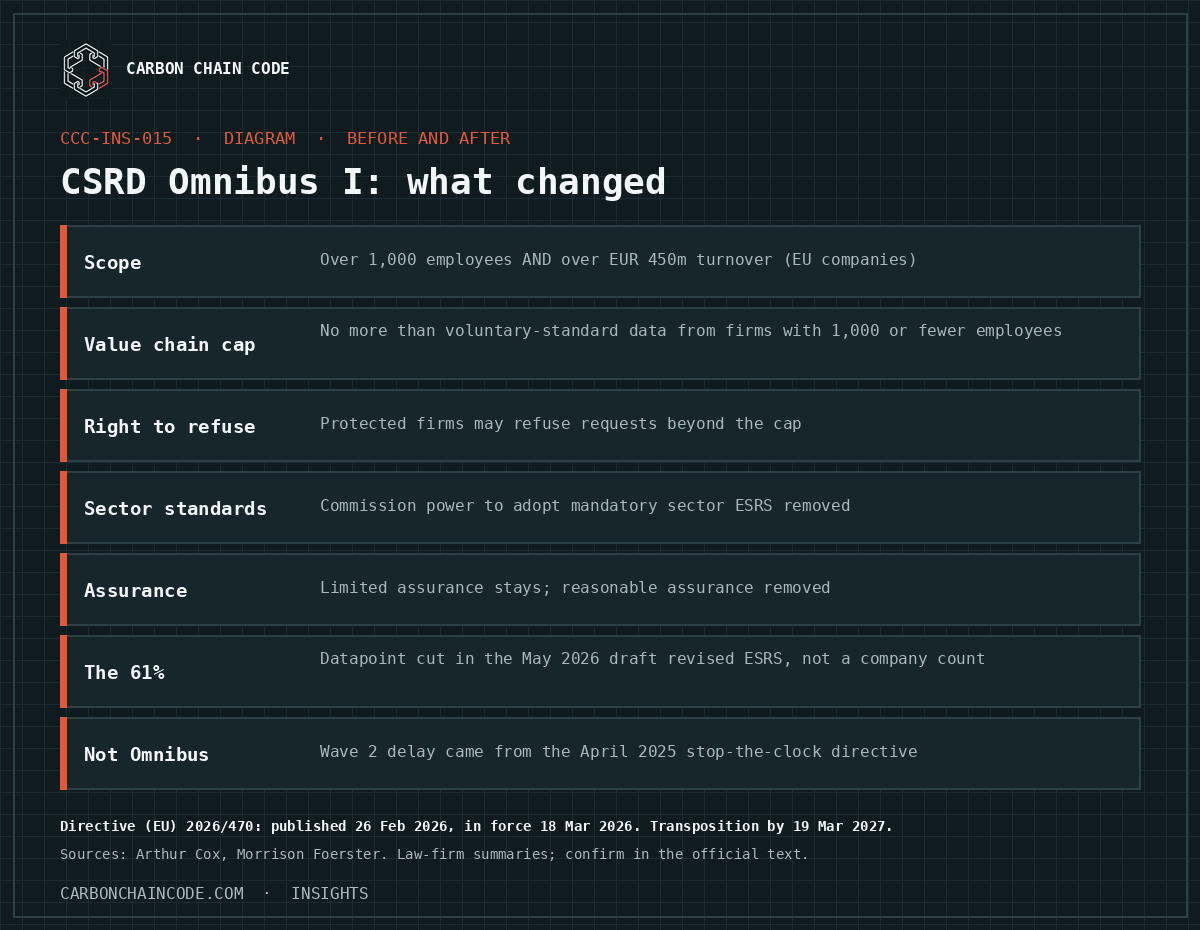
Omnibus I is the EU's 2026 simplification of the CSRD and the CSDDD. It was published in the Official Journal on 26 February 2026 and entered into force on 18 March 2026 as Directive (EU) 2026/470. For most manufacturers and suppliers the changes that matter are the narrower scope and the new limit on what large companies can ask of smaller suppliers. The earlier version of this article had several details wrong, including what the 61% figure refers to, so I rebuilt it.
The 61% is not a cut in the number of companies. It is the reduction in mandatory datapoints in the draft revised ESRS that the Commission published for consultation on 6 May 2026. The Commission adopted the revised ESRS on 3 July 2026, and an adviser summary puts the cut in the final version at about 60%. The sources I read give no figure for how many companies left the scope, and I could not confirm the earlier version's "50,000 to 19,000".
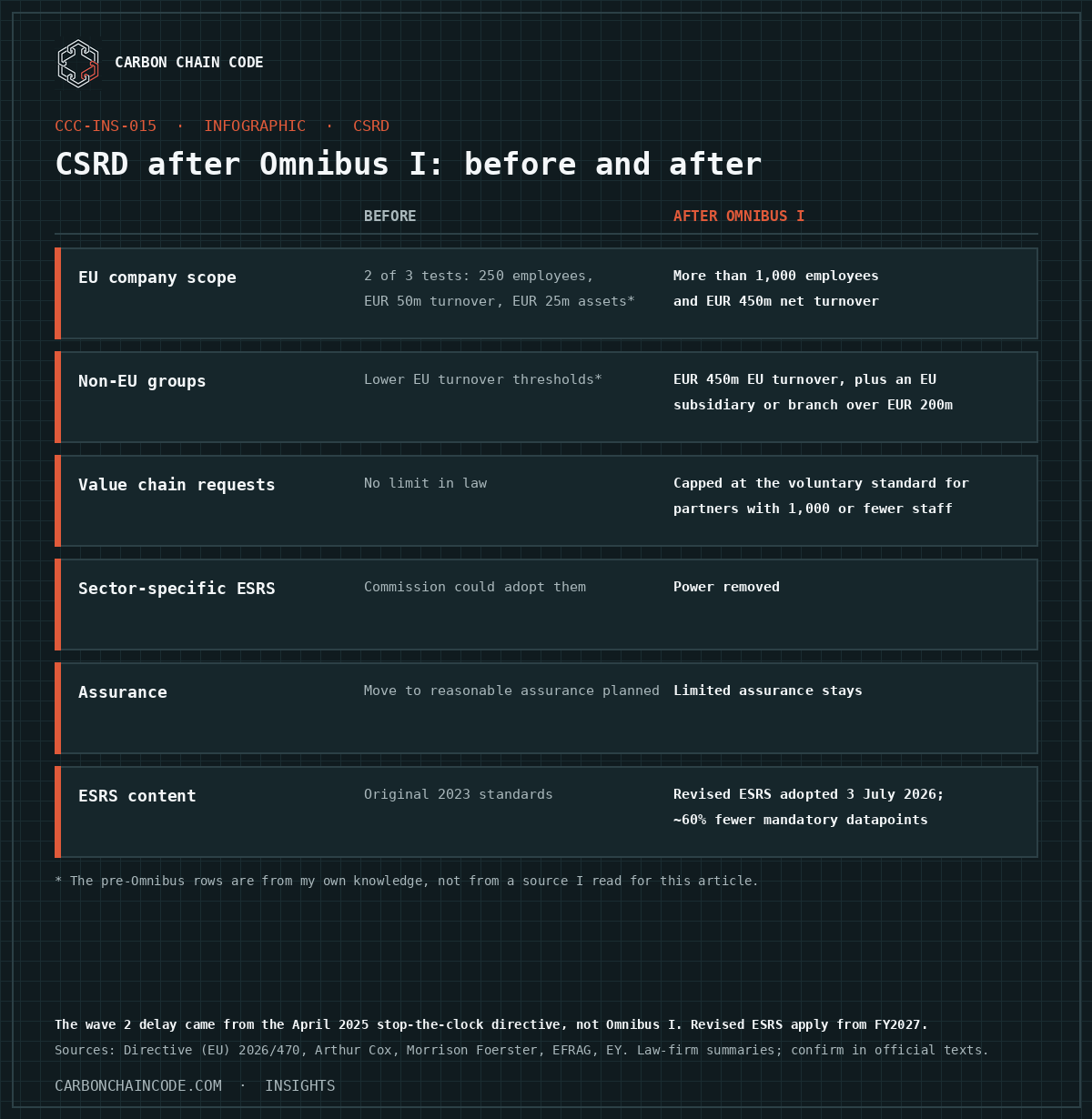
| Point | Before | After Omnibus I |
|---|---|---|
| EU company scope | Large companies meeting two of three tests (250 employees, €50 million turnover, €25 million assets) | More than 1,000 employees and more than €450 million net turnover |
| Non-EU groups | Lower EU turnover thresholds | More than €450 million EU turnover, plus an EU subsidiary or branch with more than €200 million turnover |
| Value chain requests | No limit in law | Companies may not require information from undertakings with 1,000 or fewer employees beyond limits aligned with voluntary standards |
| Sector-specific ESRS | Commission power to adopt mandatory sector standards | Power removed |
| Assurance | Planned move from limited to reasonable assurance | Limited assurance stays; move to reasonable assurance removed |
| ESRS content | Original ESRS | Revised ESRS adopted 3 July 2026 (draft of 6 May cut mandatory datapoints by 61%; about 60% in the final, per one adviser); apply from FY2027 |
This is the change that matters most for suppliers. A reporting company may not require information from a supplier or other counterparty with 1,000 or fewer employees beyond limits aligned with the voluntary reporting standard. Such a company has a statutory right to refuse requests beyond the cap, and the reporting company must tell it so. A reporting company may rely on a counterparty's self-declaration without further verification unless it has clear reason to doubt it. A company that stays within the cap is treated as having met its value chain reporting obligations, including through the use of estimates.
The earlier version of this article said the cap is set by "Annex II of the VSME" and that firms with 10 or fewer employees face a shorter list. I could not confirm either. The voluntary standard has a Basic Module and a Comprehensive Module; the May draft numbered them B1–B11 and C1–C9. It entered into force on 24 September 2026. I did not check whether the final numbering is unchanged, so check the text. The cap covers requests made for CSRD reporting. It may not limit requests under other laws or customer programmes.
The delay of waves 2 and 3 was not part of Omnibus I. It came from the earlier "stop-the-clock" directive, which entered into force in April 2025, and Omnibus I does not change those dates. Companies in wave 2 that remain in scope first report in 2028, for financial years starting on or after 1 January 2027. Member States may, but need not, exempt wave 1 companies that now fall outside the thresholds from reporting in 2026 and 2027. Member States generally have until 19 March 2027 to transpose the CSRD changes, so national details will still vary. Listed SMEs were part of the earlier waves; I could not confirm their treatment in the final text, so check it.
The Commission's power to adopt mandatory sector-specific standards, which would have covered sectors such as textiles, was removed to avoid adding datapoints. Double materiality stays. The earlier version of this article said Omnibus I tightened materiality thresholds. I found no support for that. The May draft of the revised ESRS instead allowed a top-down approach at topic level and said companies must not report information that is not material; I have not checked the final text on this. Limited assurance remains the standard, and the deadline for the Commission to adopt limited assurance standards moved to 1 July 2027.
The earlier version also referred to a 2028 review clause. I could not find it in the sources I read, so I removed it. The review dates I did find, 26 July 2028 and 26 July 2029, concern the CSDDD, not the CSRD.
Practical steps
EU companies with more than 1,000 employees and more than €450 million net turnover. Non-EU groups with more than €450 million EU turnover and an EU subsidiary or branch above €200 million.
No. It is the reduction in mandatory datapoints in the Commission's May 2026 draft revised ESRS, about 60% in the final version according to one adviser.
If you have 1,000 or fewer employees, not for CSRD purposes beyond the cap. You have a right to refuse and the customer must tell you so. Other laws and contracts may still ask for data.
No. The delay came from the stop-the-clock directive of April 2025. Omnibus I did not change those dates.
Directive (EU) 2026/470 (Omnibus I), published 26 February 2026. Arthur Cox, Omnibus I Directive published: revised scope and reduced obligations under CSRD and CSDDD. Morrison Foerster, EU Sustainability Omnibus I: the detailed omnibus adopted (December 2025), and European Commission Proposes Revised ESRS (May 2026). The pre-Omnibus scope row is from my own knowledge. These are law-firm summaries, so confirm details in the official text.
Free tool · Sustainability Frisk
Not sure if CSRD applies to your business?
Use the free CSRD Applicability Checker — answer 5 questions and get a clear in/out result.
Need a CSRD gap analysis or hands-on implementation? Sustainability Frisk can help. www.sustainability-frisk.com
Decode EU customer sustainability questionnaires and build one reusable, evidence-backed answer set. PDF guide + Excel workbook for manufacturers.
Practical CSRD guide and Excel workbook for manufacturers answering EU customer sustainability requests. Value chain cap, Annex II decoder, reply templates.

Omnibus I removed most companies from the CSRD, but it did not stop supplier data requests. Here is who still reports, what the value chain cap protects, and what a factory should prepare.

The EU Digital Product Passport will put product-level data requirements on textile supply chains, but the rules for textiles are not adopted yet. This guide separates what is in force, what is expected and what a factory can build now.