 Carbon Chain Code
CCC-SUS-006Sustainability/ESG
CSRD for Suppliers: Guide + Response Workbook
Practical CSRD guide and Excel workbook for manufacturers answering EU customer sustainability requests. Value chain cap, Annex II decoder, reply templates.
ISO 45001 and ISO 14001 share the same harmonized structure, so one management system can serve both. This guide maps clause by clause what you can run once, what must stay separate, and how to run a combined internal audit without gaps.
ISO 45001:2018 (occupational health and safety) and ISO 14001:2015 (environmental management) are both built on the ISO harmonized structure, so both use the same clause numbers from Clause 4 to Clause 10 and share a large amount of core text. That makes it practical to run one integrated management system (IMS) instead of two parallel systems. Integration does not mean the two standards are the same. Clause titles and requirements differ in several places, and ISO 45001 has requirements, such as worker participation and incident investigation, that ISO 14001 does not. This guide maps where to integrate and where to keep content separate, based on the standard structure and public guidance from certification and accreditation bodies.
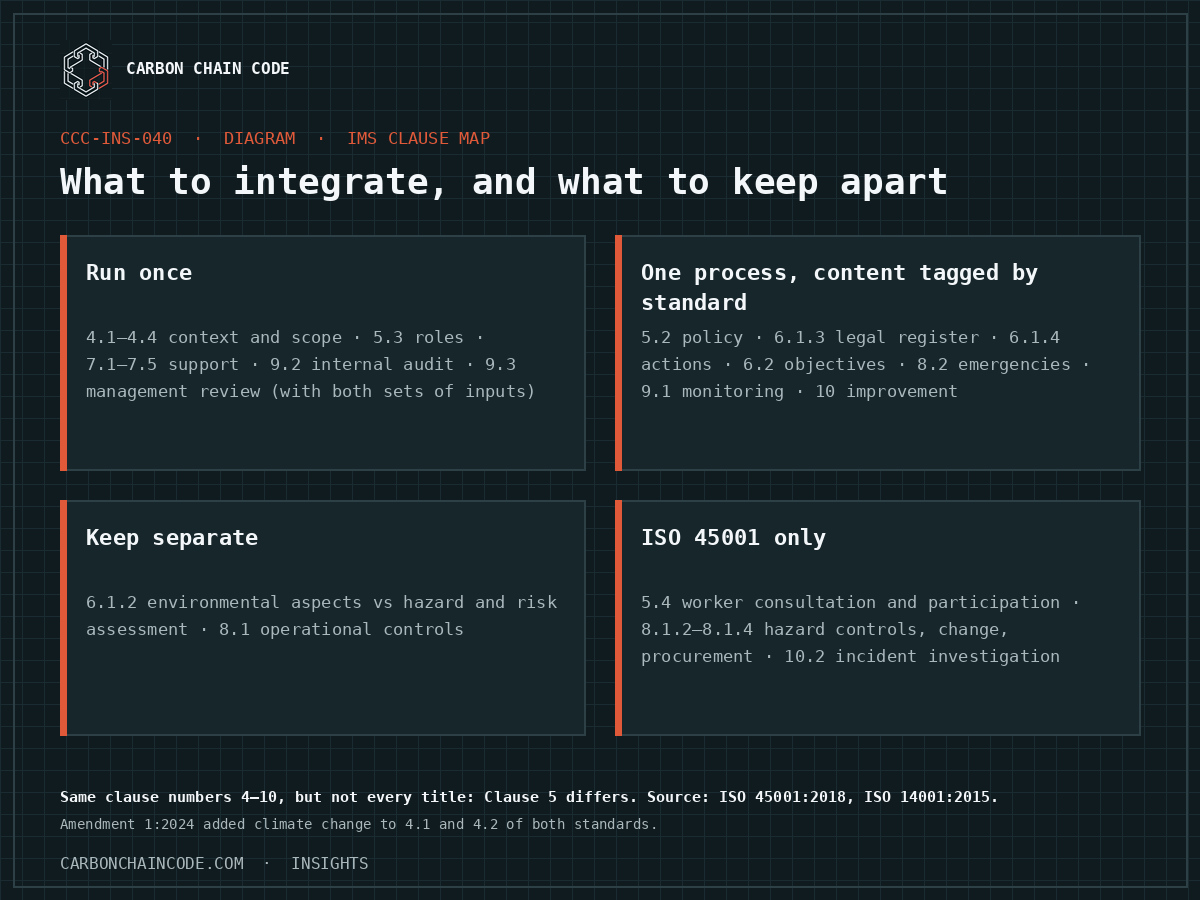
The shared structure gives you the same frame for context, leadership, planning, support, operation, performance evaluation and improvement. ISO 14001 applies it to environmental aspects, impacts and compliance obligations. ISO 45001 applies it to hazards, OH&S risks and opportunities, and legal requirements. An integrated system uses one process where one process meets both standards and keeps separate content where the subject matter differs. Clause 5 shows the point: in ISO 45001 it is titled Leadership and worker participation and includes 5.4, while in ISO 14001 it is titled Leadership and has no worker-consultation clause.
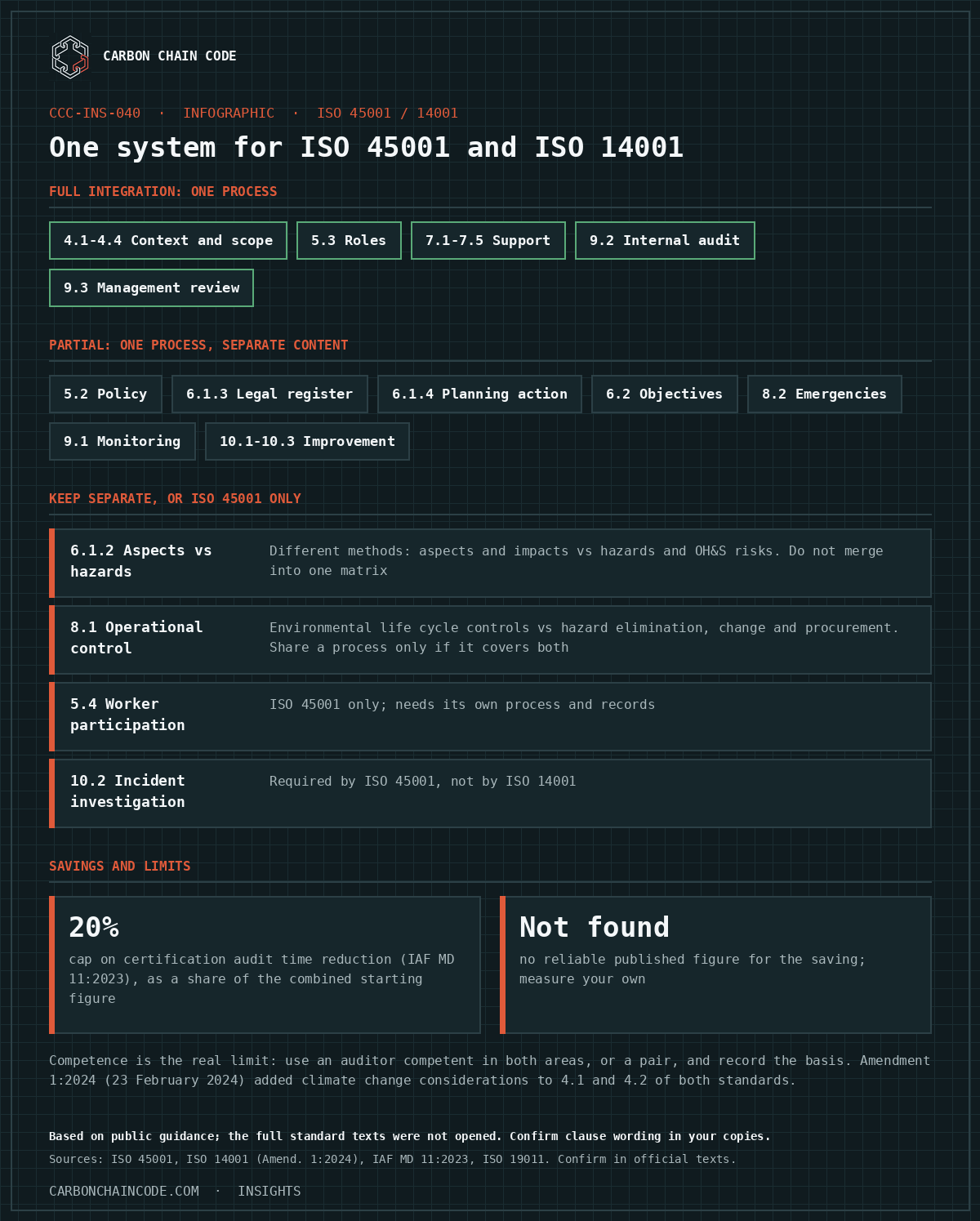
| Clause | Integration | What to do |
|---|---|---|
| 4.1–4.4 Context, interested parties, scope, management system | Full integration | One context analysis and one interested-party register. In ISO 45001, 4.2 explicitly includes workers. Since Amendment 1:2024, both standards ask whether climate change is a relevant issue (4.1) and note that interested parties may have climate-related requirements (4.2). State the scope and boundaries of each system. |
| 5.1 Leadership and commitment | Mostly shared | One leadership process. ISO 45001 adds top-management accountability for the effectiveness of the OH&S system and protection of workers from reprisals when they report. |
| 5.2 Policy | Partial integration | One policy document can serve both, but it must carry each standard's commitments: protection of the environment including pollution prevention for 14001, and safe and healthy working conditions, eliminating hazards and worker consultation for 45001. |
| 5.3 Roles, responsibilities and authorities | Full integration | One organisation chart and role matrix, with each role's environmental and OH&S responsibilities stated. |
| 5.4 Consultation and participation of workers | ISO 45001 only | No equivalent in ISO 14001. It needs its own process, including participation of non-managerial workers, for example in hazard identification and incident investigation. |
| 6.1.2 Environmental aspects (14001) / Hazard identification and assessment of risks and opportunities (45001) | Keep separate | Different subject matter and methods. 14001 works from aspects and impacts with a life cycle perspective. 45001 works from hazards, OH&S risks and OH&S opportunities. Do not merge them into one matrix. |
| 6.1.3 Compliance obligations (14001) / Legal requirements and other requirements (45001) | Partial integration | One legal register can work, with separate columns or sections for environmental and OH&S requirements and one review process. |
| 6.1.4 Planning action | Partial integration | One action-planning process. Plans and registers can be combined if each action is tagged to its standard. |
| 6.2 Objectives and planning to achieve them | Partial integration | One objectives process, separate objectives. ISO 45001 also requires consultation with workers when setting them. |
| 7.1–7.5 Support | Full integration | One competence, awareness, communication and documented information process. Competence records must show both environmental and OH&S requirements by role. |
| 8.1 Operational planning and control | Keep separate | 14001 8.1 covers environmental controls over the life cycle. 45001 8.1.1–8.1.4 cover eliminating hazards and reducing risks, management of change and procurement, including contractors and outsourcing. They can share a change and contractor process only if it covers both. |
| 8.2 Emergency preparedness and response | Partial integration | One procedure and drill programme can cover spills, releases, fire and injury scenarios. Identify which scenarios belong to which standard. |
| 9.1 Monitoring, measurement, analysis and evaluation (incl. evaluation of compliance) | Partial integration | One monitoring programme and one compliance evaluation process, with separate environmental and OH&S indicators. |
| 9.2 Internal audit | Full integration | One programme, one procedure and one schedule. This is where integration usually pays off most, provided the auditors are competent in both areas. |
| 9.3 Management review | Full integration | One meeting and one agenda, but the required inputs of both standards must be present, including environmental performance, OH&S performance, incidents and the outcome of worker consultation. |
| 10.1–10.3 Improvement | Partial integration | One corrective-action process and register, tagged by standard. ISO 45001 10.2 also requires incident investigation, which 14001 does not. |
Running two systems separately means two sets of procedures, two audit programmes, two management reviews and two corrective-action registers, with a risk of duplicated or conflicting actions on the same root cause. Combining the support processes, internal audit, management review and corrective action removes most of that duplication. I have not found a reliable published figure for the saving, so treat any percentage you see quoted as an estimate and measure your own before and after, in audit days and meeting hours.
Certification audits have a published rule. IAF Mandatory Document 11 tells certification bodies how to audit integrated systems. The body calculates audit time for each standard separately, adds them, and may then reduce the total for integration, but the reduction cannot exceed 20% of that starting figure. So do not budget for a certification audit at half the price of two separate ones. Ask your certification body how it applies MD 11 to your integration level.
The two standards need different subject knowledge. An environmental auditor needs to understand aspects, legal compliance and environmental monitoring. An OH&S auditor needs to understand hazard identification, risk control and incident handling. A combined audit run by someone who knows only one of them will leave gaps in the other, not save time. Use either an auditor competent in both areas or a pair auditing together, and record the competence basis. ISO 19011:2018 is the guideline for auditing management systems, including combined audits.
The simplest approach is one audit event with one checklist, with each question tagged to ISO 14001, ISO 45001 or both, and evidence collected once where one process serves both standards. For fully integrated areas, such as context, internal audit and management review, one question and one record is enough. For domain-specific areas, such as hazard identification, aspects and operational controls, audit each standard separately in the same session, so that the site visit and the opening and closing meetings are shared.
The key document is an integrated audit programme: one schedule covering all processes and both standards across the audit cycle, with the competence needed for each part. It shows a certification body that the systems are genuinely integrated, not two systems with shared labels.
Both standards use the ISO harmonized structure with Clauses 4–10, but not every title is identical: Clause 5 is Leadership and worker participation in ISO 45001 and Leadership in ISO 14001. ISO 45001-only requirements include 5.4 worker consultation and participation, 8.1.2–8.1.4 on hazard elimination, management of change and procurement, and incident investigation in 10.2. Amendment 1:2024 (published 23 February 2024) added climate change considerations to 4.1 and 4.2 of both standards. IAF MD 11:2023: reduction in audit time for integrated systems cannot exceed 20% of the combined starting figure.
IMS implementation checklist
Usually yes. Many certification bodies offer combined audits, using a team that covers both standards. Certificates are normally issued per standard, and you should confirm with your body how it will issue them. IAF MD 11 governs how the body plans integrated audits, and limits the time reduction for integration to 20% of the combined starting figure.
Some buyers ask for it in their supplier programmes, and others score it or accept other evidence. I could not find a published list, so check each buyer's supplier code and ask which management system certificates it accepts. Social audits such as SMETA assess health and safety in their own way and are not the same as ISO 45001 certification.
Yes, in a limited way. Amendment 1:2024 to both standards, published on 23 February 2024, asks organisations to determine whether climate change is a relevant issue (4.1) and adds a note that interested parties may have climate-related requirements (4.2). TÜV SÜD reports that there is no set transition period, the changes are expected to be implemented promptly, and certification bodies include them in audits. Record your consideration in your context analysis.
OHSAS 18001 was the earlier OH&S specification, developed by a group of standards and certification bodies, and ISO 45001 replaced it in 2018. The migration deadline was originally in March 2021 and was extended by about six months because of COVID-19, so sources give slightly different final dates. A certificate to OHSAS 18001 is no longer valid. ISO 45001 uses the harmonized structure, which allows integration with ISO 14001, puts more weight on worker participation and leadership, and takes a risk-based approach.
ISO 45001:2018 and ISO 14001:2015, with Amendment 1:2024 (TÜV SÜD, Climate action changes, Amendment 1 in management system standards). IAF Mandatory Document 11:2023, Application of ISO/IEC 17021-1 for audits of integrated management systems. ISO 19011:2018, Guidelines for auditing management systems. DQS, Transition period of ISO standards extended. I could not open the full standard texts, so confirm clause wording in your copies before relying on it.
Free tool · Sustainability Frisk
How ready is your factory for ISO 14001 certification?
Take the free ISO 14001 Readiness Assessment — 10 questions, instant gap report.
Need a CSRD gap analysis or hands-on implementation? Sustainability Frisk can help. www.sustainability-frisk.com
Practical CSRD guide and Excel workbook for manufacturers answering EU customer sustainability requests. Value chain cap, Annex II decoder, reply templates.
Most ISO 14001 preparation focuses on building the documentation. Auditors focus on something different: whether your system actually works. A TÜV-certified Lead Auditor explains the six things that determine your certification outcome.
ISO 14001 tells you to set an environmental objective. Six Sigma's DMAIC gives you a structured method to reach it. Here is how each phase maps to a Scope 1 and Scope 2 carbon reduction project, with an illustrative worked example.