RCS vs GRS: Which Recycled Content Standard Your Buyers Are Requiring
RCS and GRS both verify recycled content, but they are not interchangeable. RCS covers single-material products and has no social requirements. GRS covers multi-material products and adds facility-level social and environmental requirements. Here is how to tell which your customer needs.
By Hufsa17 October 20265 min read
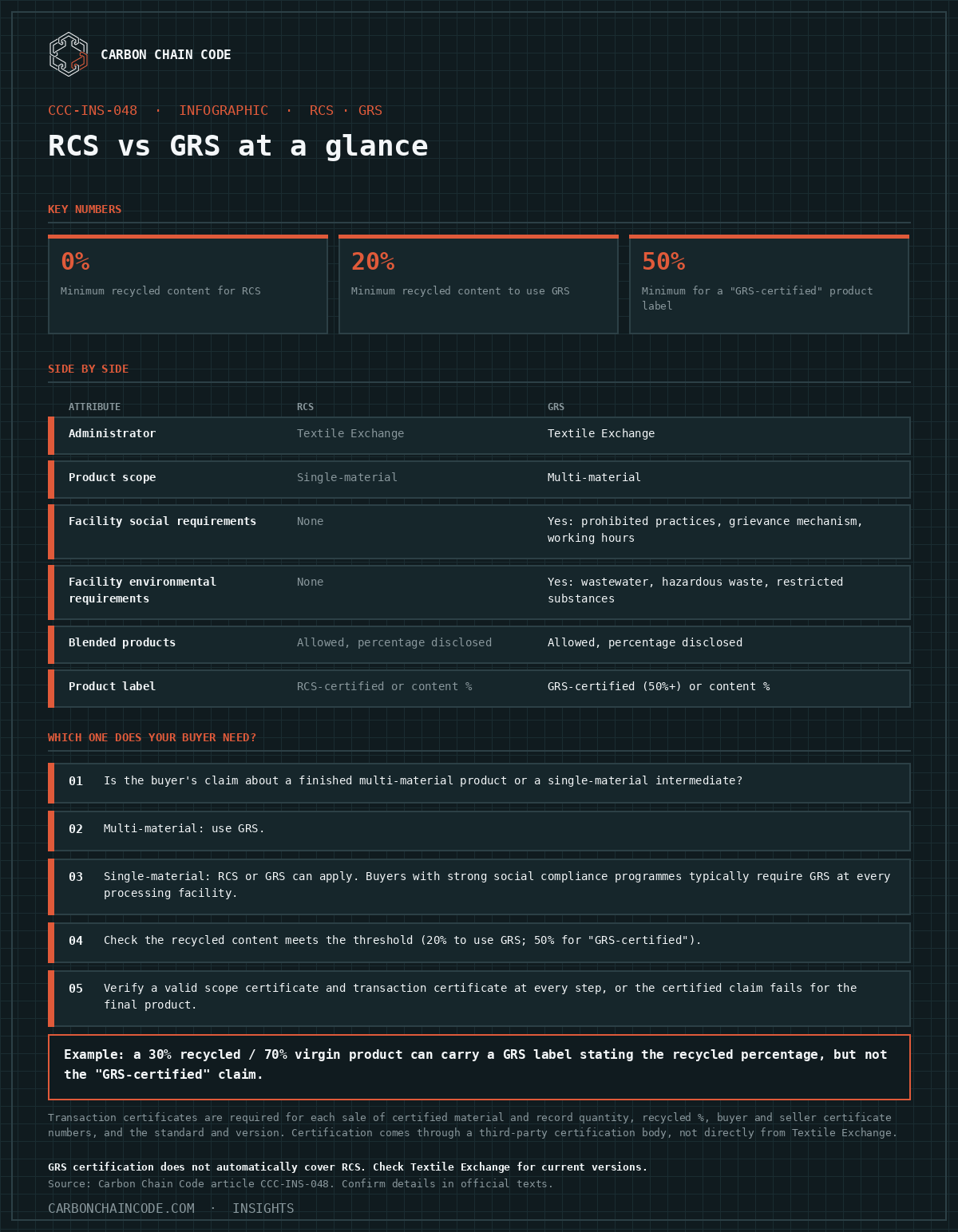
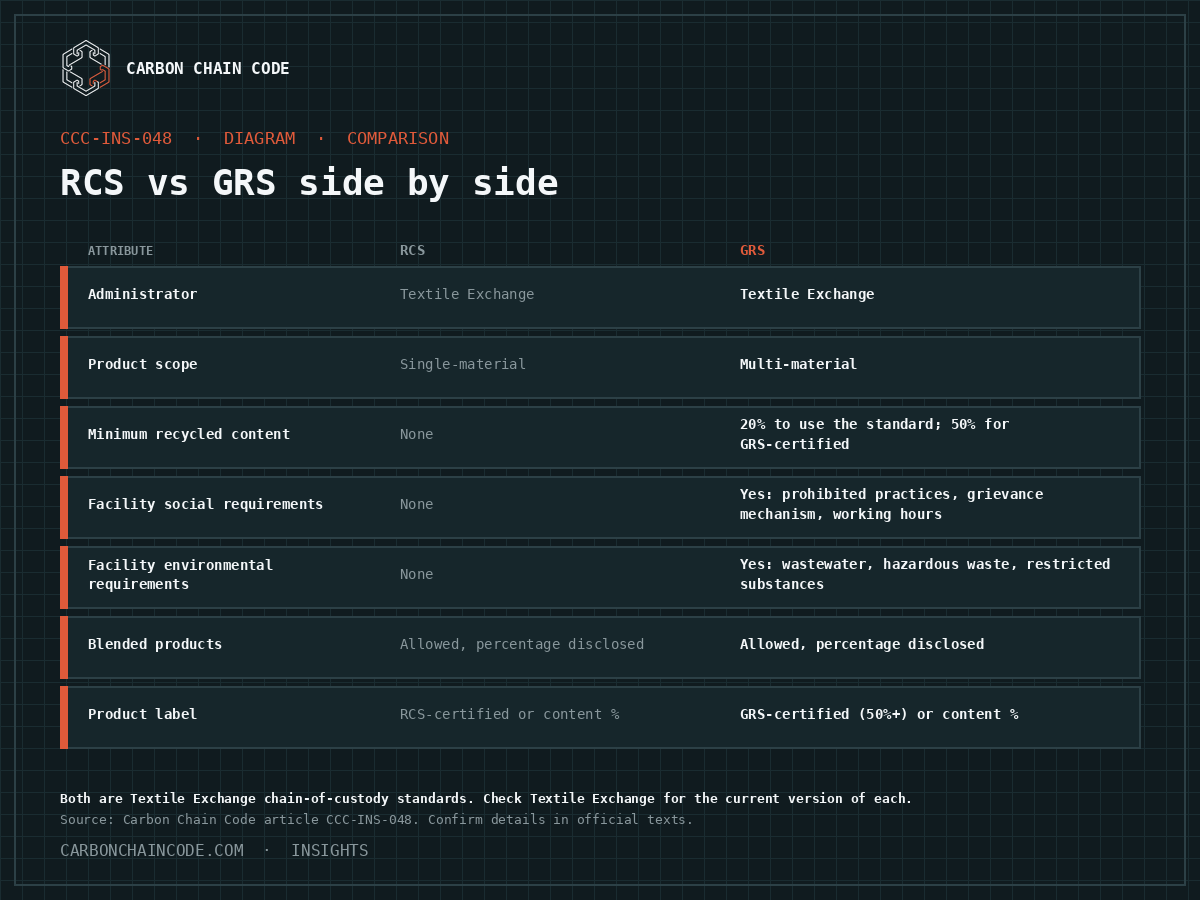
RCS — Recycled Claim Standard — and GRS — Global Recycled Standard — are both chain-of-custody standards for recycled content, both administered by Textile Exchange. The key difference is scope: RCS is for single-material products (a yarn that is 100% recycled polyester, for example) and covers chain of custody only. GRS is for multi-material products, has a 20% minimum content threshold, and adds social and environmental requirements at each certified facility.
Side-by-Side Comparison
Feature
RCS
GRS
Administrator
Textile Exchange
Textile Exchange
Current version
2.0 (check Textile Exchange for updates)
4.0 (check Textile Exchange for updates)
Scope
Single-material products
Multi-material products
Minimum recycled content
None — chain of custody for any content claim
20% to use standard; 50% to label product as GRS-certified
Content types covered
Post-consumer or pre-consumer recycled
Post-consumer or pre-consumer recycled
Social requirements at facility
None
Prohibited practices (child labour, forced labour), grievance mechanism, working hours
GRS-certified (at 50%+) or recycled content percentage
Which Standard Does Your Buyer Need?
Illustrative summary
If your buyer is making a recycled content claim on a finished product with multiple material types — for example a shoe with a recycled polyester upper and a rubber outsole — GRS is the standard that covers the full product. If the claim is on a single-material intermediate (a recycled polyester yarn, a recycled cotton fabric sold as a fabric to a cut-and-sew factory), either RCS or GRS can be used. Brands with strong social compliance programmes typically require GRS at every processing facility even for single-material products, because GRS includes the facility-level social audit requirements that RCS does not.
Transaction Certificates: What Both Standards Require
Both RCS and GRS require transaction certificates (TCs) to be issued for each sale of certified material. The TC records the quantity sold, the recycled content percentage, the certificate numbers of buyer and seller, and the standard and version. A buyer cannot make a certified recycled content claim without a valid TC for each input. If any step in the supply chain — from the recycling facility to the finished product manufacturer — does not hold a valid scope certificate and issue TCs, the chain is broken and the certified claim is not valid for the final product.
Frequently Asked Questions
If a factory holds GRS certification, does it automatically meet RCS requirements?
GRS is more demanding than RCS, so a GRS-certified facility can issue TCs for both GRS and RCS transactions, as long as the products and processes are within scope. Check your scope certificate to confirm which products are listed — certification covers the specific products and processes assessed, not everything the factory makes.
Is there a single Textile Exchange membership that covers both RCS and GRS?
Certification is obtained through a third-party certification body, not directly through Textile Exchange. The certification body conducts the audit against the relevant standard. The same audit body can certify to both standards. Textile Exchange sets and owns the standards and manages the licensing of certification bodies.
Can a factory add a GRS blended claim for a product that contains 30% recycled and 70% virgin material?
Yes. At 30% recycled content, the product meets the 20% threshold and can carry a GRS label — but not a 'GRS-certified product' claim, which requires 50%. The label should state the recycled content percentage. The virgin material is not certified under GRS — only the recycled portion's chain of custody is covered.
Need a CSRD gap analysis or hands-on implementation? Sustainability Frisk can help. www.sustainability-frisk.com
GRS certification does not guarantee a recycled content claim will hold. It certifies the chain of custody and sets a minimum content threshold. Here is what the standard requires and where factory audits focus.
A certificate and a batch-level record answer different questions. What GRS actually verifies, where its limits are, and what traceability adds, with the rules from the EU that push in that direction.
 Carbon Chain Code