Recycled Polyester in 2026: What GRS Certification Requires and What Brands Audit
GRS certification does not guarantee a recycled content claim will hold. It certifies the chain of custody and sets a minimum content threshold. Here is what the standard requires and where factory audits focus.
By Hufsa17 October 20266 min read
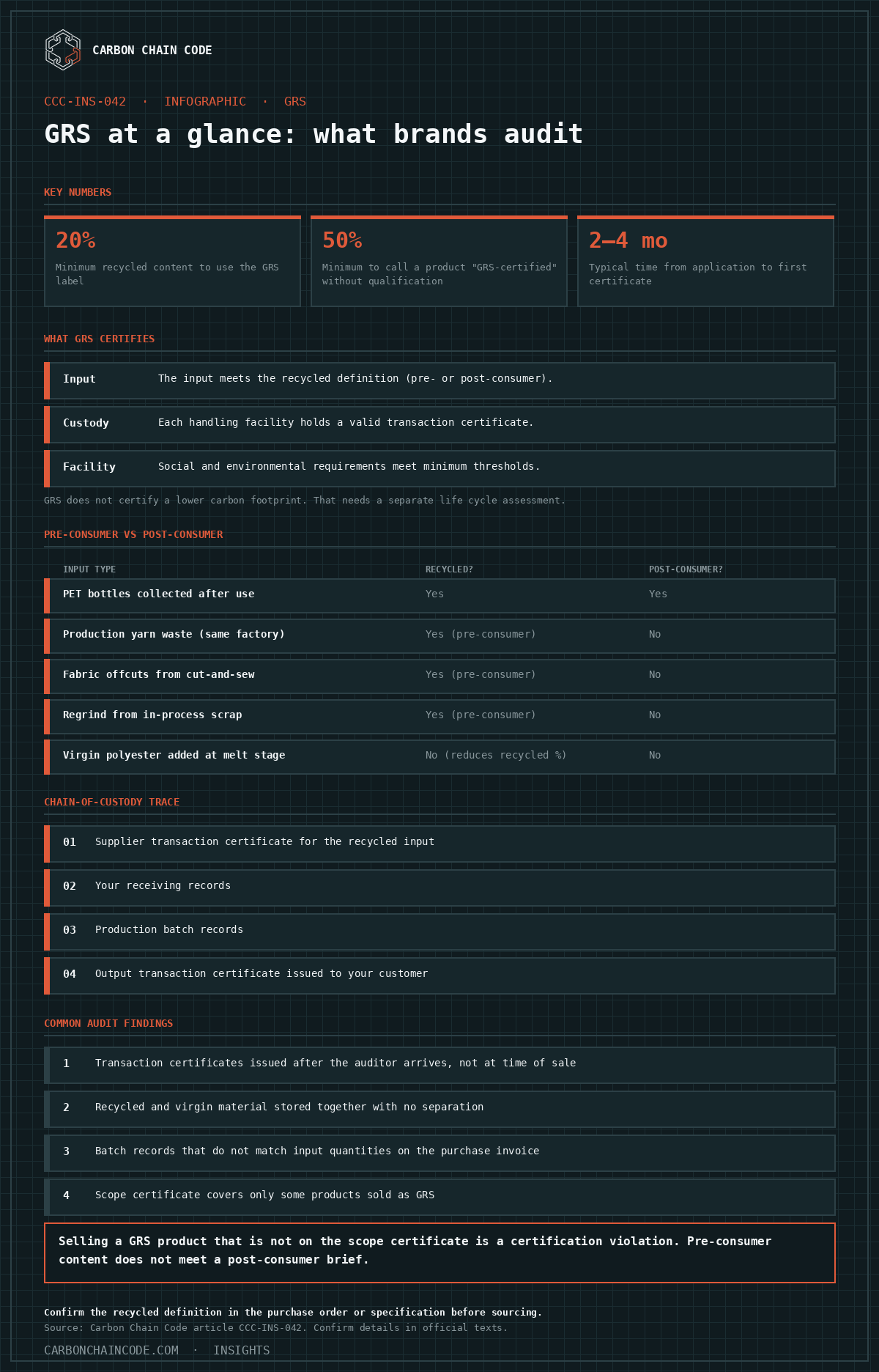
GRS — Global Recycled Standard — certifies that a product contains recycled input material and tracks that material through each step of the supply chain. Version 4.0 is the current version as of this writing [VERIFY: check Textile Exchange for any GRS 5.0 release date]. A minimum of 20% recycled content is required to use the GRS label on a product; 50% is required to call the product 'GRS-certified' without qualification.
What GRS Actually Certifies
GRS is a chain-of-custody standard. It does not certify that the recycled content has a lower carbon footprint than virgin material — that requires a life cycle assessment and is a separate claim. It certifies three things: that the input material meets the definition of recycled (pre-consumer or post-consumer), that each facility handling the material holds a valid transaction certificate, and that the social and environmental requirements at the certified facility meet the standard's minimum thresholds. A brand using the GRS label needs a valid scope certificate from every facility in the chain, from the recycled fibre producer through to the finished product manufacturer.
Pre-Consumer vs Post-Consumer: Why It Matters
Illustrative summary
GRS accepts both pre-consumer waste (production offcuts, mill waste, yarn waste that never reached a consumer) and post-consumer waste (material that was used and then collected — bottles, old garments). Most brands that market recycled polyester want post-consumer content, specifically recycled PET bottles, because it has a clearer story and a more defensible claim. If your customer's brief says post-consumer recycled, pre-consumer content from your own production offcuts does not qualify. Confirm the definition in the purchase order or specification before sourcing.
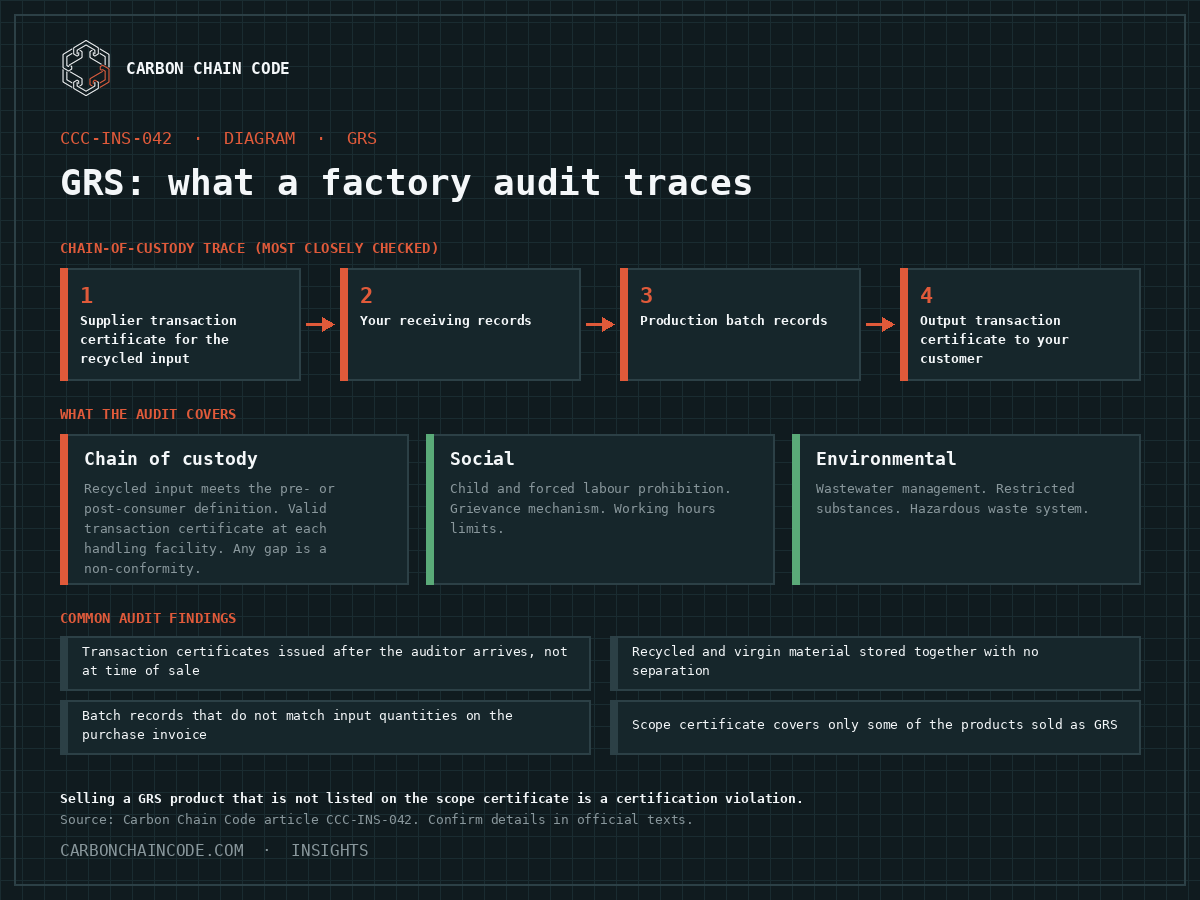
Certification bodies audit against three parts of the standard: chain of custody, social requirements and environmental requirements. Chain of custody is the most closely checked: the auditor traces a batch of recycled input from the supplier's transaction certificate through your receiving records, production batch records and the output transaction certificate you issue to your customer. Any gap in that chain — a missing transaction certificate, a batch record that does not match the purchased quantity — is a non-conformity. Social requirements include prohibition of child and forced labour, a grievance mechanism and working hours limits. Environmental requirements include a wastewater management system, prohibition of specific restricted substances, and a system for managing hazardous waste.
Common Audit Findings
From auditor reports and brand sourcing teams I have spoken with, the most common GRS findings at factories are: transaction certificates not issued at the time of sale (issued after the fact when the auditor arrives); recycled and virgin material stored in the same area with no separation; batch records that do not match the input quantities on the purchase invoice; and a scope certificate that covers only some of the products actually being sold as GRS. A scope certificate lists the products and processes the certification covers — selling a GRS product that is not on your scope certificate is a certification violation.
Frequently Asked Questions
Is GRS the same as RCS?
No. GRS is for products with multiple material types and covers recycled content plus social and environmental requirements at certified facilities. RCS — Recycled Claim Standard — is for single-material products and covers chain of custody only, with no social or environmental facility requirements. Both are administered by Textile Exchange. See the comparison article for more detail.
Can a brand make a recycled content claim without GRS certification?
A brand can make an unverified claim, but this is increasingly risky under EU and UK greenwashing regulations. The EU Green Claims Directive, if adopted, will require substantiation for environmental claims. GRS certification is the most widely accepted third-party verification for recycled content in textiles and apparel.
How long does GRS certification take?
From application to first certificate, the typical timeline is two to four months, depending on the certification body's audit schedule and how quickly you can prepare the required documentation. The main preparation work is setting up the chain-of-custody record system and getting your material suppliers to provide valid transaction certificates.
Need a CSRD gap analysis or hands-on implementation? Sustainability Frisk can help. www.sustainability-frisk.com
RCS and GRS both verify recycled content, but they are not interchangeable. RCS covers single-material products and has no social requirements. GRS covers multi-material products and adds facility-level social and environmental requirements. Here is how to tell which your customer needs.
A certificate and a batch-level record answer different questions. What GRS actually verifies, where its limits are, and what traceability adds, with the rules from the EU that push in that direction.
 Carbon Chain Code