Vetting Suppliers in South and Southeast Asia: What Differs by Market
Bangladesh, Vietnam, Pakistan, India and Cambodia each have different regulatory environments, typical audit frameworks and certification landscapes. Here is what to adjust in your vetting process by market.
By Hufsa17 October 20267 min read
Supplier vetting cannot use the same checklist in every market. Labour law compliance, typical audit acceptance, dominant certifications and the reliability of local third-party auditors vary significantly across South and Southeast Asia. This article covers the key differences for Bangladesh, Vietnam, Pakistan, India and Cambodia — the five markets that account for the majority of textiles, footwear and sporting goods sourced by European and US brands.
Bangladesh
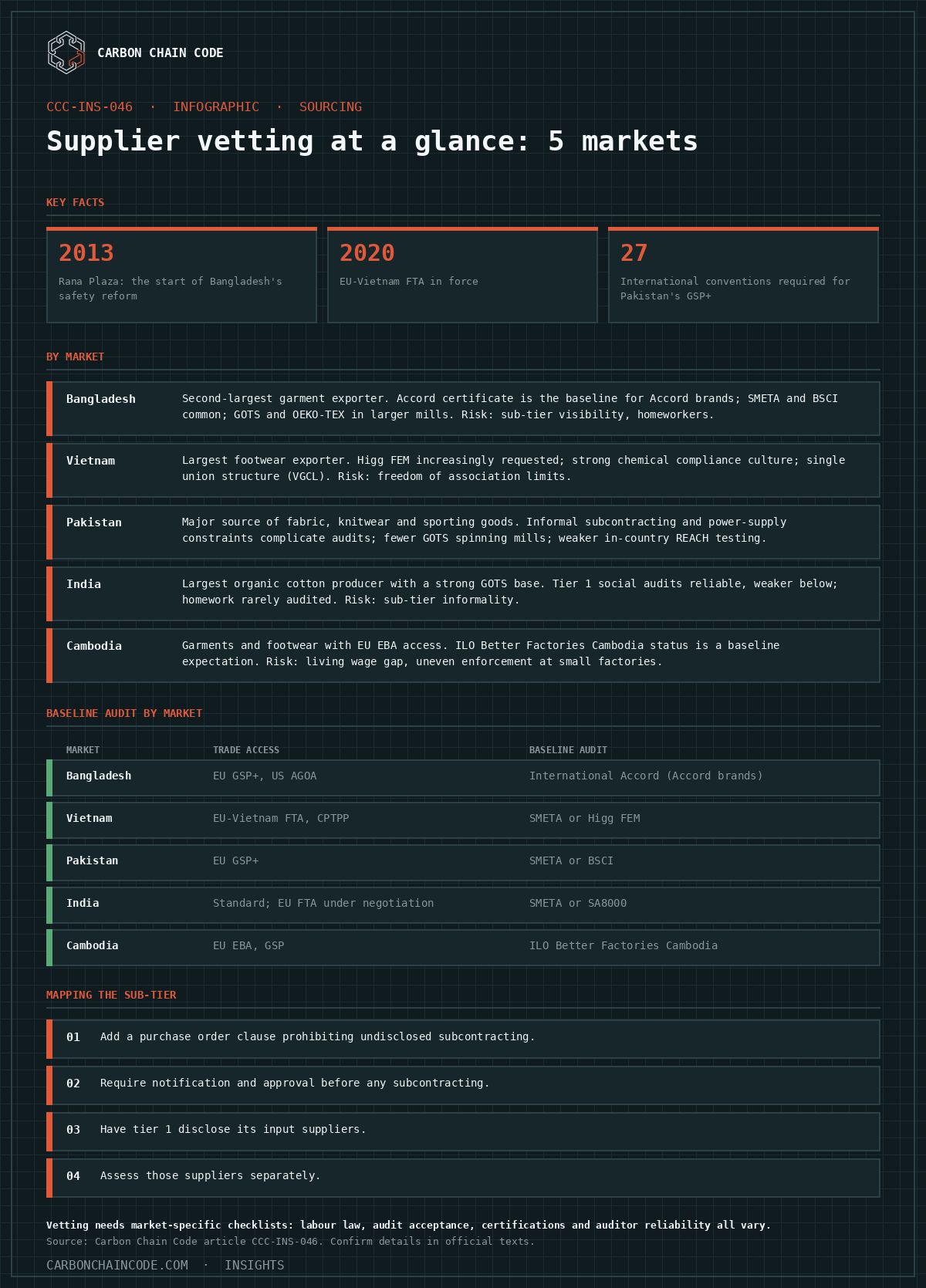
Bangladesh is the world's second-largest garment exporter and has undergone significant factory safety reform since Rana Plaza (2013). The Accord on Fire and Building Safety (now the International Accord) operates inspection and remediation programmes covering signatory factories. For buyers from EU Accord member brands, an active Accord certificate is now the baseline for structural and fire safety — not an optional extra. Social audits (SMETA, BSCI) are widely conducted. GOTS and OEKO-TEX certification are common among larger export factories. The Bangladesh Labour Act and its amendments govern working conditions; enforcement is uneven at sub-tier level.
Vietnam
Illustrative summary
Vietnam is the largest footwear exporter and a significant apparel and technical textiles source. EU-Vietnam FTA (in force since 2020) provides preferential tariff access to the EU for goods meeting rules of origin. Workers are represented through a single union structure (VGCL) — independent unions are not legally established [VERIFY: check status of Vietnam's ILO commitments on freedom of association]. Social audits are widely accepted; Higg FEM (facility environmental module) is increasingly requested by US and EU brands. Chemical compliance tends to be stronger than in some other markets because of the electronics and footwear industries' established RSL culture.
Pakistan
Pakistan is a major source for textile fabric, knitwear, and sporting goods (footballs, cricket equipment). GSP+ status with the EU provides preferential access but requires compliance with 27 international conventions on human rights, labour, environment and governance. The 2026 EU GSP+ compliance report is the latest formal assessment [VERIFY: confirm 2026 report publication and key findings]. Factory audits face practical challenges including informal subcontracting that is difficult to map, and electricity supply constraints that affect production records. GOTS-certified spinning mills exist but are fewer than in India or Bangladesh. REACH compliance varies; testing infrastructure in-country is less developed than in Vietnam.
India
India is a complex sourcing market — enormous scale and capability at the top tier, significant informality at sub-tiers. It is the largest producer of organic cotton (certified to GOTS and USDA NOP). GOTS-certified spinning and weaving facilities are among the most numerous in the world. Social compliance auditing is well-established at tier 1 but becomes unreliable below that level. State-level labour law variations add complexity — India's Labour Codes (enacted but implementation timeline varying by state) are consolidating previous legislation [VERIFY: confirm which states have fully implemented the new Labour Codes]. Home-based work (homework) is common in certain product categories and is rarely audited.
Cambodia
Cambodia is a smaller sourcing market focused on garments and footwear, with EU EBA (Everything But Arms) trade access as an LDC. ILO Better Factories Cambodia (BFC) operates an ongoing monitoring programme covering a significant proportion of the garment sector — BFC compliance status is a baseline expectation for most European buyers. The Cambodia Labour Law is relatively comprehensive on paper but enforcement at smaller factories and sub-tiers is inconsistent. Wage levels are among the lowest in the region; brands sourcing from Cambodia are routinely asked about living wage commitments.
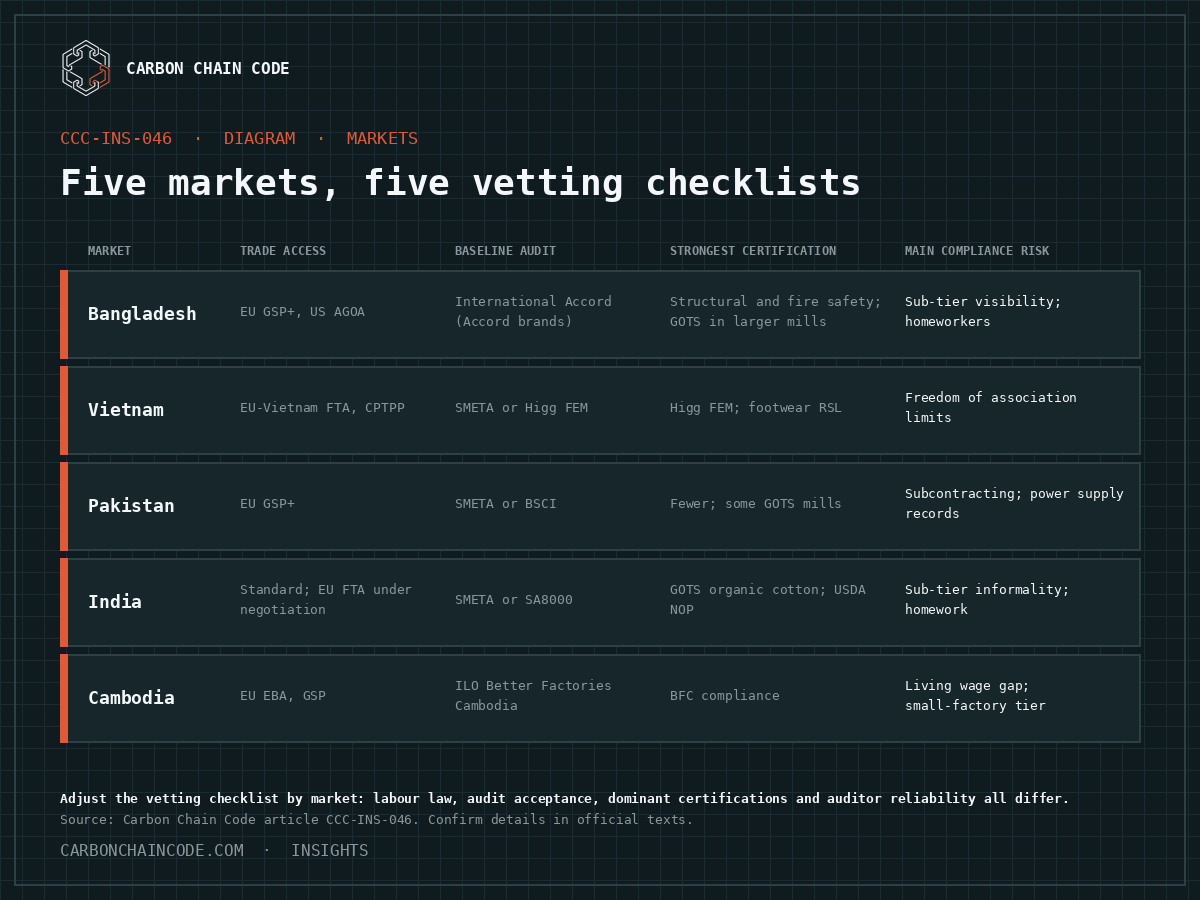
Market
Key trade access
Baseline audit requirement
Strongest certification sector
Main compliance risk
Bangladesh
EU GSP+, US AGOA
International Accord (for Accord brands)
Structural/fire safety, GOTS in larger mills
Sub-tier visibility, homeworkers
Vietnam
EU-Vietnam FTA, CPTPP
SMETA or Higg FEM
Higg FEM, footwear RSL
Freedom of association limitations
Pakistan
EU GSP+
SMETA or BSCI
Fewer — GOTS mills exist
Subcontracting, power supply records
India
Standard; EU FTA under negotiation
SMETA or SA8000
GOTS organic cotton, USDA NOP
Sub-tier informality, homework
Cambodia
EU EBA, GSP
ILO Better Factories Cambodia
BFC compliance
Living wage gap, smaller factory tier
Frequently Asked Questions
Which audit type is most widely accepted across all five markets?
SMETA (Sedex Members Ethical Trade Audit) — particularly the 4-pillar version covering labour, health and safety, environment and business ethics — is accepted by the broadest range of buyers across all five markets. BSCI (amfori) is also widely used, particularly among European brands. Higg FEM is increasingly required alongside a social audit for brands with SBTi commitments or CSRD obligations.
How should a buyer approach sub-tier mapping in these markets?
Start with a contractual requirement: the purchase order should prohibit undisclosed subcontracting and require notification and approval before any work is subcontracted. In practice, sub-tier mapping requires your tier 1 supplier to disclose their input suppliers and for you to audit or assess them separately. Tools like Sourcemap and Ulula are used for sub-tier mapping; none of them remove the need for direct engagement with tier 1 on disclosure.
Is the EU CSDDD relevant to supplier vetting in these markets?
Yes, for companies in scope. The Corporate Sustainability Due Diligence Directive (CSDDD, now CS3D) requires companies to identify and address adverse human rights and environmental impacts in their value chains. After Omnibus I changes, the threshold is companies with more than 1,000 employees and €450 million turnover. Their suppliers — including those in Bangladesh, Vietnam, Pakistan, India and Cambodia — are in scope of the due diligence obligation even if they are not themselves required to report.
Need a CSRD gap analysis or hands-on implementation? Sustainability Frisk can help. www.sustainability-frisk.com
Delistings rarely come from one audit failure. Three patterns explain how a factory ends up removed from a brand's supplier list, what the law does and does not require of brands, and how to avoid becoming one.
The Commission's July 2026 report on Pakistan was critical, and the new GSP rules from 2027 require reapplication. What GSP+ is worth, what the report said, and what exporters can do now.
 Carbon Chain Code