 Carbon Chain Code
CCC-SUS-001Sustainability/ESG · Workbook
CSRD Data Request Workbook
Decode EU customer sustainability questionnaires and build one reusable, evidence-backed answer set. PDF guide + Excel workbook for manufacturers.
COP29 in Baku finalised the rules for Article 6.4 — the UN-supervised carbon crediting mechanism. Here is what was agreed, what it means for voluntary carbon markets, and why it matters for manufacturers with net-zero targets.
Article 6 of the Paris Agreement provides the framework for countries to trade emission reductions and for a new UN-supervised carbon crediting mechanism. COP29 in Baku (November 2024) reached agreement on the rules for the Article 6.4 mechanism — the multilateral crediting system — after years of deadlock. The agreement does not resolve all questions but it opens the mechanism to operation. For manufacturers with voluntary carbon offset programmes, this changes which credits may be considered credible.
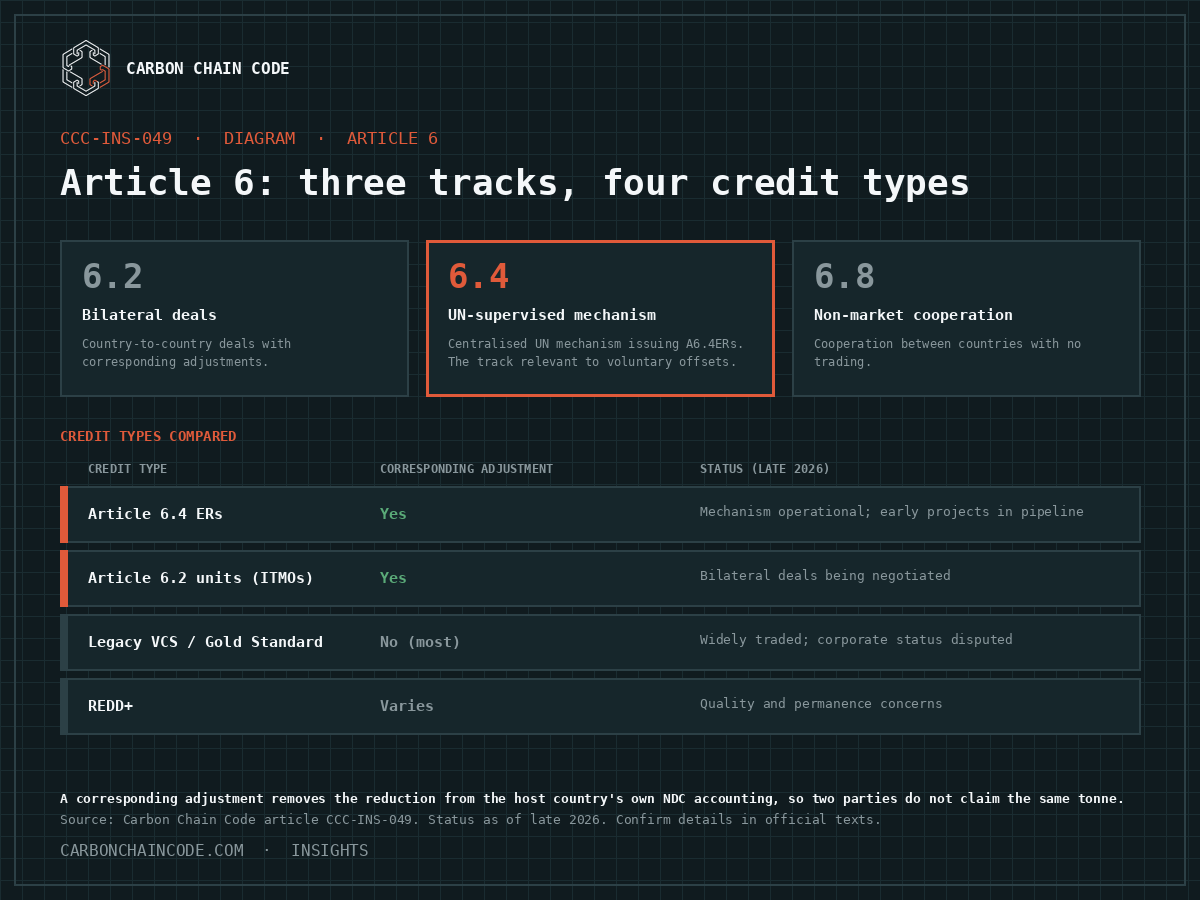
Article 6 has three tracks. Article 6.2 covers bilateral agreements between countries — one country sells emission reductions to another under a cooperative approach, with corresponding adjustments applied to both countries' nationally determined contributions. Article 6.4 establishes a centralised UN mechanism to issue carbon credits (called Article 6.4 Emission Reductions, or A6.4ERs) that can be used by countries or private sector actors. Article 6.8 covers non-market approaches — cooperation that does not involve trading. For manufacturers using voluntary carbon offsets, Article 6.4 is the track that matters.
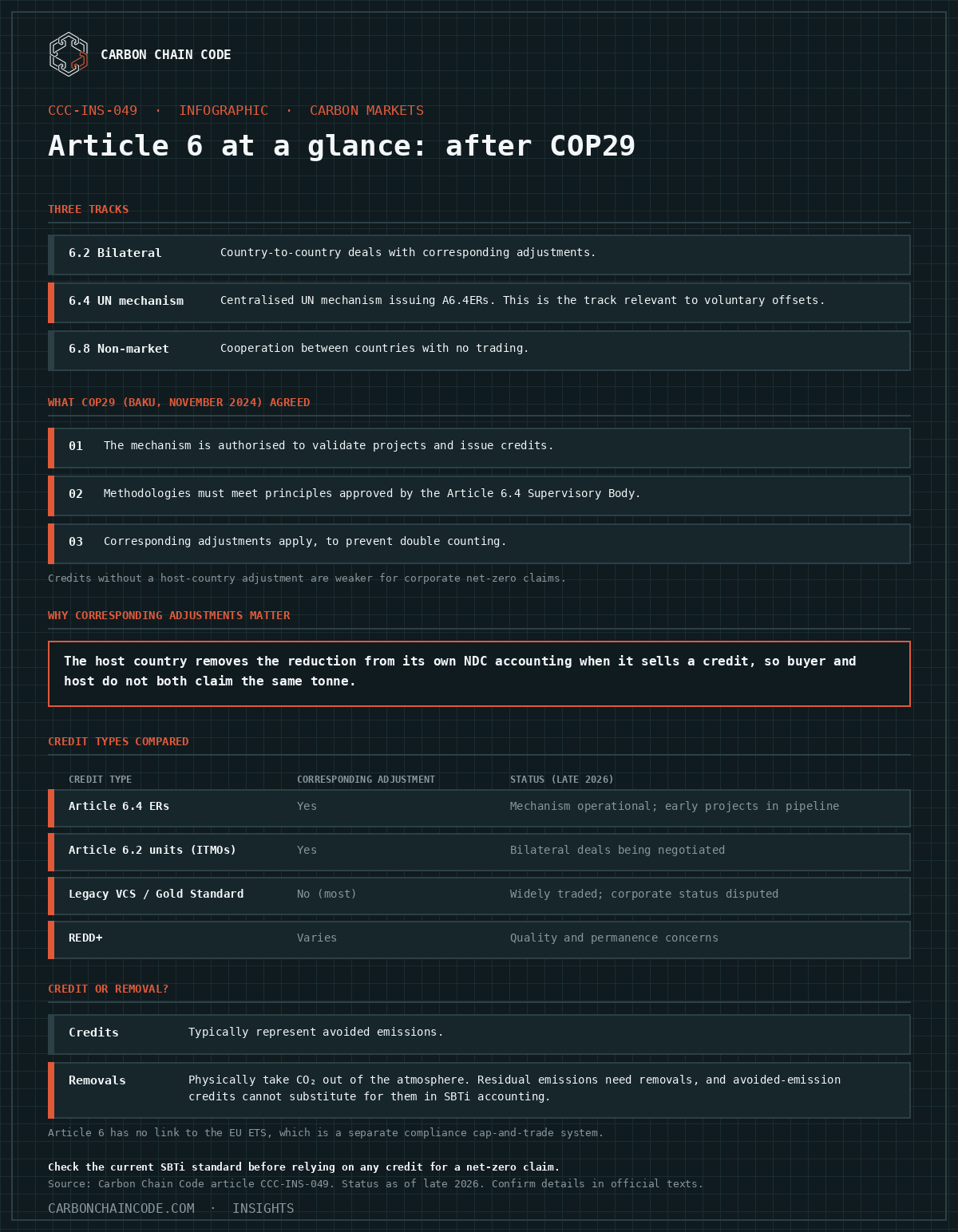
The COP29 presidency gavelled through the Article 6.4 mechanism rulebook — specifically the standards for methodologies and removals — amid significant procedural controversy [VERIFY: confirm the exact status of COP29 Article 6.4 adoption and any subsequent challenges]. The key outcomes: the mechanism is now authorised to validate projects and issue credits; methodologies must meet a set of principles approved by the Article 6.4 Supervisory Body; and corresponding adjustments — which prevent double-counting between country NDCs and private-sector claims — are applied. Credits issued without a corresponding adjustment from the host country are a weaker claim for corporate net-zero purposes.
A corresponding adjustment means the host country removes the emission reduction from its own NDC accounting when it sells a credit. This prevents both the company buying the credit and the host country from claiming the same tonne reduced. The Science Based Targets initiative requires corresponding adjustments for credits used in corporate net-zero targets (specifically for 'beyond-value-chain mitigation') [VERIFY: confirm current SBTi requirements on corresponding adjustments]. Many voluntary carbon credits currently available on the market do not have corresponding adjustments, because the bilateral agreements required under Article 6.2 have not been finalised for those projects. This distinction matters when a manufacturer is selecting offsets to accompany an SBTi-aligned target.
| Credit type | Corresponding adjustment? | Accepted for SBTi BVCM? | Status as of late 2026 |
|---|---|---|---|
| Article 6.4 ERs (from the new mechanism) | Yes | Expected yes — VERIFY | Mechanism operational; early projects in pipeline |
| Article 6.2 units (ITMOs) | Yes | Expected yes — VERIFY | Bilateral agreements being negotiated country by country |
| Legacy VCS/Gold Standard credits | No (most) | No for net-zero claims — VERIFY SBTi position | Still widely traded; status for corporate claims disputed |
| REDD+ credits | Varies | Controversial — VERIFY | Subject to quality and permanence concerns |
The SBTi requires that residual emissions — those that cannot be eliminated — be neutralised with carbon removals. For beyond-value-chain mitigation (voluntary offsetting beyond the target), it recommends high-quality credits with corresponding adjustments. Manufacturers should check the SBTi's current Corporate Net-Zero Standard for the specific requirements, as these have evolved.
A carbon credit typically represents an avoided emission — a reduction that was not counted in a baseline. A carbon removal represents CO₂ that was physically taken out of the atmosphere — reforestation, direct air capture, enhanced weathering. For net-zero targets, removals are required to neutralise residual emissions; avoided-emission credits cannot substitute for removals in SBTi accounting.
No. The EU Emissions Trading System is a compliance cap-and-trade system for covered EU installations. EU ETS allowances are not the same as voluntary carbon credits and are not traded through the Article 6 mechanism. They operate under a completely separate regulatory framework.
Need a CSRD gap analysis or hands-on implementation? Sustainability Frisk can help. www.sustainability-frisk.com
Decode EU customer sustainability questionnaires and build one reusable, evidence-backed answer set. PDF guide + Excel workbook for manufacturers.
How the EU ETS allowance price feeds into CBAM certificate prices, why price forecasts should be treated with caution, and what suppliers can do with the number.

87 carbon pricing instruments cover 29% of global emissions. The headline figures, what changed in the EU, China, the UK and Canada, and why it matters to exporters.