 Carbon Chain Code
CCC-SUS-006Sustainability/ESG
CSRD for Suppliers: Guide + Response Workbook
Practical CSRD guide and Excel workbook for manufacturers answering EU customer sustainability requests. Value chain cap, Annex II decoder, reply templates.
Bluesign is a chemical and resource management system for the textile industry. This article explains, for the factory rather than the buyer, how the bluesign System Partner assessment works for manufacturers, what input stream management means, and how to prepare.

bluesign is a Switzerland-based system for the textile industry that focuses on chemical management, resource efficiency and worker and environmental safety. Unlike GOTS, which certifies an organic fibre chain, or OEKO-TEX Standard 100, which tests finished articles for harmful substances, bluesign works through the companies in the supply chain. They join as System Partners and are assessed against the bluesign criteria. This article is a practitioner explainer based on bluesign's public information, not a bluesign assessor's product, and the bluesign criteria and your assessor decide what applies to you.
bluesign describes three groups of System Partners: brands and retailers, manufacturers and converters, and chemical suppliers. In July 2025 bluesign reported more than 900 System Partners worldwide. A mill, dye house or finishing plant joins as a manufacturer. Brands can also be System Partners, so it is not true that the system applies only to factories.
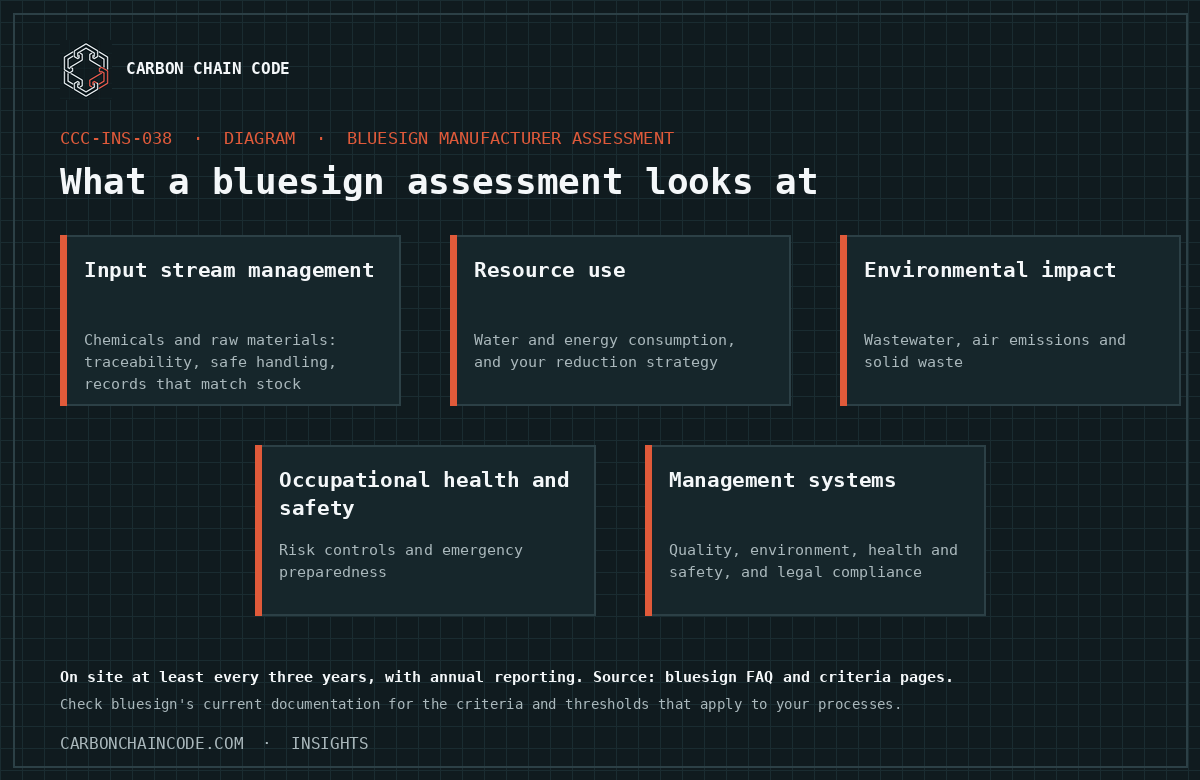
For manufacturers, bluesign's own term for its core approach is input stream management. It assesses raw material and chemical inputs, so that they can be traced and handled safely, and aims to prevent pollution at the source instead of relying only on testing outputs. You may see consultants and mills describe this as a "stream map". That is an informal label, so use bluesign's own documentation as the reference when you prepare.
In practice, an assessor will want to see that you know what chemicals and materials enter each process, in what quantities, that you can trace them to suppliers, and that what is on the shelves and in your records matches what you say you use. A facility that keeps this information current between assessments is in a much stronger position than one that builds it only for the visit.
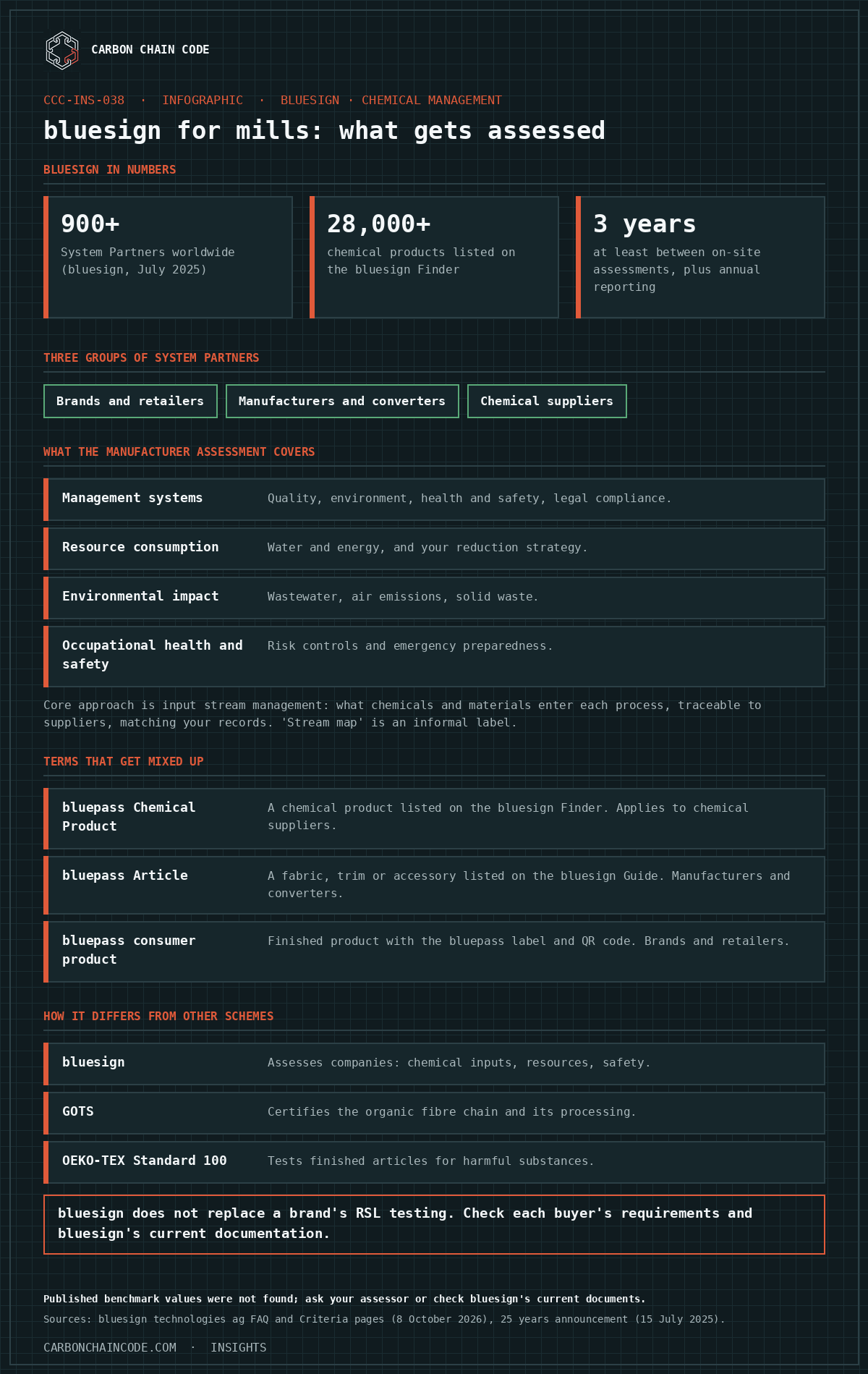
bluesign's public criteria describe the manufacturer assessment as covering management systems (quality, environment, health and safety, and legal compliance), resource consumption (water and energy, and your reduction strategy), environmental impact (wastewater, air emissions and solid waste), and occupational health and safety (risk controls and emergency preparedness). Assessments take place on site. bluesign says its assessors visit System Partners at least every three years, and partners also submit annual reporting.
More than 900 System Partners worldwide (bluesign, July 2025). More than 28,000 chemical products listed on the bluesign Finder. On-site assessment at least every three years, with annual reporting (bluesign FAQ). bluesign's current mark is bluepass, which replaced the older bluesign APPROVED and bluesign PRODUCT marks. Check bluesign.com for current figures and documentation.
The bluesign Finder is a database of chemical products that meet the bluesign criteria, called bluepass Chemical Products. Chemical suppliers apply to have their products assessed. A manufacturer sourcing from the Finder starts from products that have already been screened for hazards and compliance with restricted substance lists, which reduces the work of assessing each chemical individually. It does not replace your own input management, because the assessment still looks at how you purchase, store, use and record chemicals.
A practical risk is reformulation. If a supplier changes a product, the listing may no longer match what you are buying. Before each reorder, confirm that the product and version you receive are still listed, and ask your supplier to tell you in writing about any change. Older documents and some buyers still use terms such as BLUEFINDER or the bluesign APPROVED mark, so ask each buyer which wording and evidence it expects.
| Term | What it means | Who it applies to |
|---|---|---|
| bluesign System Partner | A company that has joined the system and is assessed against the bluesign criteria | Brands and retailers, manufacturers and converters, chemical suppliers |
| bluepass Chemical Product | A chemical product listed on the bluesign Finder | Chemical suppliers |
| bluepass Article | A fabric, trim or accessory listed on the bluesign Guide | Manufacturers and converters |
| bluepass consumer product | A finished product certified with the bluepass label, with a QR code | Brands and retailers |
The assessment looks at your water and energy consumption and your strategy to reduce it. I could not find published benchmark values in bluesign's public criteria, so check bluesign's current system documentation, or ask your assessor, for any thresholds that apply to your processes. What you can do now is measure well. Water use varies a lot between substrates and processes, so total site water alone makes it hard to explain performance. Metering water and energy at process or machine level, and calculating litres of water and kWh per kg of fabric by process, gives you data you can use whatever the assessment asks.
These schemes do different jobs and are often confused. OEKO-TEX Standard 100 is a product certificate based on testing finished articles. GOTS certifies the organic fibre chain and its processing. bluesign assesses companies and their management of chemical inputs, resources and safety. They can coexist, and each has its own requirements, so meeting one does not mean you meet another. Do not assume the chemical lists of two schemes overlap.
bluesign does not replace a brand's restricted substance list (RSL) testing. Many brands ask for both System Partner status and test reports. Ask each buyer what it requires.
Preparing for a bluesign manufacturer assessment
bluesign technologies ag: FAQ and Criteria pages (bluesign.com, accessed 8 October 2026), and the announcement on 25 years of bluesign (15 July 2025). Check bluesign's current documentation for criteria, labels and assessment rules.
Yes. bluesign has System Partners in three groups: brands and retailers, manufacturers and converters, and chemical suppliers. A brand's role is different from a mill's. It is assessed on matters such as its RSL compliance system and bill of materials, while a manufacturer is assessed on its production site.
bluesign says its assessors visit System Partner companies on site at least every three years, and partners also submit annual reporting. Confirm your own schedule with bluesign.
The consequences are set by bluesign's rules and the assessor, and I could not find a published rule. Treat the use of unlisted chemicals in bluesign production as a serious finding, and ask bluesign what its process is. Do not make bluesign claims about fabric made with an unlisted chemical until you have checked.
bluesign works mainly with chemical suppliers, textile manufacturers and converters, and brands, and most of its criteria focus on chemicals and resource use in production. A cut-and-sew factory that does no wet processing has little chemical processing to assess. If you do screen printing, coating or other wet processes, ask bluesign whether and how they fall within scope.
Free tool · Sustainability Frisk
FREE TOOL FROM SUSTAINABILITY FRISK
The ISO 14001 Readiness Assessment scores your current environmental management system against the standard’s ten requirements in five minutes.
Need a CSRD gap analysis or hands-on implementation? Sustainability Frisk can help. www.sustainability-frisk.com
Practical CSRD guide and Excel workbook for manufacturers answering EU customer sustainability requests. Value chain cap, Annex II decoder, reply templates.

Most GOTS content is written for brands, not factories. This article covers what a processing facility needs to understand, build and document to achieve and keep GOTS certification, ahead of version 8.0 taking full effect on 1 March 2027.
Most REACH guidance for textiles is written for EU importers. This article is written for the factory: the 0.1% rule, the Candidate List, the restrictions that apply to textiles from October 2026, and why your buyer's RSL is not the same as your legal obligation.