 Carbon Chain Code
CCC-SUS-006Sustainability/ESG
CSRD for Suppliers: Guide + Response Workbook
Practical CSRD guide and Excel workbook for manufacturers answering EU customer sustainability requests. Value chain cap, Annex II decoder, reply templates.
Most GOTS content is written for brands, not factories. This article covers what a processing facility needs to understand, build and document to achieve and keep GOTS certification, ahead of version 8.0 taking full effect on 1 March 2027.
GOTS (Global Organic Textile Standard) is one of the most recognised organic textile certifications globally, but most published guidance on it is written from the brand or buyer perspective. This article covers what a processing facility (a spinner, weaver, dye house or cut-and-sew unit) needs to understand, prepare and maintain to achieve and keep GOTS certification. It is a practitioner explainer based on supply-chain and audit experience, not a GOTS certifier's product. The standard text and your certification body decide what applies to you.
GOTS is revised on a roughly three-year cycle. Version 8.0 was released in March 2026 and will be fully effective from 1 March 2027, with a one-year transition period. From that date, audits and assessments run against v8.0. Early adoption is allowed. Confirm the exact dates for your audit with your certification body and at global-standard.org.
According to GOTS and certification body summaries, the changes most relevant to processing facilities are: tightened PFAS limits and updated testing; a dedicated GOTS Manufacturing Restricted Substances List (MRSL) section; a new endocrine disruptor assessment aligned with EU legislation; mandatory due diligence processes aligned with OECD guidance; new governance requirements; stronger requirements on air emissions and waste management; and updated verification testing for non-GMO cotton. Read the v8.0 text itself for the exact criteria, because summaries leave out detail.
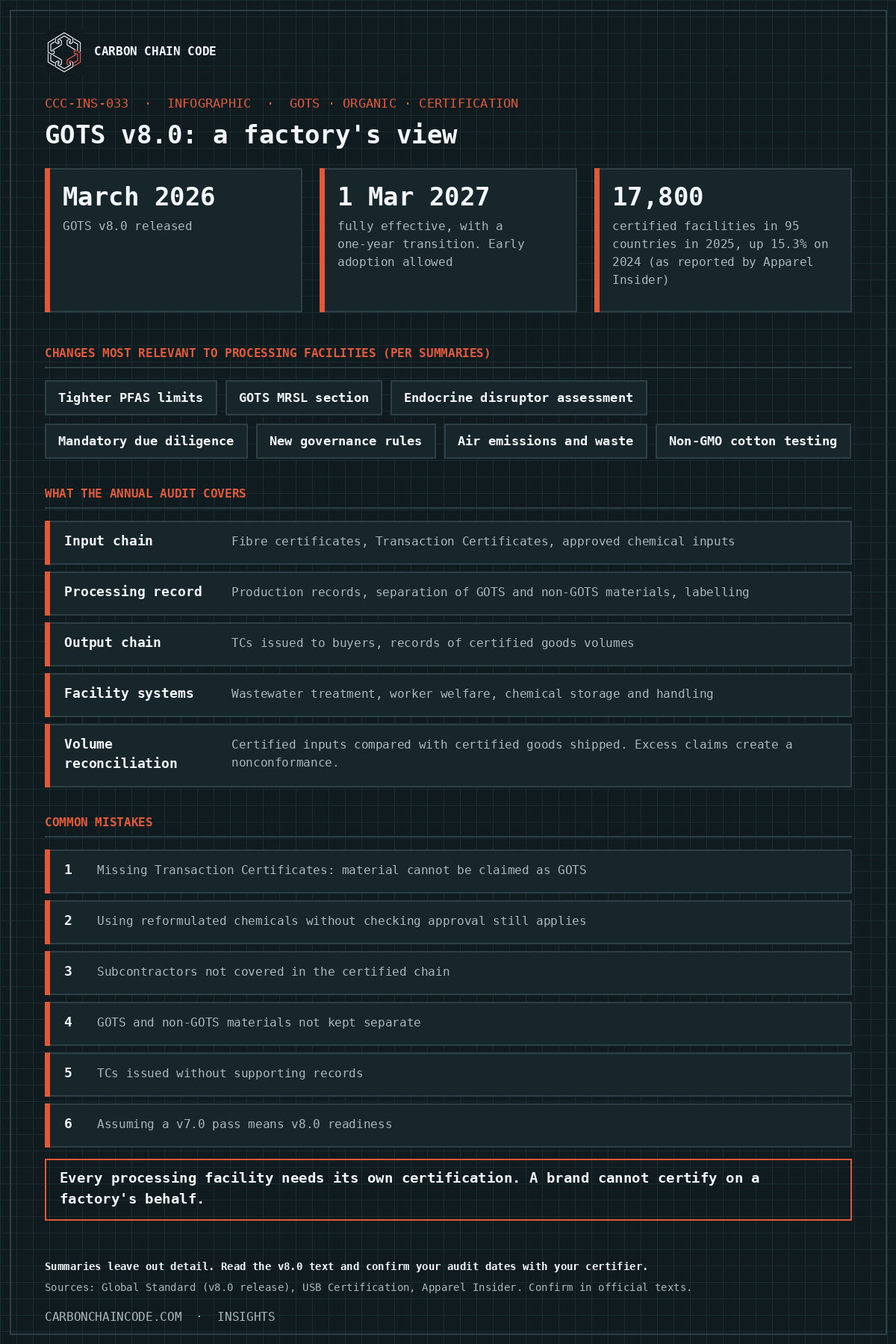
Every processing facility in a GOTS chain needs its own certification. A brand cannot certify on a factory's behalf. What your certificate covers depends on the activities you carry out, so check the wording on your own certificate with your certifier. In general terms:
| Activity | Covers | Typical facility type |
|---|---|---|
| Mechanical processing and manufacturing | Spinning, weaving, knitting, cutting, sewing | Yarn mills, fabric mills, cut-and-sew factories |
| Wet processing | Dyeing, printing, finishing, washing | Dye houses, laundries, print facilities |
| Trading | Buying and selling GOTS goods without processing | Agents, traders, importers |
| Chemical input approval | Approval of dyes and auxiliaries for use in GOTS production | Chemical suppliers, formulators |
Many factories will be certified for mechanical processing, wet processing, or both if both happen on the same site. If you subcontract a processing step such as embroidery, printing or washing, those subcontractors must be part of the certified chain: either certified themselves or covered under your certification and audited. Ask your certifier how your subcontractors must be declared before you use them for GOTS orders.
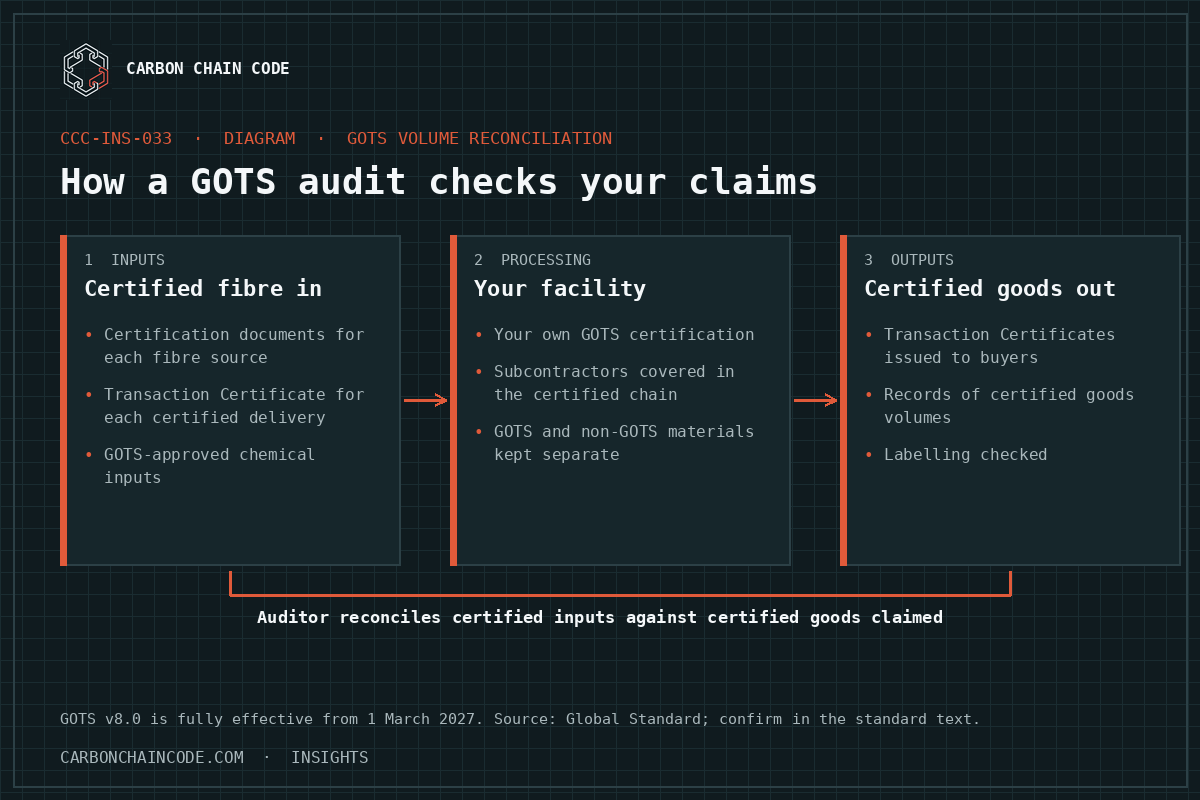
GOTS certifies the processing chain, not the farm. The organic fibre entering your facility must already be certified organic under a recognised organic standard, for example EU Regulation 2018/848 or the USDA National Organic Program. Check the GOTS manual for the list it accepts. As a processor, you need valid certification documents for every certified fibre source and a Transaction Certificate (TC) covering each certified delivery. If the paperwork for a delivery is missing, you cannot claim that material as GOTS at your facility, whatever the supplier's own certification status.
On the chemical side, dyes and processing auxiliaries used in GOTS production must be GOTS-approved chemical inputs, a pre-approval route rather than a factory-level substance test. The practical risk for a dye house is reformulation: if a chemical supplier changes a product, the approval may no longer apply to the new version. Auditors can cross-check your chemical list against current GOTS approvals, so confirm the approval status of each product when a supplier notifies you of a change.
GOTS v8.0: released March 2026; fully effective 1 March 2027 (one-year transition). 17,800 GOTS-certified facilities in 95 countries in 2025, up 15.3% on 2024 (Global Standard annual report, as reported by Apparel Insider). Annual on-site inspection by an approved certification body. Volume reconciliation is used to check certified goods claims against certified inputs. Check global-standard.org for current figures and dates.
GOTS audits are carried out each year by an approved certification body. The audit looks at four main areas: the input chain (fibre certificates, TCs, approved chemical inputs), the processing record (production records, separation of GOTS and non-GOTS materials, labelling), the output chain (TCs issued to buyers and records of certified goods volumes), and facility systems such as wastewater treatment, worker welfare and chemical storage and handling.
Volume reconciliation is a key audit tool. The certifier compares the certified inputs you received with the certified goods you shipped. If more certified product was claimed on outgoing documents than the certified inputs could produce, the discrepancy will generate a nonconformance. This is how the system catches inflated claims, and it is why accurate records of inputs, production yields and outputs are essential.
Before every audit, check your certification body's current accreditation status. Certification bodies are accredited by an independent accreditor (IOAS for GOTS), and a suspension can affect your certificate. You can check status at ioas.org or ask your certifier directly.
v8.0 readiness checklist
Global Standard gGmbH, GOTS v8.0 release announcement (global-standard.org, accessed 8 October 2026). USB Certification, GOTS 8.0 Released: Mandatory Due Diligence and Circularity Requirements Incoming. Apparel Insider, GOTS-certified facilities rise 15 per cent to 17,800 in 2025. Always rely on the GOTS standard text and your certification body for requirements that apply to your facility.
No. GOTS certifies the processing chain, not the farm. A factory needs its own GOTS certification and valid documents (certificates and Transaction Certificates) tracing certified organic fibre through the supply chain. Farm-level organic certification is held by the fibre producer.
No. Each processing facility in the chain needs its own certification. A brand's certification covers its own operations and trading activities. It cannot substitute for a factory's processing certification.
Version 8.0 was released in March 2026 and is fully effective from 1 March 2027. Audits and assessments from that date use v8.0, and early adoption is allowed. Confirm which version applies to your audit date with your certification body.
The certification body issues a corrective action request with a deadline. Serious or systematic failures, such as a broken chain of custody or unapproved chemicals in use, can lead to suspension of the certificate until they are resolved and verified. The exact grading and timelines are set by the certifier and the standard.
Free tool · Sustainability Frisk
FREE TOOL FROM SUSTAINABILITY FRISK
The ISO 14001 Readiness Assessment scores your current environmental management system against the standard’s ten requirements in five minutes.
Need a CSRD gap analysis or hands-on implementation? Sustainability Frisk can help. www.sustainability-frisk.com
Practical CSRD guide and Excel workbook for manufacturers answering EU customer sustainability requests. Value chain cap, Annex II decoder, reply templates.
Most ISO 14001 preparation focuses on building the documentation. Auditors focus on something different: whether your system actually works. A TÜV-certified Lead Auditor explains the six things that determine your certification outcome.
Most REACH guidance for textiles is written for EU importers. This article is written for the factory: the 0.1% rule, the Candidate List, the restrictions that apply to textiles from October 2026, and why your buyer's RSL is not the same as your legal obligation.