 Carbon Chain Code
CCC-SUS-006Sustainability/ESG
CSRD for Suppliers: Guide + Response Workbook
Practical CSRD guide and Excel workbook for manufacturers answering EU customer sustainability requests. Value chain cap, Annex II decoder, reply templates.
Most REACH guidance for textiles is written for EU importers. This article is written for the factory: the 0.1% rule, the Candidate List, the restrictions that apply to textiles from October 2026, and why your buyer's RSL is not the same as your legal obligation.
REACH (Regulation (EC) No 1907/2006) is EU chemicals legislation that places obligations on companies that make, import or use chemicals in the EU. For a textile manufacturer outside the EU, REACH usually does not apply to you directly. The practical question is whether the products you make contain substances that trigger information duties or restrictions for your EU customer. This article is practitioner guidance for factories, not legal advice. Check the current legal text and ask your customer's REACH contact if you are unsure.
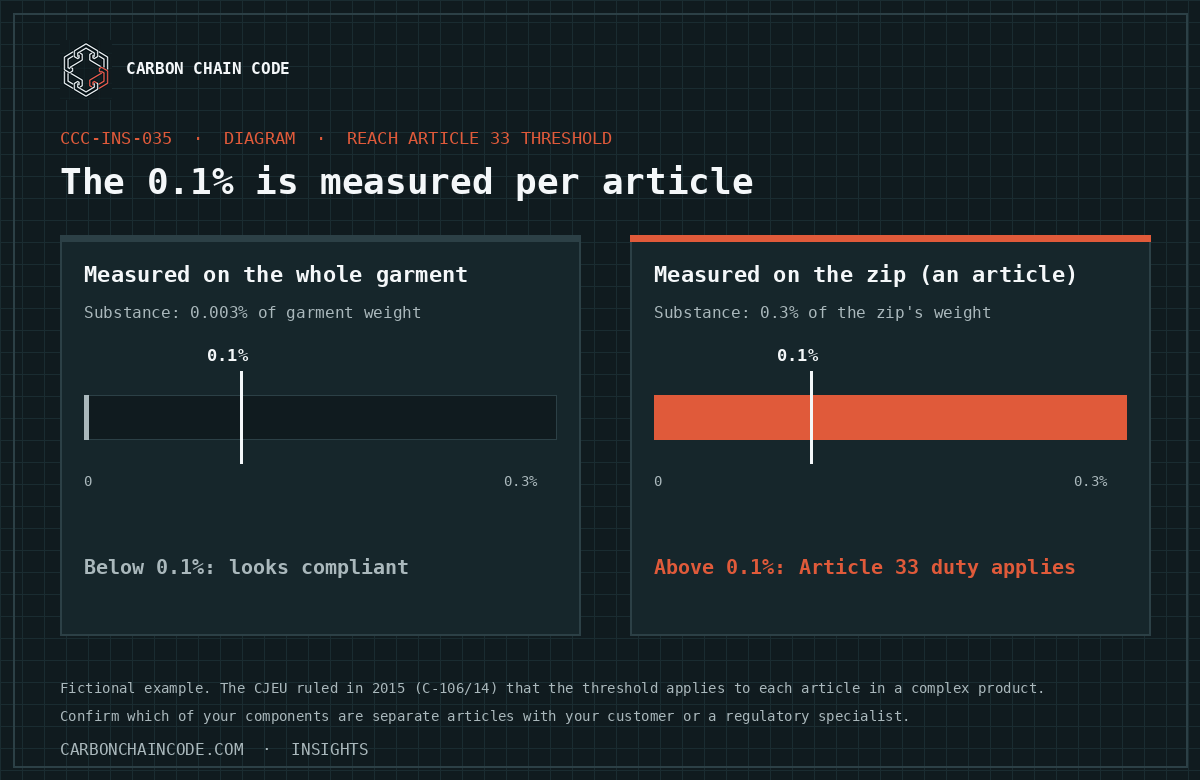
Under REACH Article 33, a supplier of an article that contains a substance on the SVHC Candidate List above 0.1% weight by weight must give the recipient enough information to use the article safely, and must give a consumer the same information on request. The key question is what the 0.1% is measured against. The Court of Justice of the EU ruled in 2015 (Case C-106/14) that the threshold applies to each article incorporated as a component of a complex product, not only to the finished product as a whole.
In practice, this means a component that is itself an article can trigger the duty even if it is a tiny share of the garment's weight. Fictional example: a metal zip contains a Candidate List substance at 0.3% of the zip's own weight. The zip makes up 1% of the garment's weight, so the substance is about 0.003% of the garment. A calculation against total garment weight shows nothing, yet the 0.1% threshold is exceeded for the zip. Calculating only against the whole garment can therefore understate your exposure. Which components count as separate articles is a legal question covered by ECHA's guidance on substances in articles, so confirm it with your customer or a regulatory specialist.
Many textile buyers also ask for material-level data, for example for fabric, trims, prints and labels, because it makes testing and supplier data easier to manage. That is a sound practice, but the legal unit for Article 33 is the article, not the homogeneous material. Homogeneous material is a concept from other EU laws such as RoHS. Do not assume it sets the REACH threshold.
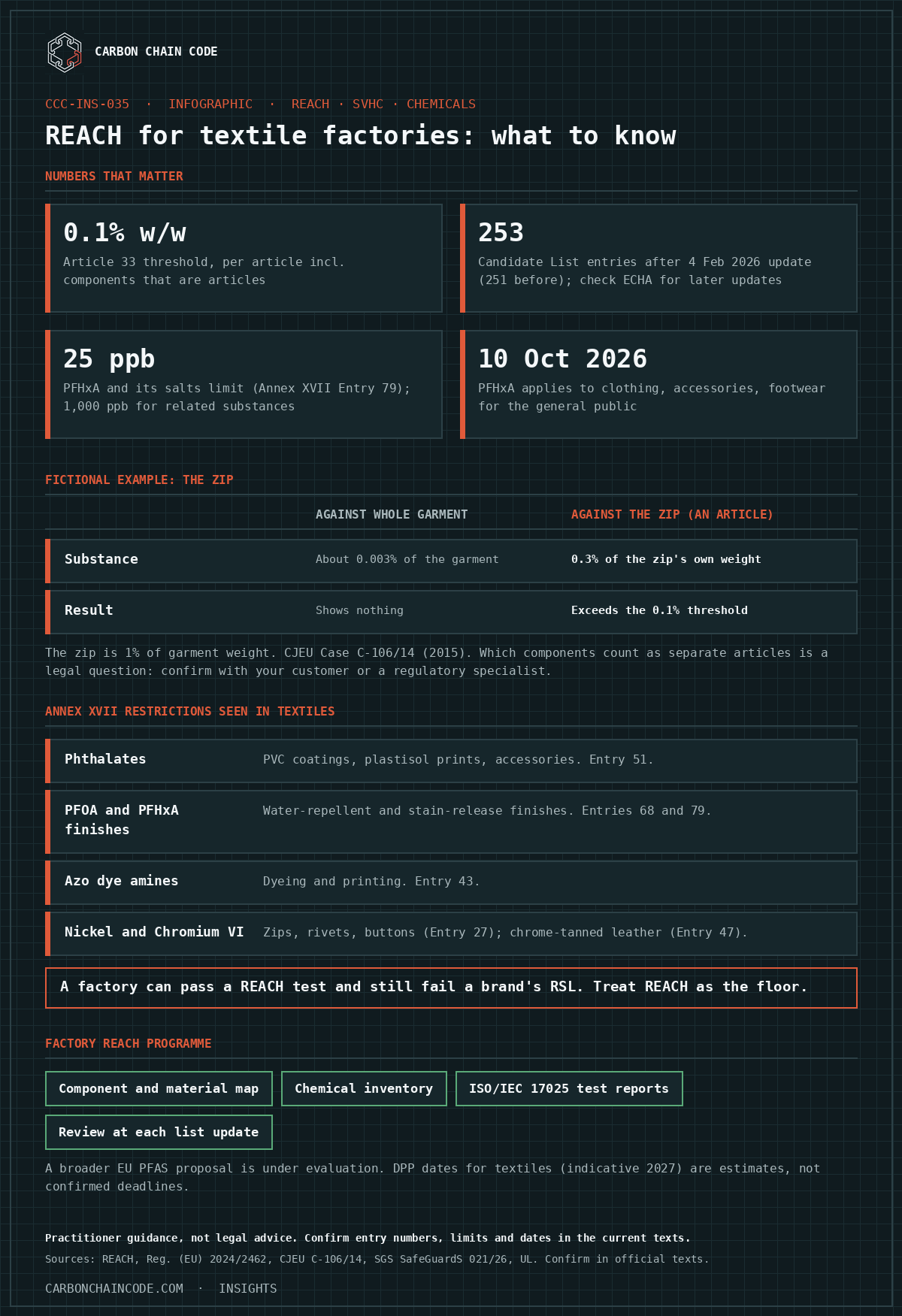
The Candidate List is maintained by ECHA (the European Chemicals Agency). It is usually updated twice a year. On 4 February 2026 ECHA added n-hexane and bisphenol AF (BPAF) and its salts, raising the list from 251 to 253 entries. I did not find a later 2026 update. Check echa.europa.eu for the current list before you rely on this number.
The Candidate List creates information duties. Annex XVII is different: it contains legal restrictions, so a product that breaches one cannot be placed on the EU market. Substances that textile factories most often encounter include:
| Substance group | Where found in textiles | Mechanism |
|---|---|---|
| Phthalates (DBP, BBP, DEHP, DIBP) | PVC coatings, plastisol prints, accessories | Candidate List and Annex XVII Entry 51 |
| PFOA and related substances | Water-repellent and stain-release finishes | Annex XVII Entry 68 |
| PFHxA, its salts and related substances | Water-repellent and stain-release finishes | Annex XVII Entry 79; applies to clothing, accessories and footwear for the general public from 10 October 2026 |
| Aromatic amines from azo dyes | Dyeing, printing | Annex XVII Entry 43 and Appendix 8 |
| Nickel | Metal fasteners, zips, rivets, buttons | Annex XVII Entry 27 |
| Chromium VI | Chrome-tanned leather | Annex XVII Entry 47 |
| Certain CMR substances | Dyes, finishes and coatings in skin-contact textiles and footwear | Annex XVII Entry 72 (applies since 2020) |
The PFHxA restriction (Annex XVII Entry 79, Regulation (EU) 2024/2462) matters now. It sets limits of 25 ppb for PFHxA and its salts and 1,000 ppb for PFHxA-related substances. It applies from 10 October 2026 to clothing and related accessories made of textiles, leather, furs and hides, and to footwear for the general public. It applies from 10 October 2027 to other textiles, leather, furs and hides for the general public. Check whether any of your water-repellent or stain-release finishes use fluorinated chemistry. A broader EU proposal to restrict PFAS as a group is under evaluation, so check its current status before relying on it. Entry numbers and limits should be confirmed in the current consolidated Annex XVII.
Direct REACH registration is almost never required for a finished-goods manufacturer outside the EU. Your EU customer, as importer, holds the legal duties. What they need from you is accurate, current substance information so they can meet their Article 33 duties, plus evidence that Annex XVII restrictions are met.
The SCIP database is a separate requirement under the EU Waste Framework Directive, not under REACH. Since 5 January 2021, EU suppliers of articles that contain a Candidate List substance above 0.1% must submit information on those articles to ECHA. The data they submit has to come from the supply chain, so if your factory cannot supply it, your customer cannot complete the notification. Ask your customer exactly which data fields they need.
A practical factory REACH programme keeps: a map of components and materials in each main product type, checked against the current Candidate List; chemical inventory records showing which dyes, auxiliaries and finishes you use; test reports from an ISO/IEC 17025 accredited laboratory for the restricted substance groups your customers ask about; and a process to review your data each time the Candidate List changes. Many buyers expect test reports to be recent, often within 12 months, but that is a customer requirement and not a REACH rule.
Candidate List: 253 entries after the update announced on 4 February 2026 (251 before). Check echa.europa.eu for later updates. Article 33 threshold: 0.1% weight by weight of each article, including components that are articles. SCIP notification: required since 5 January 2021 under the Waste Framework Directive. PFHxA restriction (Annex XVII Entry 79): 25 ppb and 1,000 ppb limits; applies to clothing, accessories and footwear for the general public from 10 October 2026.
REACH sets the legal minimum for the EU market. Many brands operate Restricted Substances Lists (RSLs) that go beyond it. The AFIRM Group RSL is used by many apparel and footwear brands and is updated regularly. ZDHC's MRSL (Manufacturing Restricted Substances List) targets process chemicals used in manufacturing, not only substances in the finished article, which is a different and more demanding layer.
The practical consequence is that a factory can pass a REACH-based test and still fail a brand's RSL requirements. Treat a buyer's RSL as your operating compliance standard, and treat REACH compliance as the floor. If you test only to REACH and present that report to a brand with an RSL, it may not be accepted.
The Ecodesign for Sustainable Products Regulation (ESPR, Regulation (EU) 2024/1781) will introduce the Digital Product Passport (DPP). The Commission's ESPR working plan gives an indicative 2027 date for the textiles delegated act, and a delegated act normally applies 18 months after entry into force. These are estimates and not confirmed deadlines. The detailed data requirements for textiles are not final, so do not assume they will match SCIP. A factory that already holds organised substance and material data will find any DPP request easier to answer, and building it now costs little.
REACH compliance checklist for textile factories
Regulation (EC) No 1907/2006 (REACH), Articles 33 and 59, Annex XVII. Regulation (EU) 2024/2462 (PFHxA restriction, Annex XVII Entry 79). Directive 2008/98/EC (Waste Framework Directive, SCIP). Regulation (EU) 2024/1781 (ESPR). Court of Justice of the EU, Case C-106/14 (Article 33 threshold applies to each article in a complex product), as summarised by Jones Day. SGS SafeGuardS 021/26 on the February 2026 Candidate List update. UL Solutions on Regulation (EU) 2024/2462. Sources consulted on 8 October 2026. Confirm entry numbers, limits and dates in the current legal texts.
Not directly in most cases. REACH duties for finished goods fall on EU importers and suppliers. A non-EU factory's practical task is to give its EU customer accurate substance data so they can meet their duties. If you cannot, your customer may be unable to meet its Article 33 and SCIP duties, and brands will not ship without the test reports they require. The pressure reaches you through commercial contracts.
ECHA usually updates the Candidate List twice a year. Each update can add substances. Subscribe to ECHA's updates, compare new entries with your chemical and material inventory, and test where a new substance could be present. Test reports should state which Candidate List version they were checked against.
They are separate REACH mechanisms. Candidate List substances trigger information duties once they exceed 0.1% weight by weight in an article. Annex XVII restrictions are legal prohibitions or limits that apply whatever the concentration threshold for disclosure. Some substances are covered by both. Annex XVII Entry 72 is the textile-specific restriction on certain CMR substances in skin-contact textiles and footwear.
No. The Court of Justice of the EU ruled that the threshold applies to each article that is a component of a complex product. A component such as a zip can exceed 0.1% even if the whole garment does not. Ask your customer or a regulatory specialist which of your components count as separate articles.
Free tool · Sustainability Frisk
FREE TOOL FROM SUSTAINABILITY FRISK
The ISO 14001 Readiness Assessment scores your current environmental management system against the standard’s ten requirements in five minutes.
Need a CSRD gap analysis or hands-on implementation? Sustainability Frisk can help. www.sustainability-frisk.com
Practical CSRD guide and Excel workbook for manufacturers answering EU customer sustainability requests. Value chain cap, Annex II decoder, reply templates.

Most GOTS content is written for brands, not factories. This article covers what a processing facility needs to understand, build and document to achieve and keep GOTS certification, ahead of version 8.0 taking full effect on 1 March 2027.

The EU Digital Product Passport will put product-level data requirements on textile supply chains, but the rules for textiles are not adopted yet. This guide separates what is in force, what is expected and what a factory can build now.