 Carbon Chain Code
CCC-SUS-001Sustainability/ESG · Workbook
CSRD Data Request Workbook
Decode EU customer sustainability questionnaires and build one reusable, evidence-backed answer set. PDF guide + Excel workbook for manufacturers.
An illustrative cost model for a 350-person fabric mill: certification and audit fees, staff days and optional items, with every assumption shown so you can replace it with your own quotes.
Brands rarely see what sustainability compliance costs a supplier, and suppliers rarely add it up. This article builds a simple model for a Tier 2 fabric mill of about 350 employees, weaving polyester and cotton-blend fabric for EU and US customers. It is a model with stated assumptions, and not a survey. An earlier version presented the figures as "composite estimates based on publicly available certification costs" and as numbers "we built". I could source only two of the fee lines, so this version says which lines are anchored, which are assumptions, and lets you change them.
GOTS fees are published by each certification body, and they vary. The Soil Association's April 2026 schedule, in pounds excluding VAT, shows an application fee of £2,554, an annual renewal core fee of £1,733 with a levy on certified organic sales above £435,427, and £82 per site payable to GOTS plus £45 per site for the certification body. Inspections outside the UK are quoted on request. Your own certification body will charge differently, so use its quote. One consequence is that the GOTS bill depends on how much certified organic product you sell, which a flat range hides. The earlier version said GOTS is the most expensive standard because of a more comprehensive audit, and I could not support that.
EcoVadis fees depend on the plan. A vendor guide (Dcycle) lists approximate annual prices of €1,080 for Basic, €1,500 for Premium, €4,700 for Select and €7,650 for Corporate, and US prices of $500 to $11,000 by company size and scope. These are estimates and not published list prices, and the guide does not map plans to company sizes. The buyer sometimes pays for the supplier's access, so check who is paying.
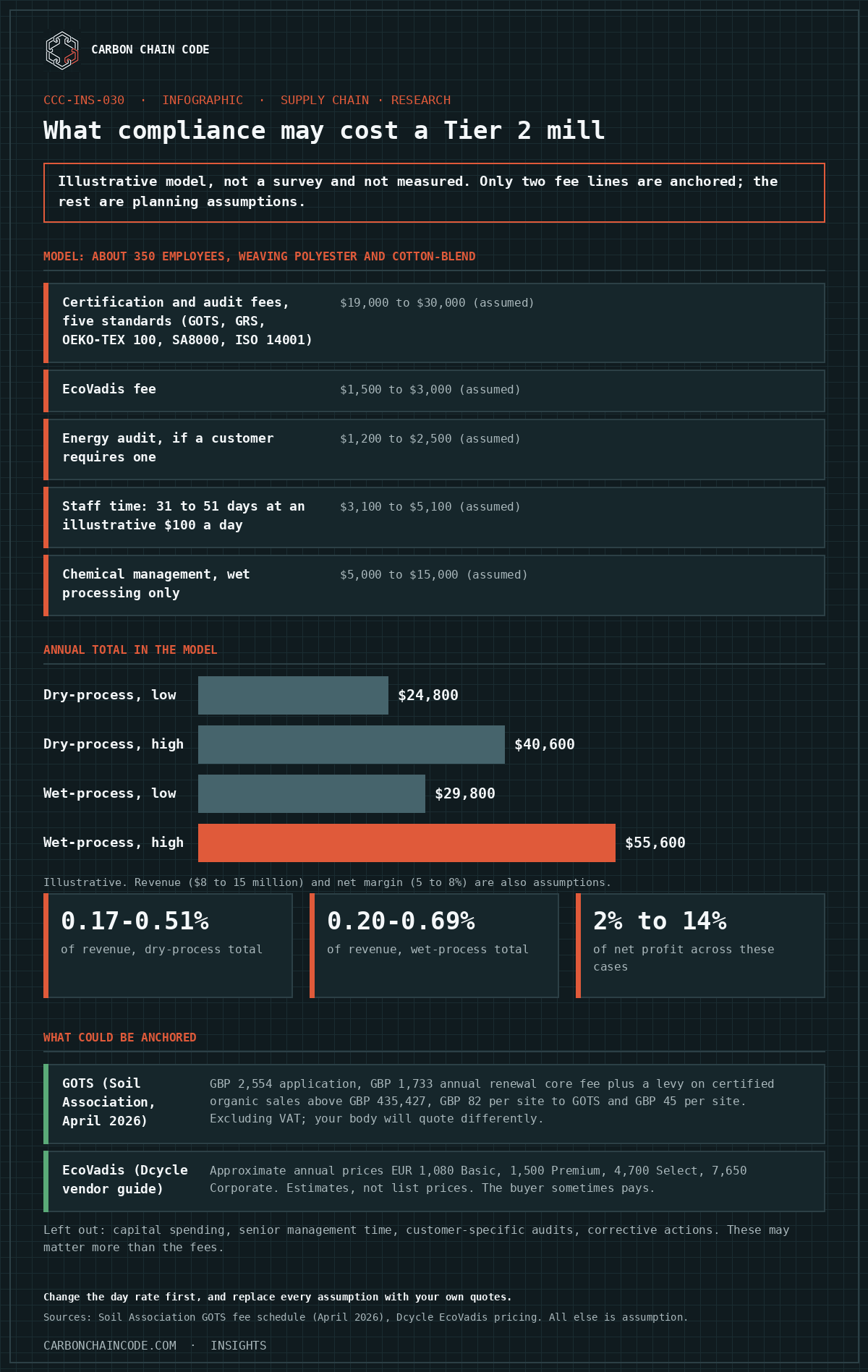
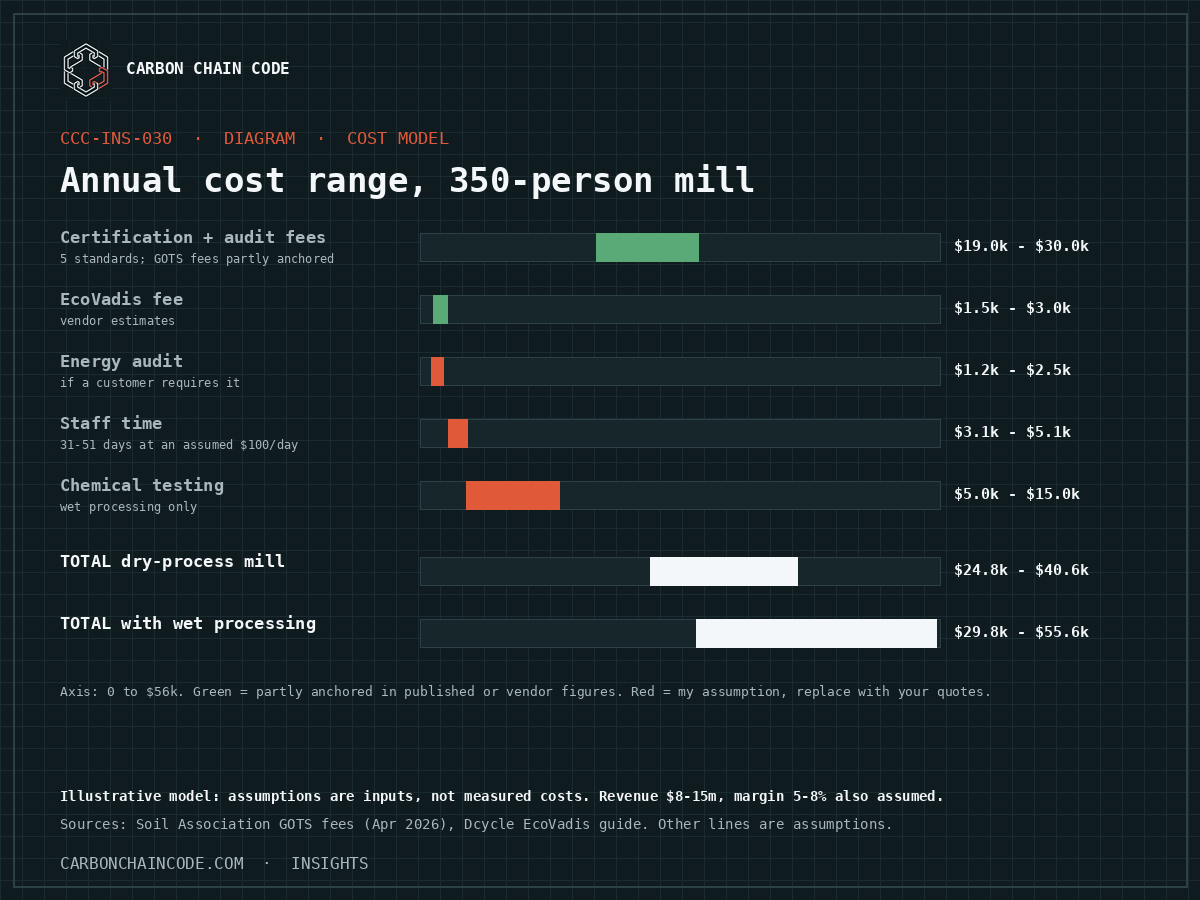
Everything else below is a planning assumption carried over from the earlier version. I could not source it, so replace it with your own quotes. Certification and audit fees for five standards (GOTS, GRS, OEKO-TEX STANDARD 100, SA8000, ISO 14001): $19,000 to $30,000 a year. EcoVadis fee: $1,500 to $3,000. Energy audit, if a customer requires one: $1,200 to $2,500. Chemical management and testing, only if the mill dyes, prints or finishes: $5,000 to $15,000. Staff time: 31 to 51 days a year. That covers EcoVadis (5 to 8 days), CDP (3 to 5), Higg self-assessments (4 to 6), brand questionnaires (10 to 15), and energy tracking, with 3 to 5 days of setup and 6 to 12 days of upkeep a year.
For the day rate I use $100 a day as an illustration. The earlier version used $250 to $400 a day, which looks like a European or US salary level and may be too high for a mill in South Asia. I do not know your staff costs, so change this input first.
| Line | Low | High |
|---|---|---|
| Certification and audit fees, five standards | $19,000 | $30,000 |
| EcoVadis fee | $1,500 | $3,000 |
| Energy audit | $1,200 | $2,500 |
| Staff time (31 to 51 days at $100) | $3,100 | $5,100 |
| Total, dry-process mill | $24,800 | $40,600 |
| Chemical management (wet processing only) | $5,000 | $15,000 |
| Total, mill with wet processing | $29,800 | $55,600 |
On revenue of $8 to 15 million, the dry-process total is 0.17% to 0.51% of revenue and the wet-process total is 0.20% to 0.69%. At a net margin of 5 to 8%, that is roughly 2% to 14% of net profit across these cases. The earlier version put the total at $45,000 to 75,000, or 0.5 to 0.9% of revenue and 6 to 18% of net margin. I could not reproduce that from its own line items, and it used dollars in the body and euros in the callout. The margin and revenue ranges are also assumptions, so substitute your own figures.
It leaves out capital spending such as meters, effluent treatment or solar, the cost of senior management time, customer-specific audits, and the cost of corrective actions found by auditors. For most mills these may matter more than the fees above. It also treats every item as paid every year, but some are paid only when a customer demands them.
The earlier version also said fewer than 20% of suppliers get any financial recognition for compliance costs, citing Better Buying data, and I could not confirm that figure, so I removed it. The Better Buying surveys do cover supplier-buyer practices, but I will not attach a number I have not checked. The commercial point stands as an argument: if these costs sit in your margin, you cannot show them to a buyer unless you have counted them.
Replace the assumptions with your own quotes and staff costs. With the assumptions here, a dry-process mill comes to about $24,800 to $40,600 a year and a mill with wet processing about $29,800 to $55,600. These are illustrative, not measured.
Rebuild it for your mill
No. They are an illustrative model. Only the GOTS and EcoVadis fee structures are anchored in published or vendor figures. The rest are planning assumptions you should replace.
It depends on the certification body and your certified organic sales. The Soil Association's April 2026 schedule has a £2,554 application fee and a £1,733 core renewal fee, plus a sales-based levy and per-site fees. Get a quote from your own body.
A vendor guide estimates about €1,080 to €7,650 a year by plan, but these are not official list prices. Check whether your customer is paying.
Staff time is a large part of the cost for a small team, and a rate borrowed from a high-wage country can inflate it several times.
Soil Association Certification, Fees for certification of textile products and textile to GOTS (version 18, April 2026), in pounds sterling excluding VAT. Dcycle, EcoVadis pricing, plans and medals (2026), approximate vendor estimates. All other figures are my planning assumptions, carried over from the earlier version of this article, and are not sourced.
Free tool · Sustainability Frisk
FREE TOOL FROM SUSTAINABILITY FRISK
The Carbon Footprint Calculator walks you through Scope 1 and Scope 2 from energy records to a per-unit figure you can share with customers.
Need a CSRD gap analysis or hands-on implementation? Sustainability Frisk can help. www.sustainability-frisk.com
Decode EU customer sustainability questionnaires and build one reusable, evidence-backed answer set. PDF guide + Excel workbook for manufacturers.

Brands ask factories for more certificates and data. What the evidence says about who pays, where purchasing practices are improving, and what the EU due diligence law actually requires.
A factory with EU customers may be asked for several ratings at once. What each one measures, how it is scored, who sees the result, and where one shared data set saves work.