 Carbon Chain Code
CCC-SUS-006Sustainability/ESG
CSRD for Suppliers: Guide + Response Workbook
Practical CSRD guide and Excel workbook for manufacturers answering EU customer sustainability requests. Value chain cap, Annex II decoder, reply templates.
Natural rubber is a regulated commodity under the EU Deforestation Regulation. From 30 December 2026 for large and medium operators, EU operators placing in-scope rubber products on the market must show deforestation-free sourcing with plot-level geolocation. Here is what that requires and what a manufacturer in the rubber supply chain should do.
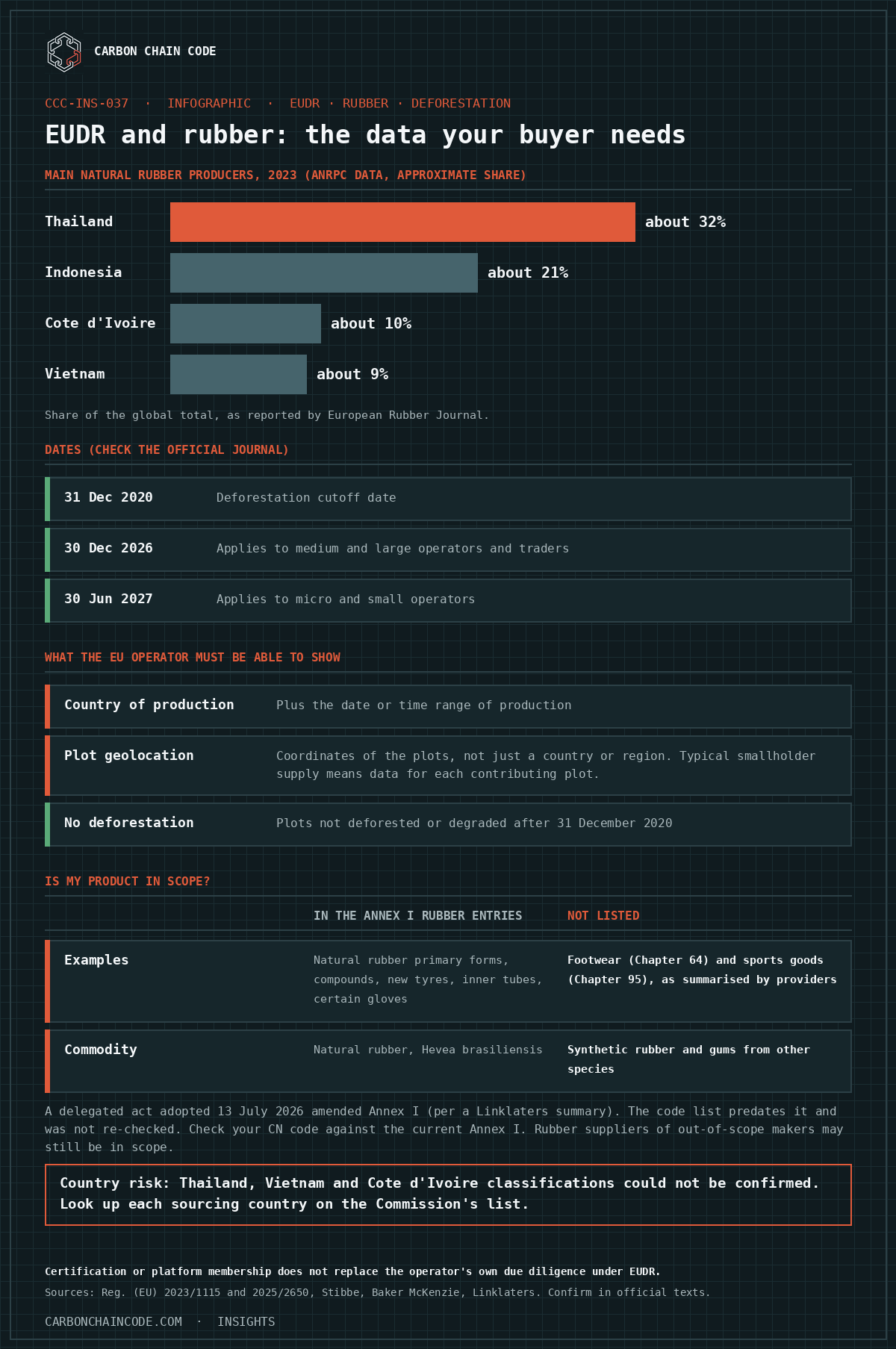
The EU Deforestation Regulation (EUDR, Regulation (EU) 2023/1115) prohibits placing seven commodities, and products derived from them, on the EU market unless they are deforestation-free and produced in line with the laws of the country of production. Natural rubber (Hevea brasiliensis) is one of the seven. The Regulation was amended by Regulation (EU) 2025/2650, which entered into force on 26 December 2025. It applies to medium and large operators and traders from 30 December 2026, and to micro and small operators from 30 June 2027. The Commission's simplification review, published on 4 May 2026, said the timelines continue to apply. Dates and scope can change, so check the Official Journal before you plan around them.
EUDR does not ban deforestation. It bans placing products on the EU market that are linked to deforestation or forest degradation after 31 December 2020. The mechanism is due diligence. A primary operator, meaning the company that first places a relevant product on the EU market or exports it, must collect specific information, assess the risk of non-compliance and, unless the risk is negligible, mitigate it or not place the product on the market. Due diligence statements are submitted by primary operators through the EU information system.
The information requirement is the most demanding part for rubber. The operator must be able to show the country of production, the geolocation of the plots where the rubber was produced (coordinates, not just a country or region), the date or time range of production, and that the plots were not deforested or degraded after 31 December 2020. For rubber from many plots, which is typical of smallholder supply in Thailand, Indonesia, Malaysia or Vietnam, that means data for each contributing plot.
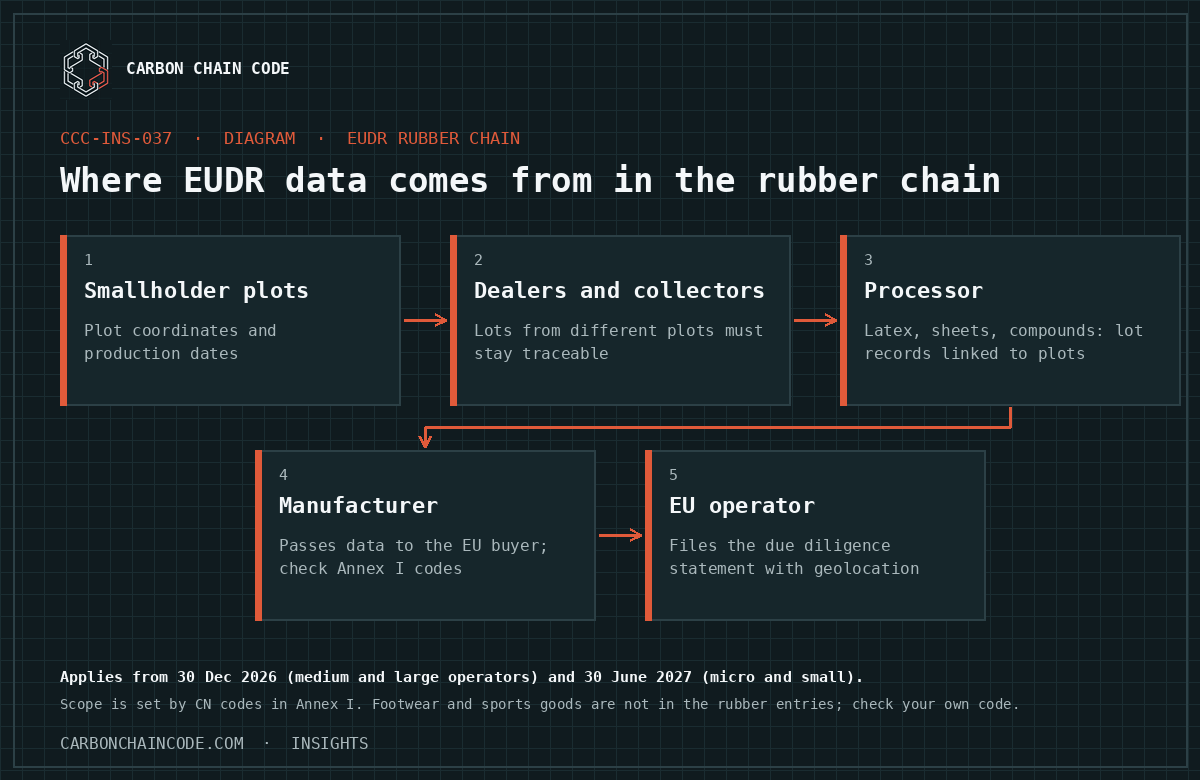
Most natural rubber is grown by smallholders on small plots, spread across very large numbers of holdings in South and Southeast Asia. Collecting plot coordinates behind a single container of latex concentrate or dry rubber can mean reaching many farmers through one or more layers of dealers and collectors. When lots from different plots are mixed before processing, traceability breaks unless each lot is recorded.
Industry platforms and certification schemes, such as the Global Platform for Sustainable Natural Rubber (GPSNR) and the Global Organic Latex Standard (GOLS), are working on traceability. Membership or certification can help with data and risk assessment, but under EUDR it does not replace the operator's own due diligence. Coverage of dealer-aggregated supply is still incomplete.
Regulation (EU) 2023/1115, amended by Regulation (EU) 2025/2650. Commodity: natural rubber (Hevea brasiliensis). Deforestation cutoff: 31 December 2020. Application: 30 December 2026 (medium and large operators and traders), 30 June 2027 (micro and small operators). Plot-level geolocation required for the land where the commodity was produced. Main producers in 2023 by ANRPC data, approximate share of the global total: Thailand about 32%, Indonesia about 21%, Côte d'Ivoire about 10%, Vietnam about 9%. Maximum fines must be set at no less than 4% of the operator's annual EU turnover. Check Official Journal and Commission pages for any later change.
Scope is set by the combined nomenclature (CN) codes listed in Annex I, not by whether a product contains rubber. For rubber, Annex I lists items in Chapter 40, including natural rubber in primary forms (part of CN 4001), compounded and unvulcanised rubber (4005 and 4006), vulcanised rubber thread and cord (4007), certain vulcanised rubber plates, sheets and strips (part of 4008), new pneumatic tyres (4011), tyre treads (part of 4012), inner tubes (4013), vulcanised rubber gloves and clothing accessories (part of 4015) and hard rubber articles (4017). EUDR applies to Hevea brasiliensis. Synthetic rubber and gums from other species are outside the commodity.
Footwear (Chapter 64) and sports goods (Chapter 95) do not appear in the rubber entries of Annex I as summarised by compliance providers. Check your own product's CN code against the current Annex I, which a delegated act adopted on 13 July 2026 has amended. According to a Linklaters summary, it removes vulcanised rubber articles under CN 4010 and 4016 (such as conveyor and transmission belts) and limits retreaded tyres to tyre treads. The list above predates that act and I did not re-check every code against the final Annex I. A product with a code that is not listed is not a relevant product, even if it contains natural rubber. If you make footwear soles, sports equipment or similar items, you may fall outside EUDR directly, but your rubber suppliers are likely to be in scope, and your customers may still ask for rubber traceability for their own policies.
A manufacturer outside the EU that exports in-scope rubber products to EU buyers is not itself the EU operator. The EU operator or first placer holds the due diligence duty, and it cannot satisfy it without data from the supply chain. Expect requests for plot coordinates for the rubber sources in your chain, evidence about deforestation status after 31 December 2020, and the country and region of origin. If the data cannot be provided, the EU importer cannot file a due diligence statement for that product.
The amended Regulation also created a category of downstream operators: companies that place on the market products made from inputs already covered by a due diligence statement. Non-SME downstream operators and traders no longer carry out full due diligence on each product, but they must collect and keep supplier and customer information for five years, and act if there is evidence of non-compliance. If your EU customer is a downstream operator, expect requests for declaration reference numbers and traceability records.
The practical path is to work upstream through your rubber or compound supplier to get plot-level data. If your supplier is part of a scheme or platform, ask what traceability data it can provide, and ask how it handles rubber from dealers. If your rubber is not traced, work with your dealer or trader to trace it to source plots.
The Commission published its first country benchmarking list on 22 May 2025. Belarus, North Korea, Myanmar and Russia are classed as high risk, EU member states as low risk, and Indonesia and Malaysia as standard risk. I could not confirm the classification of Thailand, Vietnam or Côte d'Ivoire from the sources I checked, so look up each sourcing country on the Commission's current list. The classification affects the burden: operators sourcing from low-risk countries can use simplified due diligence, while standard and high-risk origins need the full process. The list can be reviewed, so check it for updates.
EUDR rubber compliance checklist for manufacturers
Regulation (EU) 2023/1115 (EUDR) and Regulation (EU) 2025/2650 (amendment), as summarised by Stibbe on 30 December 2025. Commission simplification review of 4 May 2026, as summarised by Baker McKenzie. EUDR Annex I rubber codes as summarised by Prewave. Commission country benchmarking list of 22 May 2025, as summarised by Compliance Solutions. ANRPC 2023 production figures reported by European Rubber Journal. Linklaters, Commission adopts delegated act on EUDR product scope (July 2026). Sources consulted on 8 October 2026. Confirm Annex I codes, dates and penalties in the Official Journal text.
No. EUDR applies to natural rubber from Hevea brasiliensis. Synthetic rubbers such as SBR, NBR and EPDM are not regulated commodities. A product made entirely from synthetic rubber is outside the Regulation. For a product with a blend, check whether its CN code is listed in Annex I and whether it contains natural rubber.
Member states set penalties, which must be effective, proportionate and dissuasive. The Regulation requires the maximum fine to be set at no less than 4% of the operator's annual EU turnover, and provides for measures such as seizure of products and temporary exclusion from public procurement. For a non-EU exporter, the immediate consequence is commercial: your EU buyer cannot place the product on the market without the supporting data.
The cutoff is 31 December 2020. Operators check plots against satellite-based deforestation monitoring, using tools such as Global Forest Watch and EU-based Copernicus services. They compare the plot boundary with forest cover before the cutoff and confirm that it has not been cleared since. Certification or platform membership can support the risk assessment but does not replace it.
Not directly, as far as the Annex I rubber entries show. Footwear (Chapter 64) and sports goods (Chapter 95) are not listed. Check your product's CN code against the current Annex I. Your rubber inputs, such as compounds and sheets, may be in scope, so your suppliers and customers may still ask for traceability.
Free tool · Sustainability Frisk
Does EUDR apply to your supply chain?
Use the free EUDR Applicability Checker to find out which commodities and products are in scope.
Need a CSRD gap analysis or hands-on implementation? Sustainability Frisk can help. www.sustainability-frisk.com
Practical CSRD guide and Excel workbook for manufacturers answering EU customer sustainability requests. Value chain cap, Annex II decoder, reply templates.
CSRD tells large companies to report on sustainability. CSDDD tells them to act on adverse impacts across their chains of activities. After Omnibus I, both cover only the largest companies, on different timelines, and the old civil liability and transition plan points no longer work as this article first described them.

Most REACH guidance for textiles is written for EU importers. This article is written for the factory: the 0.1% rule, the Candidate List, the restrictions that apply to textiles from October 2026, and why your buyer's RSL is not the same as your legal obligation.