 Carbon Chain Code
CCC-SUS-006Sustainability/ESG
CSRD for Suppliers: Guide + Response Workbook
Practical CSRD guide and Excel workbook for manufacturers answering EU customer sustainability requests. Value chain cap, Annex II decoder, reply templates.
Brands are moving from spend-based Scope 3 estimates to supplier-specific data. Here is what they are asking for, how the four GHG Protocol calculation methods differ, and what a factory needs to build to answer.

GHG Protocol Scope 3 Category 1 covers purchased goods and services: the emissions embedded in everything a company buys. For a large apparel or sporting goods brand it is often the largest single category. Many brands have calculated it with a spend-based method, multiplying procurement spend by an economic emissions intensity factor from a database such as EXIOBASE. That is fast and cheap, but regulators, assurance providers and the brands themselves increasingly want better data for their biggest suppliers. That pressure reaches factories as data requests.
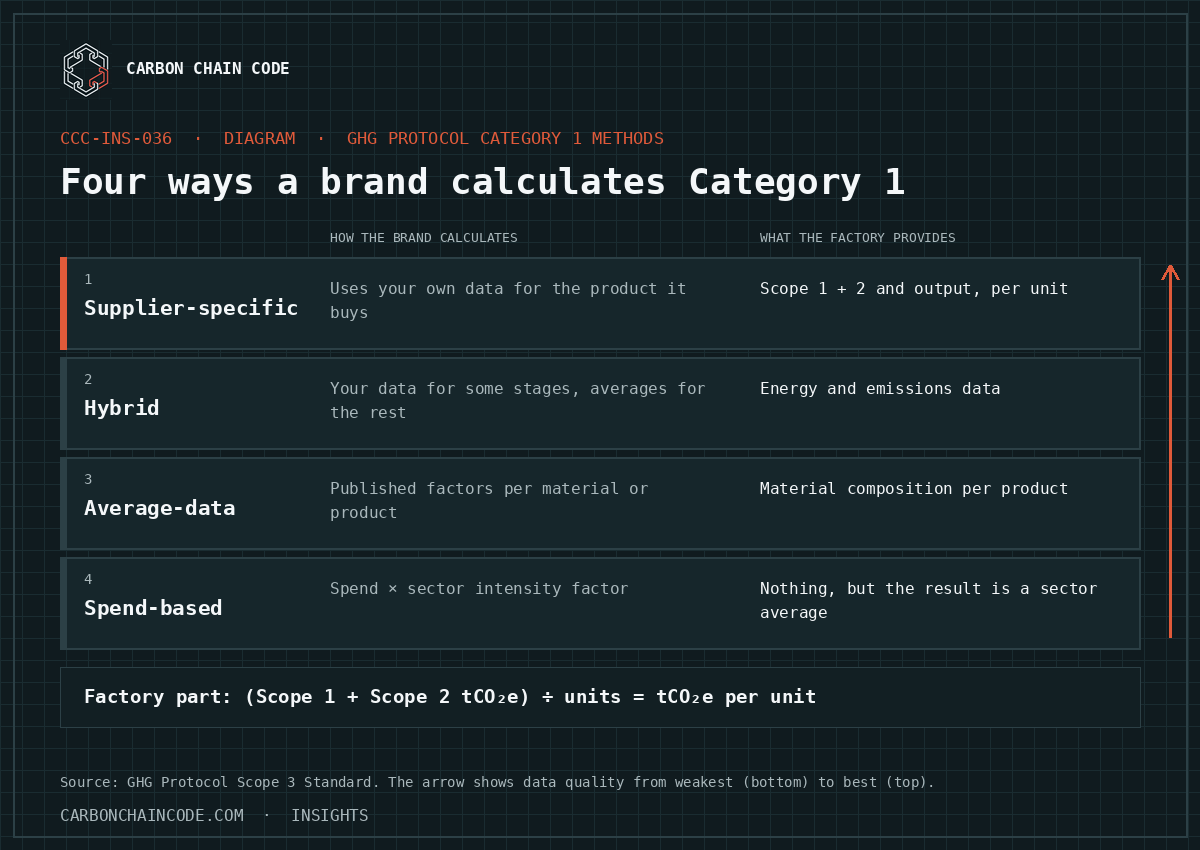
The GHG Protocol Scope 3 Standard describes four methods for Category 1, listed here from best to weakest data quality. Knowing which one a brand is using tells you what you are being asked to provide. Note that these are methods, not the "Tier 1, Tier 2, Tier 3" supplier tiers used in supply chain mapping.
| Method | How the brand calculates | Data used | What the factory provides |
|---|---|---|---|
| Supplier-specific | Uses emissions data from the supplier for the product it buys | Facility or product-level data from the supplier | Scope 1 and Scope 2 emissions and production output, allocated per unit |
| Hybrid | Combines supplier data for some stages with average data for the rest | Supplier energy data plus material emission factors | Energy and emissions data; material details if requested |
| Average-data | Uses industry-average emission factors for materials or products | Published factors per kg or per unit | Material composition per product |
| Spend-based | Multiplies spend by an economic emissions intensity factor | Economic input-output database | Nothing, but the result is sector-average |
Most brands currently use a mix of methods, with spend-based or average-data estimates for suppliers that have no data programme. ESRS E1 under CSRD requires companies to disclose their significant Scope 3 categories and how they were calculated, so brands in scope have a reason to improve their data. The revised ESRS apply from FY2027 with an FY2026 option, so check the current text for what it requires on primary data.
Omnibus I (Directive (EU) 2026/470) introduced a value chain cap for CSRD reporting. In-scope companies generally cannot ask suppliers with an average of no more than 1,000 employees for more than the voluntary SME reporting standard (VSME) when the information is for the customer's CSRD reporting. The VSME includes energy and greenhouse gas emissions, so Scope 1 and Scope 2 data is typically within what can be asked. The cap does not necessarily stop a customer asking for more for other purposes, such as its own supplier programme or a target initiative, so check the stated purpose of each request.
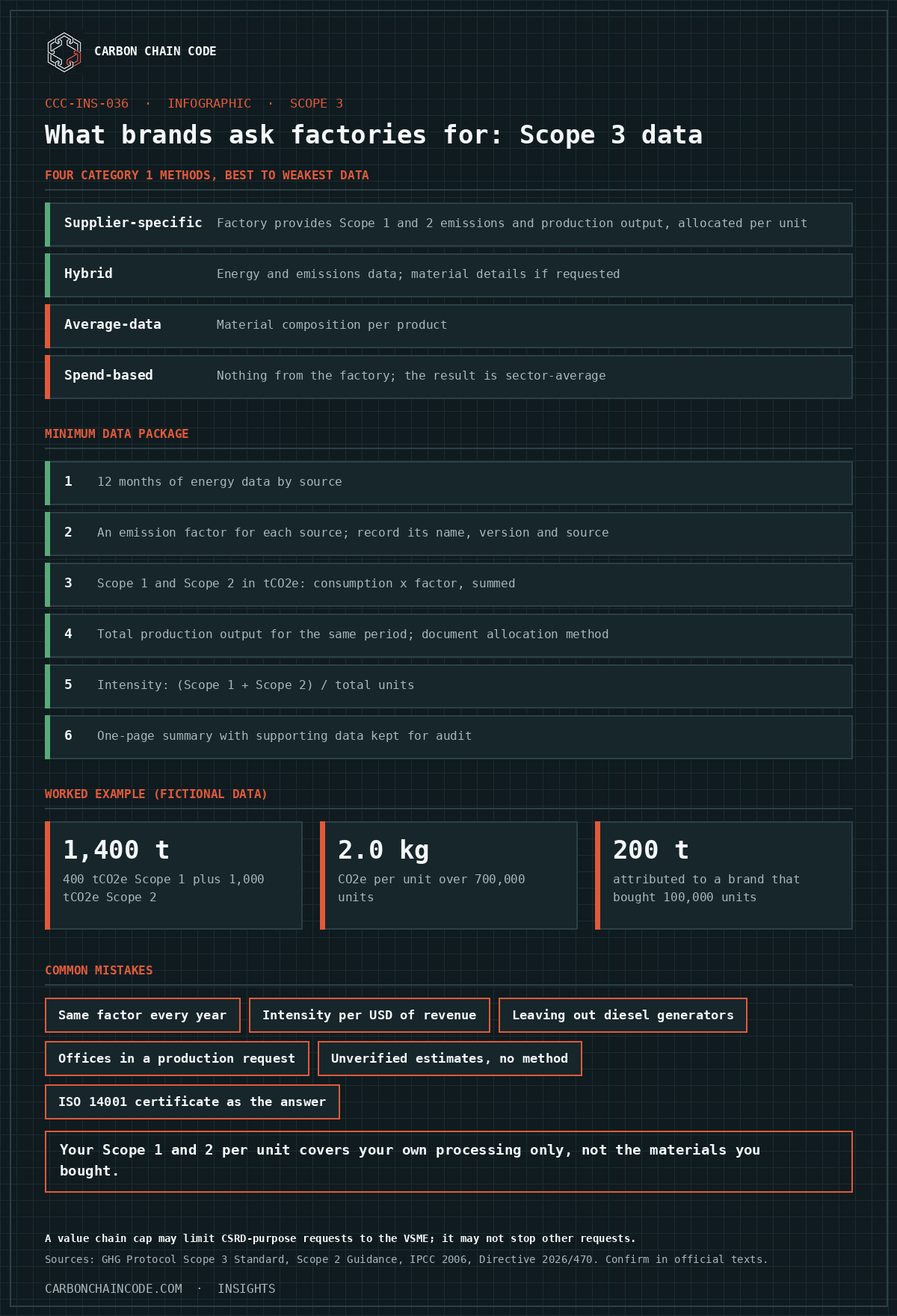
A supplier-specific request typically asks for three core items: total facility Scope 1 emissions (tCO₂e per year, from direct combustion such as gas, diesel, fuel oil and steam boilers), total facility Scope 2 emissions (tCO₂e per year, from purchased electricity, usually location-based using the national grid factor), and total production output for the reporting period (units or weight). From these the brand calculates an emissions intensity in tCO₂e per unit, then multiplies it by the quantity it bought from you.
Requests also commonly ask for the emission factors used and their source, the reporting period, whether the figures have been verified, and sometimes a breakdown by energy source. Some brands also ask for the embedded emissions in your own purchased materials, particularly for materials such as leather, cotton or recycled polyester.
A limit to keep in mind: your Scope 1 and Scope 2 per unit covers your own processing only. The full cradle-to-gate emissions of a product also include the materials you bought. Brands usually add material emissions from other data, which is why many use the hybrid method.
A fictional factory records 400 tCO₂e of Scope 1 and 1,000 tCO₂e of Scope 2 in a calendar year, a total of 1,400 tCO₂e, and produces 700,000 units. Its intensity is 1,400 ÷ 700,000 = 0.002 tCO₂e, or 2.0 kg CO₂e per unit. A brand that bought 100,000 units attributes 100,000 × 2.0 kg = 200,000 kg, or 200 tCO₂e, of factory Scope 1 and 2 emissions to that purchase.
A spend-based estimate takes what the brand paid you and multiplies it by an average emissions intensity for your sector. As an illustration with an invented factor of 0.82 kg CO₂e per USD, a brand that paid USD 500,000 would book 500,000 × 0.82 = 410,000 kg, or 410 tCO₂e, whether your factory runs on grid electricity, diesel generators or solar. The same figure applies to an efficient factory and an inefficient one, so the estimate can be wrong in both directions, and it gives you no credit for efficiency investments.
External assurance providers review Scope 3 disclosures for large companies under CSRD, and spend-based figures are harder to defend for a material category. The Science Based Targets initiative also expects companies to engage suppliers on their emissions. Check the current SBTi criteria for the exact requirement, because the standard is being revised.
The minimum data package is simpler than most factories expect. You need twelve months of energy consumption by source (electricity bills plus gas, diesel and LPG purchase records), an emission factor for each source, the resulting tCO₂e by source (consumption × factor), and total production output for the same period. For grid electricity, use a published national grid factor for your reporting year, from your national regulator or an international database, and record its name and version.
The more rigorous version adds verification of the energy data (meter calibration records or a utility bill check), documentation of each emission factor's source and version, and a clear statement of organisational boundary: which legal entities and facilities are included. A factory with ISO 14001 and an environmental objectives programme under Clause 6.2 often already collects most of this energy data.
Scope 3 Category 1 = purchased goods and services (upstream). GHG Protocol Scope 3 Standard: four methods (supplier-specific, hybrid, average-data, spend-based). Intensity formula: (Scope 1 tCO₂e + Scope 2 tCO₂e) ÷ units of production = tCO₂e per unit. Fictional example: 1,400 tCO₂e ÷ 700,000 units = 2.0 kg CO₂e per unit. CSRD value chain cap (Directive (EU) 2026/470): requests to suppliers with an average of no more than 1,000 employees for the customer's CSRD reporting are generally limited to VSME. Always use grid and fuel factors from a published source for your reporting year.
A factory that makes several product types must divide total facility emissions across them. The GHG Protocol allows allocation on a physical basis (such as mass, volume or units) or an economic basis (revenue). In the author's judgment, physical allocation, for example by weight, is often the more defensible choice for textile and apparel factories, because it follows material throughput. Economic allocation is simpler but gives a luxury shoe and a work boot different intensities even when the manufacturing process is the same.
Many brands specify the allocation method in their request. If they do not, document your method and apply it consistently. Changing it year on year makes your data incomparable across reporting periods.
GHG Protocol Corporate Value Chain (Scope 3) Accounting and Reporting Standard, Category 1 calculation methods. GHG Protocol Scope 2 Guidance. IPCC 2006 Guidelines for National Greenhouse Gas Inventories. Directive (EU) 2026/470 (Omnibus I) and Delegated Regulation (EU) 2026/1563 (revised ESRS). Check the edition and wording of each against the version your customer or reporting framework uses.
Usually not directly. The obligation runs to the EU company, which must disclose its Scope 3 emissions under CSRD if it is in scope. But if you cannot provide primary data, the brand will use an estimate for your facility, which gives you no credit for efficiency investments. For CSRD purposes, requests to suppliers with an average of no more than 1,000 employees are generally limited to the voluntary SME standard.
Location-based Scope 2 uses the average emission factor of your national grid. Market-based Scope 2 uses the factor for the electricity you contracted, for example through renewable energy certificates or a direct renewable power purchase agreement. The GHG Protocol Scope 2 Guidance asks companies that have contractual instruments to report both, and ESRS E1 requires both. Brands usually specify which one they want from you. If not, provide both and note the difference.
As specific as the brand's purchasing records. If a brand buys by pairs, give intensity per pair. If it buys by weight, give intensity per kg. If you produce several sizes, document whether you count units equally or weight them by material content. Consistency matters most: calculate it the same way next year so the brand can track change.
No. It covers your own processing. A product's cradle-to-gate footprint also includes the emissions from the materials you bought. Brands usually add those from other data, which is why many use the hybrid method.
Free tool · Sustainability Frisk
Want to calculate your factory carbon footprint?
Use the free Carbon Footprint Calculator — built for manufacturers, covers Scope 1 and 2.
Need a CSRD gap analysis or hands-on implementation? Sustainability Frisk can help. www.sustainability-frisk.com
Practical CSRD guide and Excel workbook for manufacturers answering EU customer sustainability requests. Value chain cap, Annex II decoder, reply templates.

ISO 14001 tells you to set an environmental objective. Six Sigma's DMAIC gives you a structured method to reach it. Here is how each phase maps to a Scope 1 and Scope 2 carbon reduction project, with an illustrative worked example.

CSRD tells large companies to report on sustainability. CSDDD tells them to act on adverse impacts across their chains of activities. After Omnibus I, both cover only the largest companies, on different timelines, and the old civil liability and transition plan points no longer work as this article first described them.