 Carbon Chain Code
CCC-SUS-001Sustainability/ESG · Workbook
CSRD Data Request Workbook
Decode EU customer sustainability questionnaires and build one reusable, evidence-backed answer set. PDF guide + Excel workbook for manufacturers.
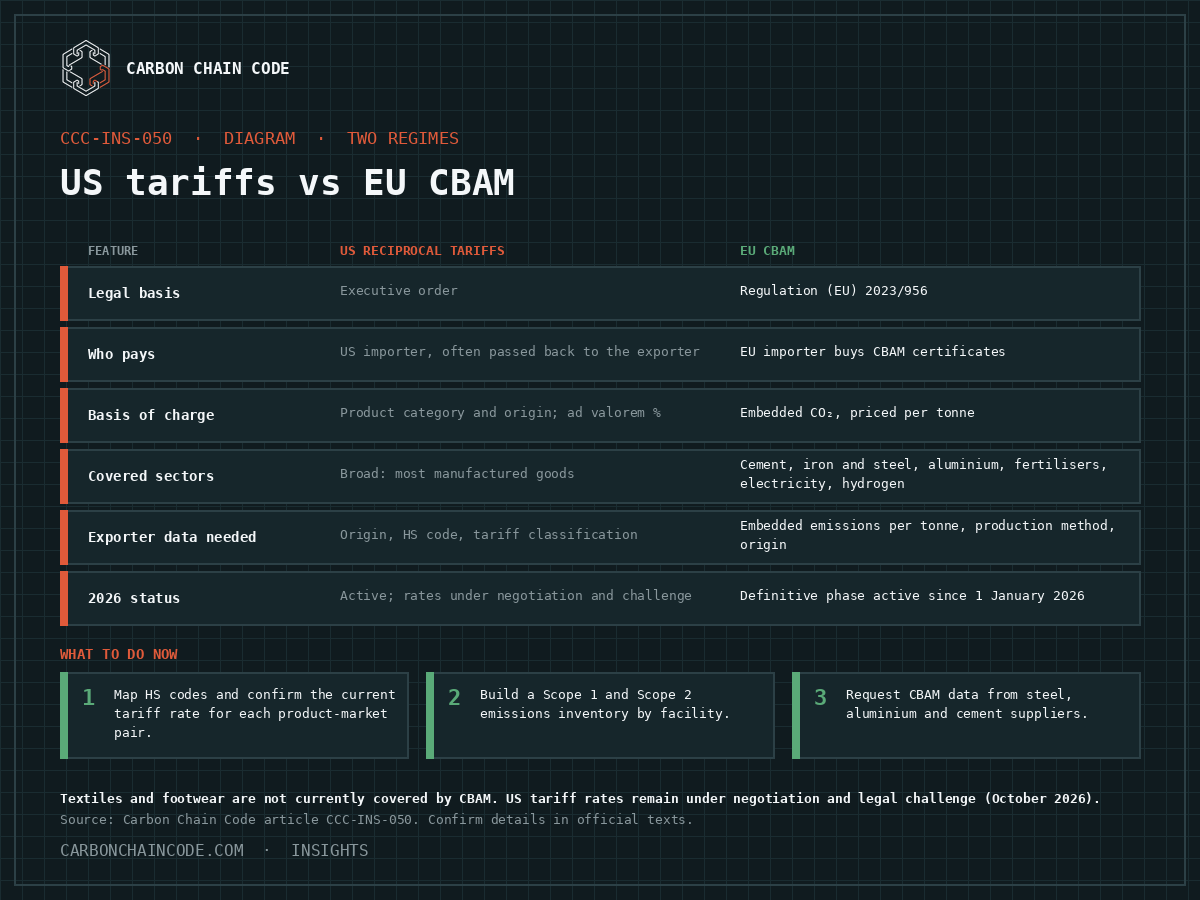
US reciprocal tariffs and EU CBAM create two separate but simultaneous trade cost pressures for Asian manufacturers. Here is what each one covers, where they overlap, and what to do now.
Asian manufacturers exporting to both the US and EU are navigating two simultaneous trade cost pressures in 2026: US reciprocal tariffs introduced or expanded in 2025, and the EU Carbon Border Adjustment Mechanism (CBAM) entering its definitive phase in 2026. They are different in structure, scope and timeline, but both require the same underlying capability: good data on what you make and what emissions it produces.
The US tariff landscape for textiles, footwear and manufactured goods from Asia changed significantly in 2025 with the introduction of broad reciprocal tariffs under executive orders, building on existing Section 301 tariffs on Chinese goods and Section 232 tariffs on steel and aluminium. The tariff levels and affected countries changed multiple times in 2025 and are still subject to negotiation and legal challenge as of October 2026 [VERIFY: confirm current US tariff status for key markets — Bangladesh, Vietnam, Pakistan, India — including any exemptions or pauses]. The practical effect for manufacturers: export pricing to the US must now include a tariff cost calculation that was not required two years ago, and buyers are pushing for that cost to be shared.
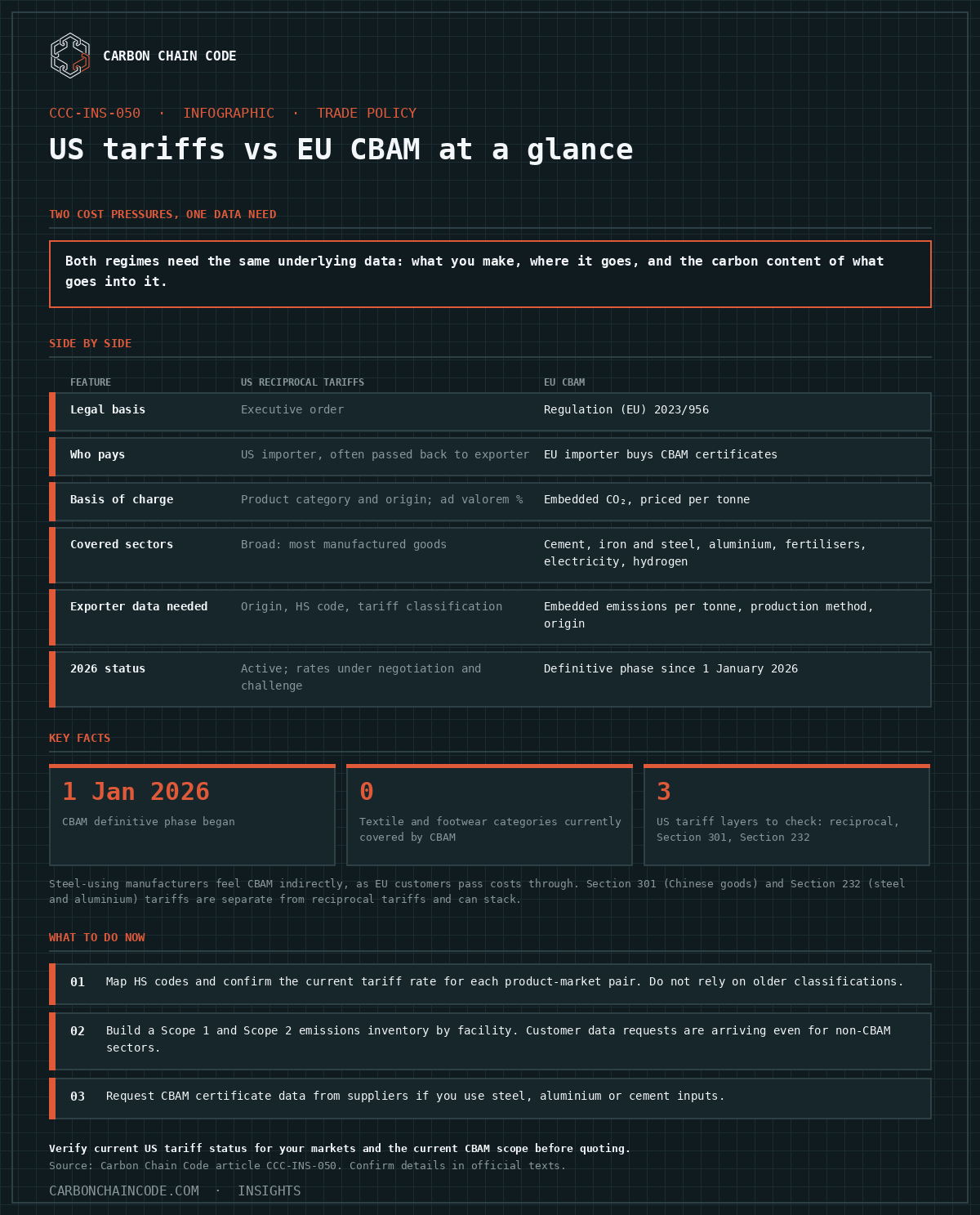
CBAM entered its definitive phase on 1 January 2026. EU importers are now required to purchase CBAM certificates to cover the embedded emissions in imports of covered products. The covered sectors are cement, iron and steel, aluminium, fertilisers, electricity, and hydrogen. Textiles and footwear are not currently covered [VERIFY: confirm current CBAM scope and whether any extension is proposed]. The Q3 2026 CBAM certificate price was approximately €82.32 per tonne of CO₂ (sourced from a trade report — verify against the EU Commission's official price data). For a steel-using manufacturer — for example a factory making metal components or using steel tooling — the CBAM cost passes through from EU customers who import the steel they use.
The overlap is not in their scope — US tariffs and CBAM cover different things using different mechanisms — but in the data and compliance requirements they create. Both require a manufacturer to know: what product categories they export and under what HS codes; what inputs go into those products; and what the carbon content of those inputs is. A factory building out an emissions inventory for CBAM-related customer data requests is producing the same underlying data it needs to respond accurately to US customs declarations. Investing in one reduces the cost of the other.
| Feature | US Reciprocal Tariffs | EU CBAM |
|---|---|---|
| Legal basis | Executive order (presidential trade authority) | Regulation (EU) 2023/956 |
| Who pays | US importer (typically passed back to exporter in price negotiation) | EU importer purchases CBAM certificates |
| Basis of charge | Product category and country of origin; ad valorem percentage | Embedded CO₂ emissions in the product; priced per tonne |
| Covered sectors | Broad — most manufactured goods | Cement, steel, aluminium, fertilisers, electricity, hydrogen (textiles not currently included) |
| Data required from exporter | Country of origin, HS code, tariff classification | Embedded emissions per tonne of product, production method, country of origin |
| 2026 status | Active — rates subject to negotiation and legal challenge | Definitive phase active from 1 January 2026 |
Three actions matter regardless of which markets you export to. First, map your HS codes and confirm the current tariff rate for each product-market combination. Rates have changed and will continue to change — do not rely on a classification done two years ago. Second, build your Scope 1 and Scope 2 emissions inventory by facility, if you have not already. CBAM will expand scope over time and customer data requests are already arriving for textiles and footwear even though they are not yet in the CBAM basket. Third, if you use steel, aluminium or cement inputs, ask your suppliers for their CBAM certificate data — EU importers of your products may need to pass that data upstream.
No. CBAM applies at the EU border, to the EU importer of covered goods. A garment factory outside the EU buying steel equipment does not pay CBAM. The factory's EU customer who imports the garments is the CBAM declarant — and garments are not currently a covered category. The CBAM cost reaches a factory indirectly when a steel or aluminium component supplier passes the certificate cost through in their price.
Yes. If a manufacturer can demonstrate that its actual embedded emissions are lower than the default values used by EU importers, the CBAM certificate obligation is lower. This requires third-party verified production data in the format specified by the EU CBAM regulation. The practical benefit makes emission measurement worthwhile even for factories not currently required to report under CSRD.
No. Section 301 tariffs specifically target Chinese goods and predate the reciprocal tariff programme. The 2025 reciprocal tariffs apply more broadly across countries. Both may apply simultaneously to a given Chinese export to the US. The stacking of tariff types means Chinese manufacturers face significantly higher effective rates than manufacturers in other Asian markets. [VERIFY: confirm current stacked tariff rates for Chinese textiles and footwear to the US]
Need a CSRD gap analysis or hands-on implementation? Sustainability Frisk can help. www.sustainability-frisk.com
Decode EU customer sustainability questionnaires and build one reusable, evidence-backed answer set. PDF guide + Excel workbook for manufacturers.
The definitive phase began on 1 January 2026, but the first declaration is not due until September 2027. What the 2026 price, the early registry figures and the downstream proposal actually show.
Textiles are not covered by the EU Carbon Border Adjustment Mechanism, and they are not in the Commission's current extension proposal. This guide explains what CBAM does cover, how its costs are calculated, and what a Pakistani textile manufacturer should prepare.