 Carbon Chain Code
CCC-SUS-001Sustainability/ESG · Workbook
CSRD Data Request Workbook
Decode EU customer sustainability questionnaires and build one reusable, evidence-backed answer set. PDF guide + Excel workbook for manufacturers.
The data requests that commonly arrive from EU customers, what each one is asking for, which parts the CSRD cap may limit, and what a good answer contains.

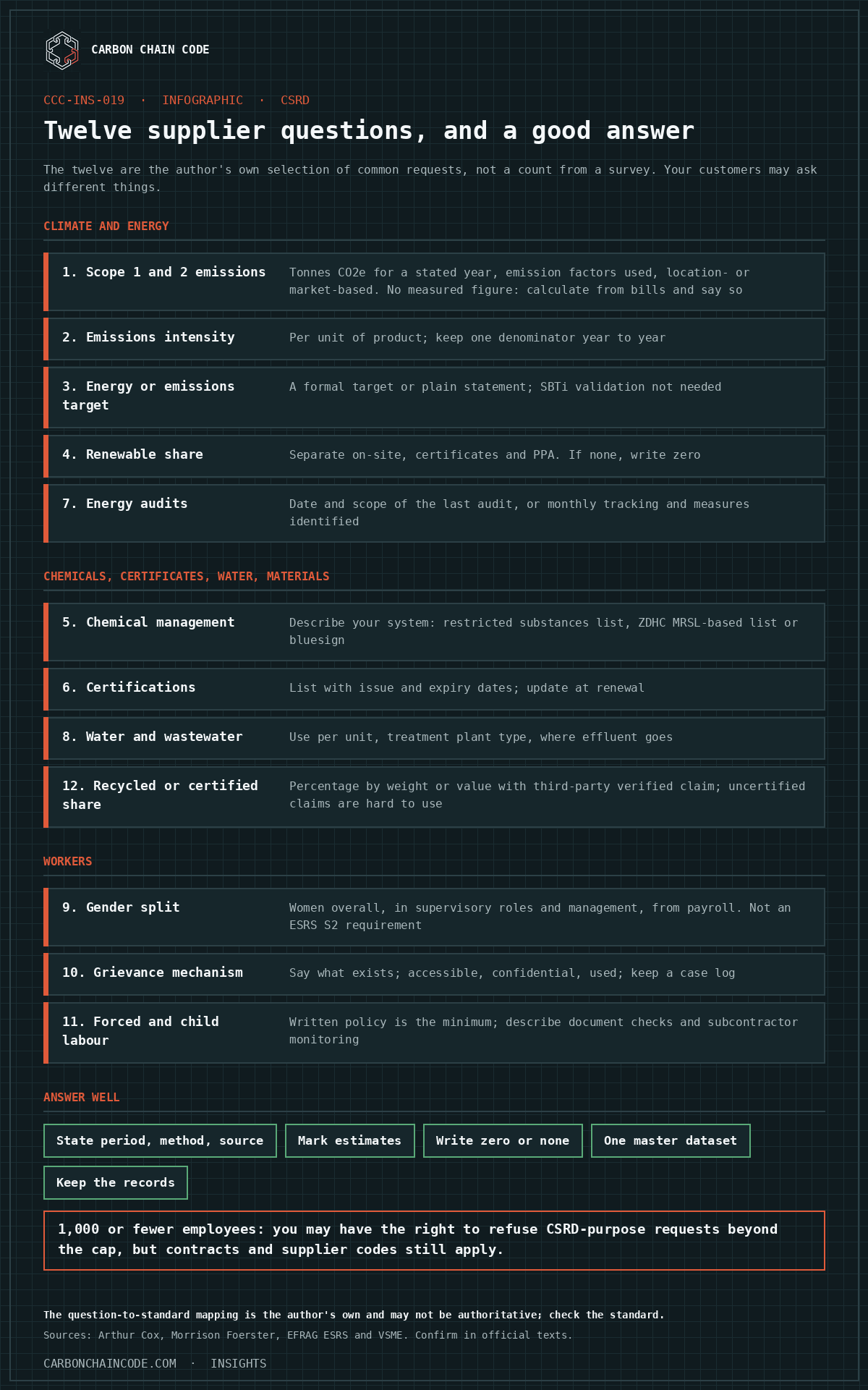
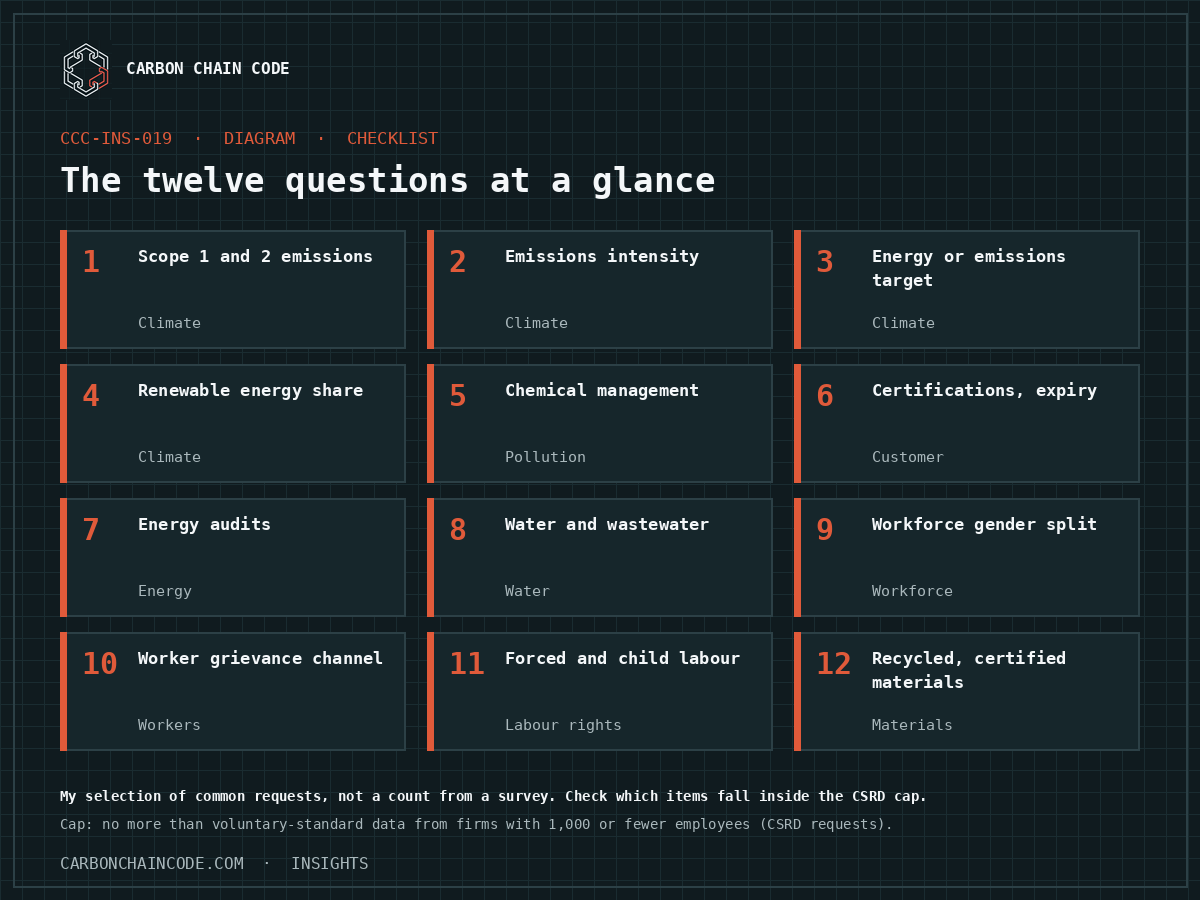
Customers inside the CSRD's scope, and many outside it, send suppliers questionnaires on climate, pollution, workers and materials. This article lists twelve questions that, in my experience, come up often, and explains how to answer each. The list is my own selection from common requests, not a count from a survey of questionnaires, so your customers may ask for different things.
Under Omnibus I, a company reporting under the CSRD may not require information from a counterparty with 1,000 or fewer employees beyond limits aligned with the voluntary reporting standard, and a protected company has a statutory right to refuse requests beyond the cap. The cap covers requests made for CSRD reporting. It does not necessarily cover requests under a customer's own supplier code, other laws or your contract. The earlier version of this article said the cap is set by "Annex II of the VSME". I could not confirm that. The voluntary standard entered into force on 24 September 2026. The May draft had a Basic Module (B1–B11) and a Comprehensive Module (C1–C9); I did not check whether the final text keeps that numbering, so check which items are within the cap.
| Question | Where it comes from | What a good answer contains |
|---|---|---|
| 1. What are your Scope 1 and Scope 2 emissions? | Climate (ESRS E1; VSME B3) | Tonnes CO₂e for a stated year. Scope 1 is fuel burned on site, Scope 2 is purchased electricity. Give the emission factors used and say whether Scope 2 is location-based or market-based. If you have no measured figure, calculate from bills and fuel invoices and say so. |
| 2. What is your emissions intensity? | Climate | Scope 1 and 2 per unit of product: per tonne, per 1,000 metres or per pair. Pick one denominator and keep it from year to year. |
| 3. Do you have an energy or emissions target? | Climate | A formal target or a plain statement, such as a percentage reduction per unit by a year against a baseline. It does not need to be SBTi-validated. A customer asks because its own climate disclosures may describe supplier engagement, not because the standard requires suppliers to have targets. |
| 4. What share of your energy is renewable? | Climate (VSME B3) | Separate on-site generation, purchased certificates and any power purchase agreement. If none, write zero, which is a clear answer. |
| 5. Do you have a chemical management policy? | Pollution (ESRS E2) and worker safety | Describe your system: a restricted substances list, a ZDHC MRSL-based approved list, or a certification such as bluesign. The question asks whether you have a system, not whether every chemical is fully characterised. |
| 6. Which certifications do you hold, and when do they expire? | Customer programme | A list with issue and expiry dates, for example GOTS, GRS, SA8000, ISO 14001, ISO 45001, OEKO-TEX or WRAP. Update it when a certificate renews so that a customer does not find an expired one in an audit. |
| 7. Do you carry out energy audits? | Energy | State the date and scope of your last energy audit and the measures it listed. If you have not had one, say that you track energy monthly and list the efficiency measures identified. I corrected an earlier claim here: ISO 50001 requires an energy review and internal audits, not a specific annual external audit, and EU law requires periodic energy audits for large non-SME companies, which may include a customer but not a small supplier. |
| 8. What is your water use and wastewater treatment? | Water (ESRS E3; VSME B6) | For wet processing, give consumption per unit, the type of treatment plant and where treated effluent goes. For dry-process sites, say so and give total site use. |
| 9. What is the gender split of your workforce? | Workforce data (VSME B8); not an ESRS S2 requirement | Percentage of women overall, in supervisory roles and in management, from payroll records. I corrected an earlier claim: ESRS S2 covers workers in the value chain and does not itself require workforce demographics from each supplier. |
| 10. What is your worker grievance mechanism? | Value chain workers (ESRS S2) | Say what exists: a committee, a hotline, a direct channel outside the supervisory line, or a third-party service. It should be accessible, confidential and used. Keep a log of cases and outcomes. |
| 11. Do you have a forced and child labour policy? | Labour rights (ESRS S2) | A written policy is the minimum. A better answer describes how you check age and employment documents for all workers, including agency and seasonal staff, and how you monitor subcontracted labour. |
| 12. What share of your materials is recycled or certified? | Resource use (ESRS E5) | Percentage of material input by weight or value with a third-party verified claim, such as GRS or RCS for recycled content or GOTS or FSC for sustainable sources. Uncertified claims are hard for a customer to use. |
The "where it comes from" column is my mapping from the ESRS topics and from my memory of the VSME module numbers. It is a guide, not an authoritative list, so check the standard itself before telling a customer that a question is outside the cap.
Principles
If you have 1,000 or fewer employees and the request is made for a customer's CSRD reporting, you may have the right to refuse items beyond the cap, and the customer must tell you so. That does not remove requirements in your contract or a customer's supplier code. Refusing may also cost you business. I would answer the basics, and use the cap as a basis for negotiating scope, not as a reason to stop responding.
Not under the CSRD if you are within the cap and the item is beyond it. Contracts and customer codes may still require answers. Check which source the request relies on.
Calculate from utility bills and fuel records, state the factors, and mark the figure as calculated. A documented estimate is more useful than a blank.
No. A formal or informal target is a legitimate answer. An SBTi-validated target is not required to answer the question.
No. ESRS S2 covers workers in the value chain, and a customer's request for your workforce demographics is a data request, perhaps drawn from the voluntary standard, not an S2 requirement.
Arthur Cox, Omnibus I Directive published (February 2026), and Morrison Foerster, European Commission Proposes Revised ESRS (May 2026), for the cap. EFRAG ESRS topical standards E1, E2, E3, E5, S1 and S2, and the VSME standard, for the mapping, which is from my own knowledge and not re-checked. ISO 50001 and the EU Energy Efficiency Directive points are from my own knowledge; confirm in the texts.
Free tool · Sustainability Frisk
Not sure if CSRD applies to your business?
Use the free CSRD Applicability Checker — answer 5 questions and get a clear in/out result.
Need a CSRD gap analysis or hands-on implementation? Sustainability Frisk can help. www.sustainability-frisk.com
Decode EU customer sustainability questionnaires and build one reusable, evidence-backed answer set. PDF guide + Excel workbook for manufacturers.
Practical CSRD guide and Excel workbook for manufacturers answering EU customer sustainability requests. Value chain cap, Annex II decoder, reply templates.

Omnibus I removed most companies from the CSRD, but it did not stop supplier data requests. Here is who still reports, what the value chain cap protects, and what a factory should prepare.
The scope, the value chain cap, assurance and sector standards, and what the 61% figure really refers to. A plain summary for manufacturers and their suppliers.